
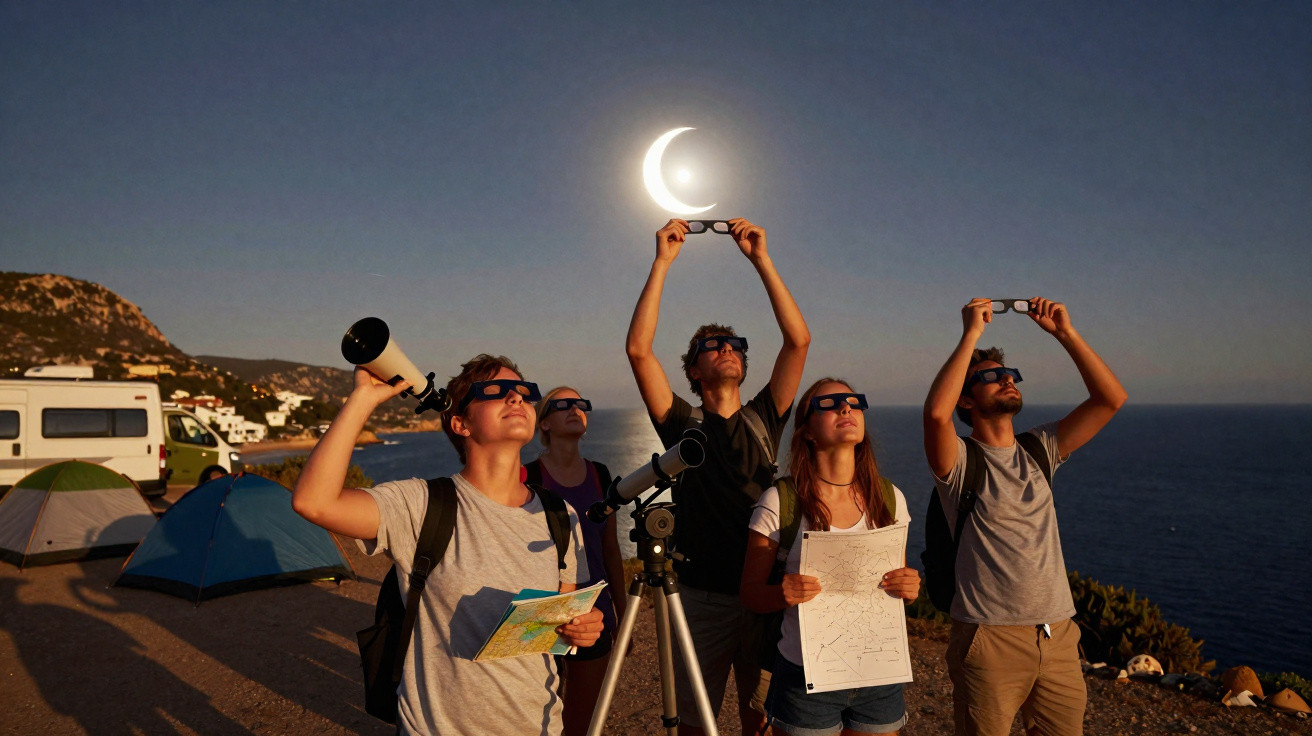
On 12 August 2026, millions of people will turn their eyes skywards. A solar eclipse will sweep from the Arctic to Spain’s Mediterranean coast, bringing a natural spectacle that many people across Europe will witness only once in their lifetime. For viewers in German-speaking countries, it is worth looking up not only for the eclipse itself, but also for an astrophysical ‘bonus programme’ of shooting stars and bright planets.
What will happen in the sky in 2026
A solar eclipse occurs when the Moon moves in front of the Sun and casts its shadow on Earth. On 12 August 2026, the alignment will be precise enough to produce a total solar eclipse over parts of Europe: for a few minutes, the Sun will disappear entirely behind the Moon’s disc.
“In parts of Europe, the solar disc will be almost or completely obscured that evening – shortly before sunset.”
The path of totality will stretch from areas of the Arctic Ocean, across Iceland and down to the Iberian Peninsula. German-speaking regions will see only a partial eclipse, but its effects may still be striking: daylight will fade, the surroundings will take on an eerie blue-grey hue, birds may fall silent and animals can become unsettled.
France in semi-darkness: up to 95 per cent of the Sun disappears
France will experience a particularly dramatic eclipse. Across much of the country, especially in the south-west close to the Spanish border, the Moon will cover a large part of the Sun. Up to 95 per cent of the solar disc will vanish, and it will happen in the evening, when the Sun is already low in the sky.
Key times for France (Central European Summer Time, UTC+2):
- Start of the partial eclipse: approximately 19:30
- Peak of the eclipse: around 20:30
- End: with sunset shortly afterwards
Brightness will drop noticeably even under cloudless skies. It will create the feel of twilight in the middle of a long high-summer evening. Many people in France are already comparing the event with 11 August 1999, when a total solar eclipse was last visible across parts of Europe.
“For an entire generation in Europe, 2026 could be the only chance to witness such a powerful solar eclipse.”
Such alignments are rare. France will not see another total solar eclipse until 3 September 2081.
Spain and Iceland: focal points for solar eclipse tourism
Spain and Iceland will offer the most spectacular views, as both lie within the so-called zone of totality, where the Moon completely covers the Sun. Only the dazzling solar halo, known as the corona, will remain visible.
Solar eclipse holidays: Spain prepares
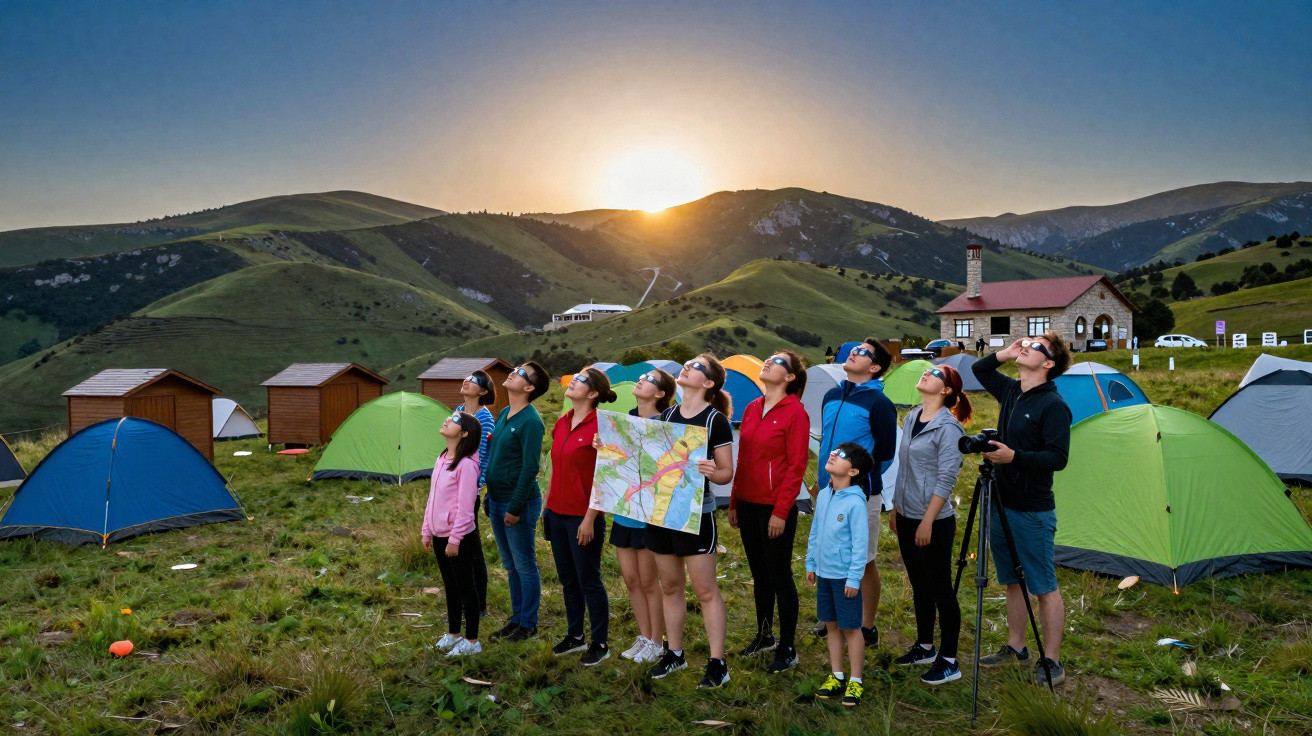
Around 40 per cent of Spain’s land area will fall within the zone of totality in 2026, during the peak holiday season in mid-August. The eclipse is therefore set to draw amateur astronomers, families and sightseers alike.
The Spanish government is taking the expected influx of visitors seriously. A dedicated government group is already coordinating ministries and regional authorities, aiming to manage safety, infrastructure, prices and capacity at tourist destinations as smoothly as possible.
Rural tourism is expected to attract especially high visitor numbers. Farm stays and small country hotels along the eclipse route are reporting strong interest. Industry associations are developing certification schemes to curb excessive price rises and establish reliable standards.
Iceland: hotels nearly full and cruises sold out
The situation appears even tighter in Iceland, which is also on the path of totality. Popular areas including Reykjavik, the Reykjanes Peninsula and the Snæfellsnes region are already reporting near-full occupancy for mid-August 2026.
Accommodation prices are expected to rise by 60 to 100 per cent compared with typical August rates. At the same time, the market for expedition vessels and cruises is expanding rapidly:
- Expedition ships are planning itineraries between Iceland and the fjords of East Greenland.
- Cruise operators are introducing dedicated solar eclipse voyages, centred on watching the event from the deck.
- Trips in the waters off Spain and around the Balearic Islands are being planned specifically around the eclipse date.
Anyone intending to use Iceland as their viewing base should arrange flights and accommodation early. Last-minute bargains are unlikely, and some options may become more of a luxury experience.
Double celestial event: solar eclipse and Perseids
12 August is already regarded as the peak of the Perseids, one of the year’s best-known meteor showers. Every August, the particle trail left by Comet Swift-Tuttle meets Earth’s atmosphere, producing bright meteors.
“In 2026, the Perseids maximum coincides with the solar eclipse – a date that is already thrilling astronomy enthusiasts.”
As the Sun darkens, sky brightness could temporarily fall enough for particularly bright meteors to be visible even during the day. Those with a clear view may have the opportunity for an exceptionally unusual sight: an almost black edge to the Sun, a narrow rim of light and, now and then, the bright ‘fiery streak’ of a shooting star.
Several prominent celestial objects will also be favourably placed:
- Venus, the bright ‘evening star’ that is often the first to catch the eye, will appear close to the eclipsed Sun.
- Jupiter, the Solar System’s largest planet, will also be relatively near the scene.
- With some luck, the Pleiades star cluster may also become visible in the twilight.
Together, these elements will create a rare scene: the Moon’s black disc in front of the Sun, accompanied by bright planetary points and delicate specks of starlight.
How to observe the solar eclipse safely
However captivating the event may be, looking at it without protection can be dangerous. Even when most of the Sun is covered, the remaining light is sufficient to cause permanent retinal damage.
| Viewing aid | Suitable? | Note |
|---|---|---|
| Ordinary sunglasses | No | Offer virtually no protection for direct solar viewing |
| Specially certified eclipse glasses | Yes | Must meet a current standard and be undamaged |
| Homemade filters or smoked glass | No | Light transmission is difficult to control, creating a high risk |
| Projection method (for example, a pinhole camera) | Yes | Indirect viewing method, also suitable for use with children |
Anyone wishing to look through binoculars or a telescope will also need special solar filters fitted over the front opening of the instrument. Improvised methods can damage both the optics and the viewer’s eyes.
Who could benefit most – and who should plan carefully
For tourism in many European regions, the eclipse represents an unexpected economic boost. Rural accommodation, smaller towns away from the usual beach resorts and remote islands are suddenly moving into the spotlight.
At the same time, local authorities face several challenges:
- Traffic: roads leading to viewing points could become congested.
- Safety: people may crowd onto cliffs, mountains and coastlines, often with little experience of the terrain.
- Environment: impromptu campsites and overcrowded car parks can put pressure on sensitive natural areas.
Anyone planning a trip should consider more than maximum obscuration. Accessibility, medical provision and overnight accommodation also matter. In the end, a slightly more remote location with ‘only’ 80 or 90 per cent coverage may provide a calmer and safer experience than a hotspot within the zone of totality.
What terms such as ‘syzygy’ mean
Astronomers use the term ‘syzygy’ for the precise alignment of the Sun, Moon and Earth. The technical expression describes any arrangement in which three celestial bodies are almost exactly in a straight line. A solar or lunar eclipse can occur only when the orbits of Earth and the Moon are aligned particularly well.
The apparently perfect match in size between the Sun and Moon is another special circumstance. The Sun has roughly 400 times the Moon’s diameter, but it is also approximately 400 times farther away. This makes the two appear almost the same size in the sky. Without that relationship, there would be no sharply defined solar rings or periods of totality, only shallow shading.
Anyone looking up in 2026 will therefore see more than an attractive spectacle: a fortunate coincidence of celestial mechanics, probably the most impressive one that most people will ever witness in their lifetime.

Comments
No comments yet. Be the first to comment!
Leave a Comment