
Pen-ink traces and ethyl alcohol
While NASA’s Perseverance rover continues to collect and seal samples on the Martian surface for the sample-return mission, scientists on Earth have long been examining Martian rocks blasted into space by asteroid impacts and subsequently delivered to our planet as meteorites.
These visiting specimens were the focus of a new study by researchers at the University of the Basque Country (UPV/EHU). They found unexpected compounds which, at first glance, could have been interpreted as evidence of complex organic chemistry, including “synthetic organic molecules” not normally associated with natural Martian processes.
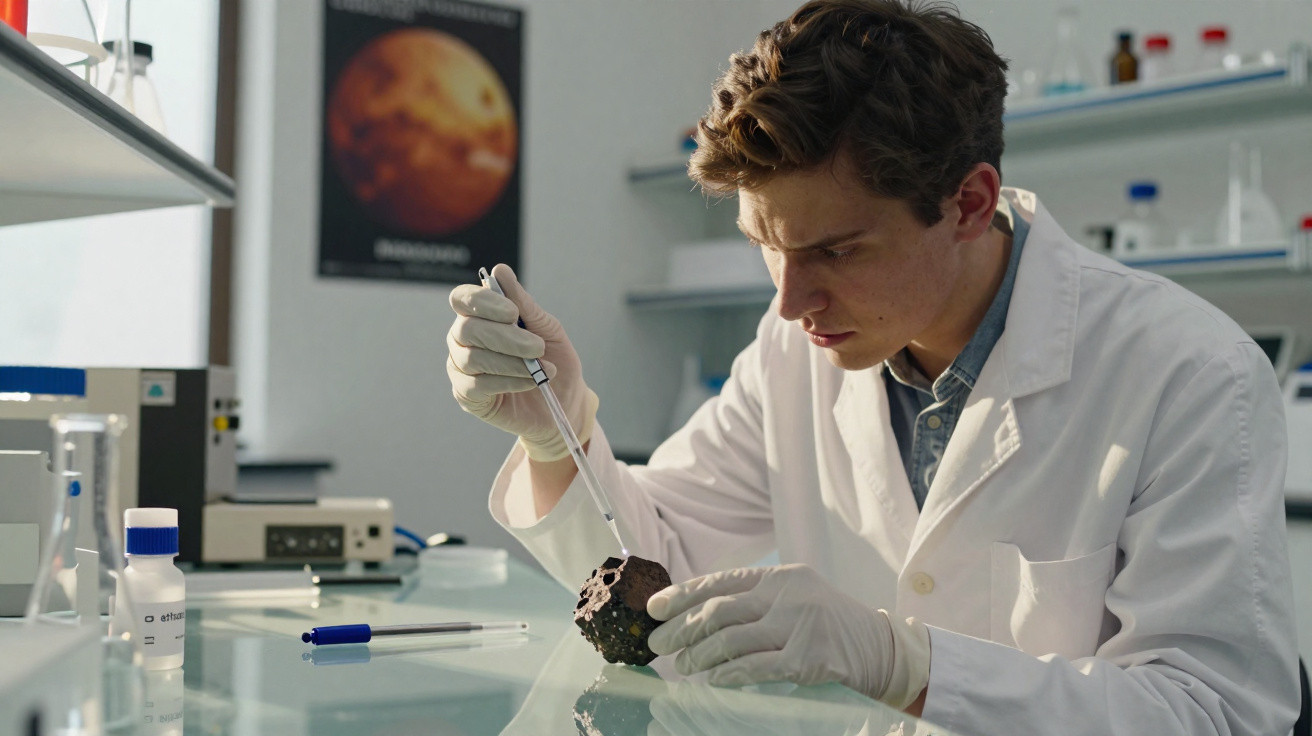
A closer investigation, however, showed that a substantial proportion of these signals did not originate on Mars. The samples contained traces of ethyl alcohol, diamond dust and several ink pigments, including constituents used in ballpoint and gel pens.
As the study’s authors explained, the contamination arises not on Mars but on Earth, during the preparation of meteorites for examination. Once they reach laboratories, samples must inevitably be sawn, polished and chemically treated. The tools, lubricants and solvents used in these procedures can leave residual traces.
How Martian meteorites become contaminated
Cutting into the meteorite’s interior is a particularly problematic stage. Its outer crust forms as the specimen passes through Earth’s atmosphere, offering some protection; however, laboratory staff must open the rock to access the “untouched” material within. This is the point at which contamination can occur.
The researchers note that even carefully designed protocols cannot entirely prevent the introduction of outside material. Ethyl alcohol, for instance, is used to clean equipment, while diamond abrasives are used for cutting. Similar traces have previously been identified in samples, including those from the Apollo lunar missions.
The new study specifically recorded ink residues: two types of blue ballpoint-pen ink and the “hostaperm violet” pigment (Pigment Violet 23), which is typical of gel pens. The scientists stress that these compounds are unequivocally the result of laboratory contamination rather than Martian chemistry.
According to the authors, finding such “extraneous signals” does not indicate that laboratories have made mistakes. On the contrary, it allows sample-preparation protocols to be refined. They propose replacing some solvents and reassessing cleaning methods to reduce the likelihood of transferring organic traces.
The study’s authors also make clear that there are no grounds for banning pens from laboratories, even though they proved to be one source of the detected “Martian” molecules.





Comments
No comments yet. Be the first to comment!
Leave a Comment