
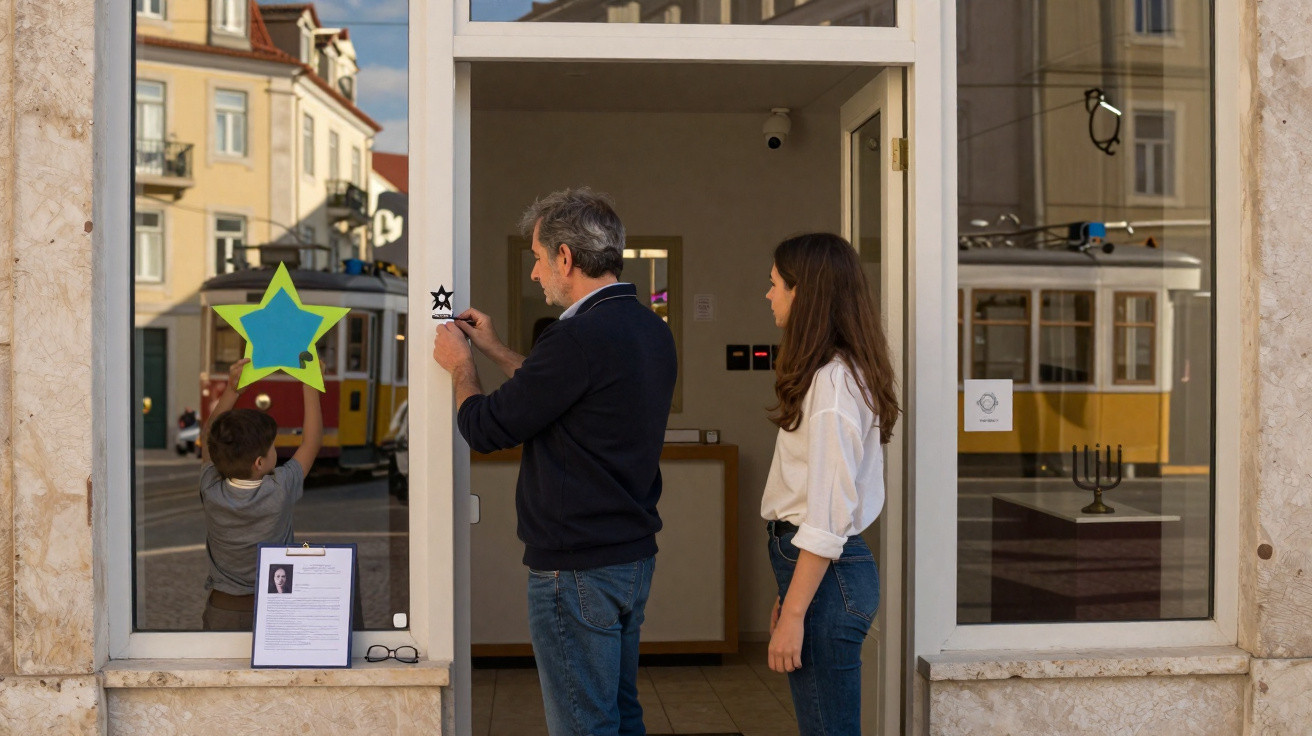
The Judicial Police reports in its latest Annual Internal Security Report (RASI) an “escalation” in “antisemitic” acts of violence targeting official and private bodies connected to the State of Israel. These “unlawful actions” have also affected people and businesses from Tel Aviv, as well as Portugal’s Jewish community.
According to the official data, the violence is perpetrated by far-left groups supporting the Palestinian cause.
The Security Intelligence Service (SIS) also states in the same report that some demonstrations by these activists involve “acts of vandalism”, the “proclamation of antisemitic messages”, and campaigns of “pressure and intimidation” aimed at pro-Israel organisations.
Antisemitic hostility towards Jewish institutions in Portugal
Hostility towards Jewish institutions in Portugal has risen sharply as the conflict in the Middle East has intensified.
Lisbon Jewish Cultural Centre has repeatedly been targeted with hate messages. Several statements against the State of Israel have been painted on its walls. Speaking to SIC Notícias in June last year, Luciano Waldeman, founder of the Rua da Judiaria centre, said that every two weeks someone tries to pull the Star of David-a six-pointed Jewish symbol-from the wall.
Stickers and written messages calling for a boycott of Israel and directed against Israelis have been placed on the centre’s exterior walls, including “You are not welcome in Portugal” and “Death to Israel”. Other graffiti has included “Free Gaza”, alongside anti-Jewish hate statements such as “child murderers”.
Public Prosecution Service closes alleged antisemitism case at Coimbra
In its latest edition, Expresso reported that the Ombudsman had accused the University of Coimbra (UC) of “serious shortcomings” in its handling of complaints by an Israeli doctoral student, who had reported alleged antisemitic demonstrations on the institution’s campus. In a ruling dated 27 March 2026, Deputy Ombudsman Ravi Afonso Pereira found that UC had adopted a stance of “fundamental passivity” and had not taken “measures to prevent, mitigate or resolve the situation”, while also breaching the complainant’s “fundamental rights”.
The matter dates back to June 2024, when Bar Harel, then studying for a PhD in Computer Engineering at UC, reported to the Student Ombudsman that allegedly antisemitic leaflets were being distributed and displayed within the university. The Ombudsman’s document even refers to an email from the Student Ombudsman to UC’s Social Action Services stating that Harel required “medical treatment” and could “cause [UC] problems”.
It was this “atmosphere of threat”, as he described it to Expresso, that allegedly prompted him to leave his doctorate in October 2025. However, Harel had already brought the matter to the Ombudsman in January that year, which then requested clarification from UC. In its reply, the university said it had removed the posters from campus and had taken no further action because the student had not provided “specific information that would enable any action by the University”.
The Attorney-General’s Office told Expresso that Coimbra’s Department of Investigation and Prosecution had closed the case. According to the Attorney-General’s Office communications department, “it is confirmed that the investigation resulted in a decision to close the case”. Two other investigations connected with the same matter reached the same outcome: a “decision to close the case”.
[Article updated with recent information from the Attorney-General’s Office]






Comments
No comments yet. Be the first to comment!
Leave a Comment