
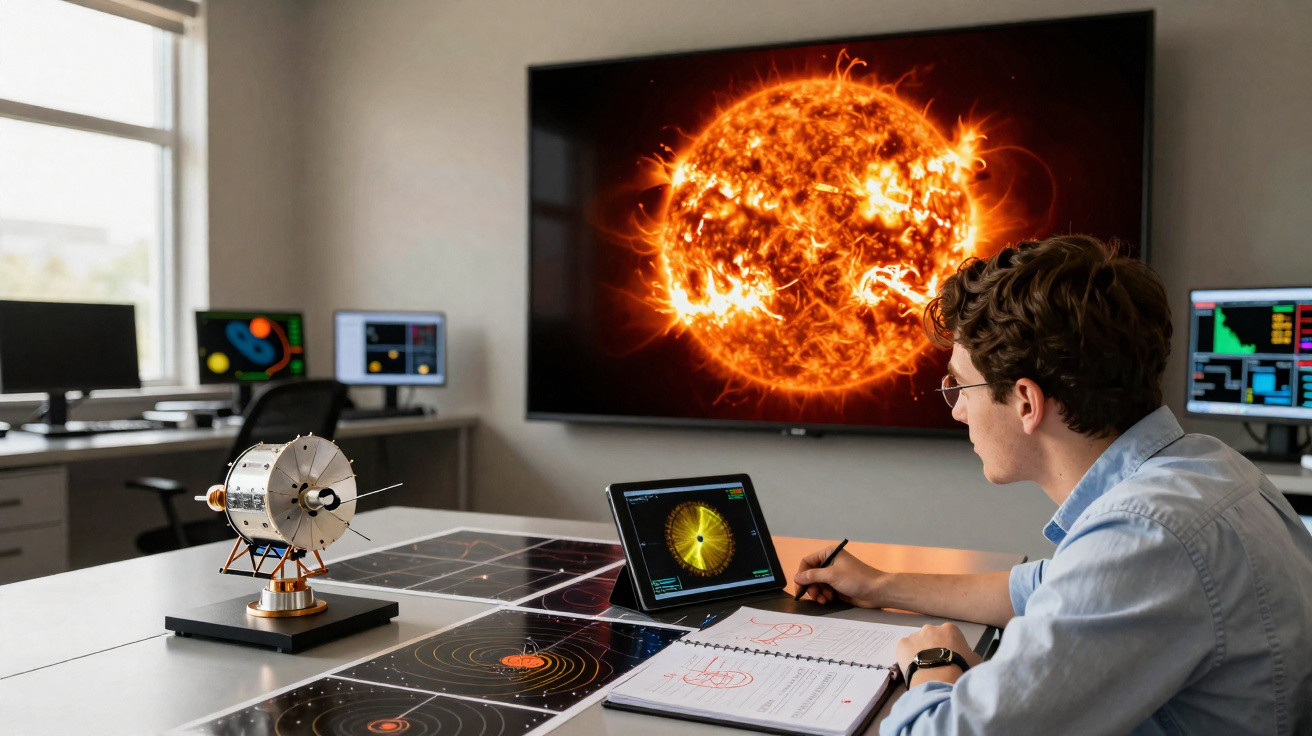
NOAA 13664 tracked across the Sun
The solar storm of May 2024 is remembered by many for bringing auroras to places where they are seldom visible. Yet, as millions of people looked up at the night sky, astronomers were closely monitoring the Sun.
For more than three months, two observatories on opposite sides of the Sun followed an active area on its surface from its formation to its disappearance. The near-continuous monitoring sets a new record and may contribute to more accurate space-weather forecasts.
From formation to fading activity
Known as NOAA 13664, the active region emerged on the Sun's far side on 16 April 2024. It then rotated into Earth's view in May, producing the most powerful geomagnetic storms seen in decades. The region rotated beyond view on 18 July 2024 and appeared to have become less active by the time it could be seen again.
During the intervening 90 or so days, astronomers monitored NOAA 13664 almost without interruption. Their only short gap in coverage came between 26 and 29 April.
"This is the longest continuous series of images ever created for a single active region," says Ioannis Kontogiannis, a solar physicist at ETH Zurich in Switzerland. "It's a milestone in solar physics."
Usually, astronomers can examine an active region on the Sun for only around two weeks at a time. The Sun completes a rotation every 28 days, so a particular region can be viewed from Earth for just half of that period.
Solar Orbiter and Solar Dynamics Observatory
On this occasion, however, two spacecraft observed the region simultaneously from separate positions. ESA's Solar Orbiter, launched in 2020, was watching the far side of the Sun when NOAA 13664 formed, while NASA's Solar Dynamics Observatory continued its observations from Earth orbit.
With these two spacecraft providing complementary views, researchers could follow the evolution of the active region's magnetic fields and investigate how those changes fuel solar activity.
Solar storms offer more than spectacular displays of light: they can harm satellites, power grids and communications systems. Improving understanding of these events, and predicting when they may occur, is therefore essential.
The study appeared in the journal Astronomy & Astrophysics.




Comments
No comments yet. Be the first to comment!
Leave a Comment