
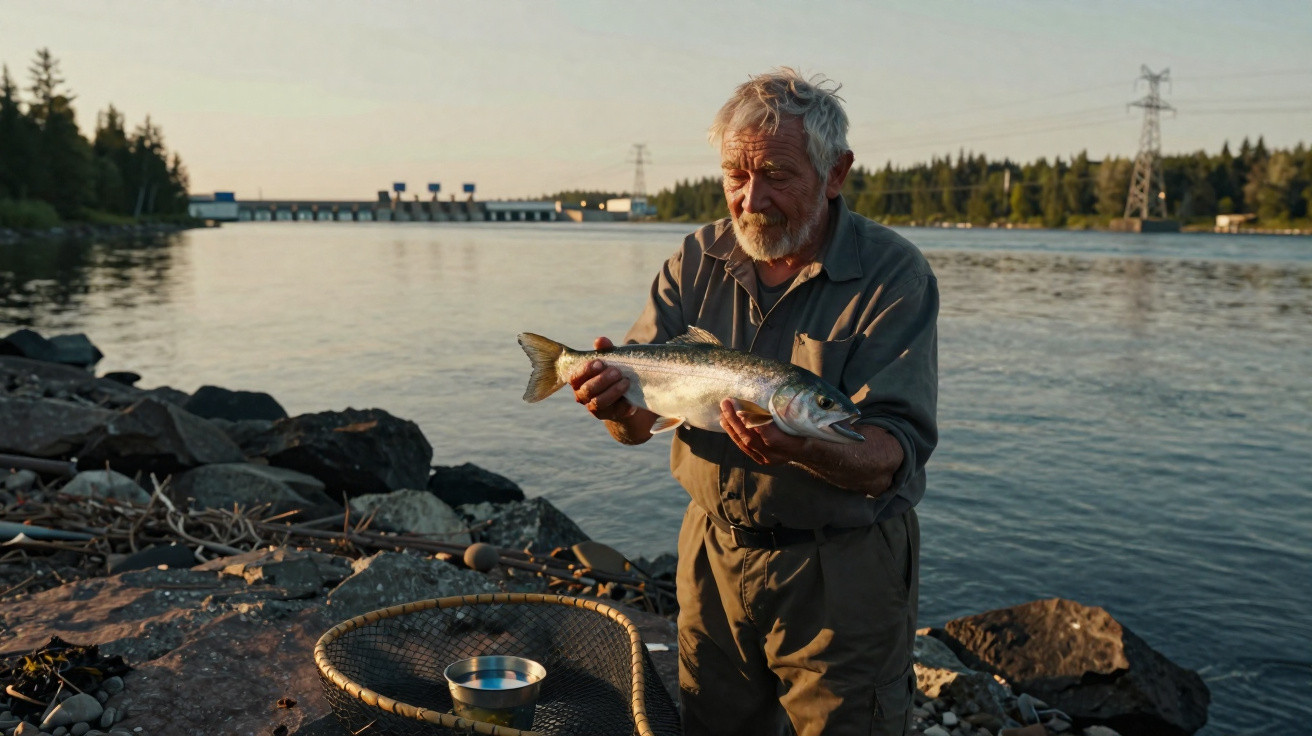
In northern Quebec, the silence of the great lakes conceals a history that profoundly affected entire families. From 1971 onwards, the vast James Bay hydroelectric schemes reshaped waterways, flooded forested land and disrupted Cree reference points for hunting, fishing and passing on knowledge. In total, nearly 11,500 km² of land was inundated by the reservoirs and diversions of the La Grande complex.
Along the shores, the change did not arrive with a siren. It emerged gradually: in the water’s colour, in dead trees still rising from bays, and then in test results revealing mercury in fish that had once been central to family meals. It was a quiet disaster, but one impossible to forget.
When dams changed the taste of fish
To understand what happened, one must picture a vast territory where fishing was not a Sunday pastime but an everyday practice. The Cree caught pike, walleye, lake trout and whitefish according to the season, often at places known for generations and bearing names that did not even appear on official maps.
When the James Bay works began in 1971, the landscape changed at an almost brutal pace. Rivers were diverted, wooded areas were submerged, and several major reservoirs were created, including Caniapiscau Reservoir, a huge artificial expanse of water visible from space.
This upheaval did more than erase canoe routes and fishing camps. It also altered the water’s chemistry. In a flooded forest, what appeared motionless was in fact still decomposing. Submerged vegetation and soils encouraged the conversion of mercury naturally present in the environment into methylmercury, a far more toxic form.
Researchers then observed a phenomenon well known in newly created reservoirs: mercury builds up through the food chain. Small organisms absorb it, small fish eat those organisms, and predators then concentrate the contaminant in their own tissues. Ultimately, the most sought-after fish can sometimes become the riskiest.
For Cree families, the issue went far beyond nutrition. Fish shared by the fire, smoked for winter or given to a neighbour has social and cultural importance. We all know how a dish can evoke a person or a place; there, that memory could suddenly be accompanied by public-health advice.
In some affected areas, mercury levels led health authorities to recommend limiting consumption of certain species. Pregnant women, young children and people who ate fish frequently were particularly affected. Telling a community to reduce this food meant, in practical terms, affecting part of its self-reliance.
The figures are staggering: nearly 11,500 km² of forest and land were submerged across the entire James Bay hydroelectric development. Yet behind that area were traps, burial sites, hunting routes, familiar bays and stories that no one could simply relocate to another shore.
Mercury: the invisible poison that imposed new habits
When confronted with mercury guidance, the most helpful response is to seek highly specific information: which species is affected, in which lake or reservoir, and how often can it be eaten? Not every fish has the same contamination level, and recommendations change over time as new measurements become available.
Older predatory species, such as large pike or some walleye, often contain more methylmercury than smaller fish. That does not mean every fishing activity is prohibited. It means that portion size, the size of the catch and where it was caught can make a considerable difference on the plate.
The mistake would be to assume that removing the skin or cooking fish thoroughly eliminates the danger. Mercury does not behave like fat or surface dirt: it is present in the flesh. Let us be honest: nobody really checks consumption advice before every meal, but in affected areas, that action can matter.
Authorities, Cree organisations and public-health teams had to learn how to communicate without humiliating people or causing unnecessary alarm. A ban imposed without listening would have been perceived as another dispossession. The real challenge was to protect health while recognising that traditional fishing remained a living, essential practice deeply tied to identity.
This history also highlights a common error in major projects: considering only the megawatts generated, jobs created or kilometres of power lines installed. Those figures matter, of course. But they say nothing about a child hearing elders hesitate before serving the fish they have always eaten.
The political turning point came with the James Bay and Northern Quebec Agreement, signed in 1975 after lengthy Cree and Inuit mobilisation. The agreement recognised land rights, provided compensation and established monitoring mechanisms, without erasing the effects already felt around the reservoirs.
One phrase often returns when Indigenous peoples and industrial projects are discussed: land is not scenery; it is a relationship. It helps explain why altering a river can never be reduced to a line on a map or a financial estimate.
“When water is transformed, a people’s habits, food and memory are transformed too.”
- Check local advice before regularly eating fish caught in a reservoir.
- Give priority to information produced with the Indigenous communities concerned.
- Differentiate between species, fish sizes and fishing areas instead of making generalisations.
What the James Bay story still compels us to confront
It would be easy to file this matter under “mistakes of the past”. That would be comforting, but incomplete. James Bay dams provide renewable electricity often described as clean, while their consequences show that low-carbon energy can also leave a very heavy human and ecological footprint.
The word “clean” does not account for drowned trees, monitored fish or meals that have become a source of uncertainty. Nor does it convey the Cree people’s ability to defend their rights, develop their own knowledge and remind us that decisions made far from the land always affect a face, a family and a season.
The question remains painfully current: who decides that a sacrifice is acceptable, and who will have to live with its consequences for decades? Debates about hydroelectricity, mining or major electricity networks would benefit from starting there, at the water’s edge, with those who can recognise a lake before they even see it.
Sharing this memory does not mean mechanically setting environmentalism against development. It means rejecting overly simple narratives. A dam can generate electricity, reduce fossil-fuel use and, at the same time, weaken a traditional food system; these realities can coexist, even when they are uncomfortable.
Generations that did not witness the first construction works in 1971 still inherit this altered geography. They also inherit vigilance: monitoring mercury, protecting species, safeguarding fishing knowledge and securing a genuine place in decision-making. Water retains memory, sometimes longer than official statements.
| Key point | Detail | Added value for the reader |
|---|---|---|
| Flooded territories | The James Bay hydroelectric development, launched in 1971, led to the flooding of around 11,500 km² of land, forests and areas used by Cree communities. | Understanding that the flooded area also represents places for living, fishing, hunting and cultural transmission. |
| Methylmercury contamination | The decomposition of submerged vegetation encouraged the formation of methylmercury, which accumulated through reservoir food chains, especially in large predatory fish. | Knowing why a fish can appear perfectly healthy while still requiring consumption precautions. |
| Locally relevant guidance | Risks vary according to species, fish size, catch location and how frequently fish is eaten. Public-health advice and local knowledge remain complementary. | Taking a more practical approach: finding out more before frequently eating fish from an affected lake or reservoir. |



Comments
No comments yet. Be the first to comment!
Leave a Comment