
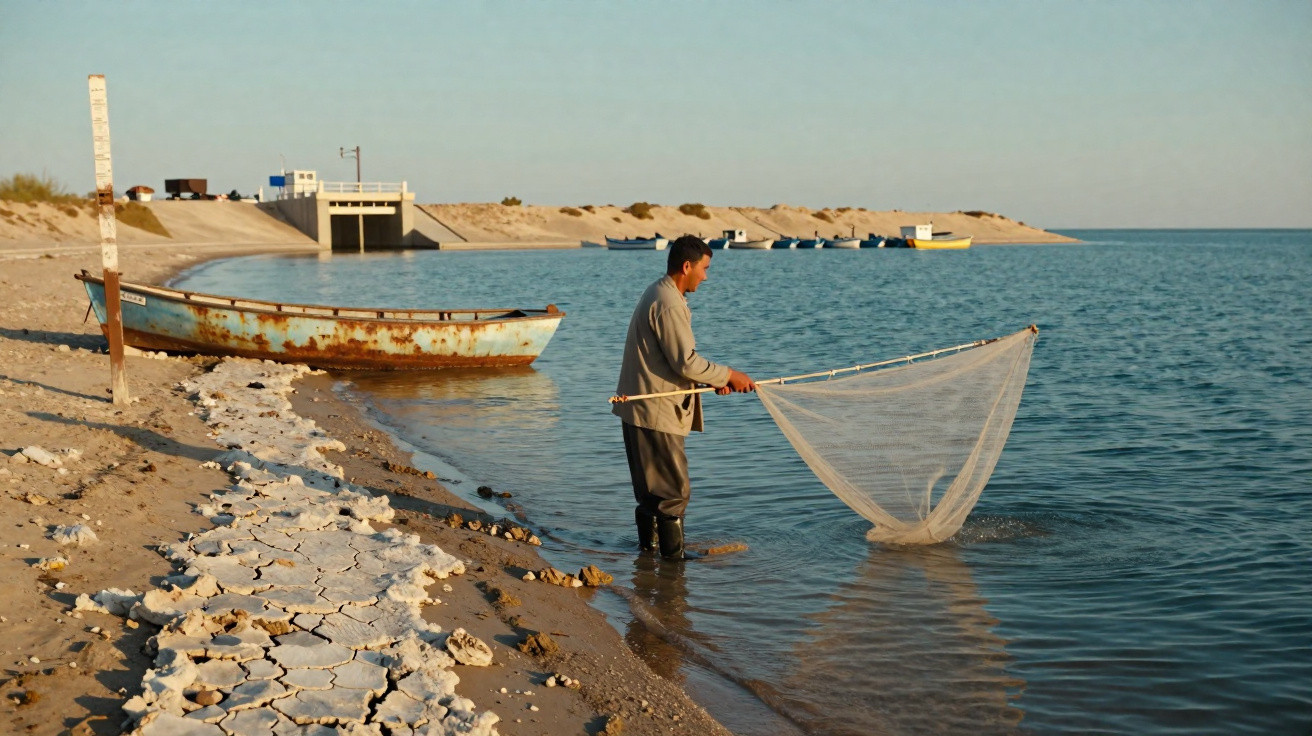
In Aralsk, the wind still whips up white dust that stings the eyes and settles on shoes. Yet something has changed over the past twenty years on the deserted quays of this Kazakh town: the water has returned, close enough for fishermen to head out at first light once again. In 2005, an outwardly unremarkable dam held back the waters of the Syr Darya and gave the Small Aral Sea a second chance. The recovery remains fragile, incomplete and at times painful for those who remember its former vastness. Even so, it is remarkable.
An earthwork that reshaped the fate of a sea
Looking at images of the Aral Sea in the 1990s is still a shocking experience: shipwrecks rust in the sand, far from any wave, as though left behind by a world that had suddenly retreated. We all know the feeling of seeing a familiar place become unrecognisable after a few years; here, it was tens of kilometres of water that vanished. The northern section, known as the Small Aral Sea, had become a weakened, highly saline expanse cut off from its former ports.
Completed in 2005 with financial support from the World Bank, the Kok-Aral Dam was built across the isthmus separating the Small Aral Sea from the larger Aral Sea further south. About 13 kilometres long, the structure made it possible to retain the Syr Darya’s water in the Kazakh basin rather than allowing it to flow into the parched south. Within the first few years, the water level rose far faster than expected. It was a rare sight in a story long presented as an irreversible disaster.
The idea is straightforward, almost like something at home: when a bath leaks at one end, running the tap will not help if the water cannot stay in it. The dam sealed that leak. By concentrating river inflow in a smaller area, Kazakhstan raised the Small Aral Sea’s level, lowered its salinity and restored tolerable conditions for several fish species. The sea as a whole has not been saved, but part of the disaster has stopped worsening.
The water returned, followed by the fishermen
On the ground, the change is not simply a line on a chart. As the water comes closer, residents regain tangible markers: the smell of algae, birds above the waves and nets being mended outside homes. In Aralsk, the sea is still some distance from the town centre, but it is no longer an unreachable memory that appeared to condemn an entire generation. Local authorities have also restored fishing infrastructure and supported fish-processing workshops.
The clearest measure is the catch: fishing, which collapsed after the sea dried up, has gradually resumed in the northern Aral. Figures differ depending on the year and the species counted, but catches increased from a few dozen tonnes in the early 2000s to more than a thousand tonnes in some years after the dam was built. This is not the abundance of the past. Yet it is enough to restore wages and everyday work to villages that no longer expected much from the sea.
The approach also offers a practical lesson for regions facing water scarcity: before pursuing vast schemes, it is necessary to understand where water is being lost and who relies on it. Kok-Aral works because it focuses on a smaller basin, supplied by a specific river, with a realistic aim. Let us be honest: few people truly do this every day, especially when urgency encourages promises of complete restoration. Here, the decision was to preserve a living part rather than chase a dream that had become unattainable.
A genuine success that cannot conceal the damage
The first mistake would be to assume that one dam can erase decades of poor management. The drying of the Aral Sea began in the 1960s, when the Soviet Union diverted large volumes from the Amu Darya and Syr Darya to irrigate cotton crops. Water was taken upstream, season after season, causing one of the world’s largest inland seas to retreat. The larger Aral Sea, shared primarily with Uzbekistan, remains in a dramatic state today.
The map must also be viewed without romanticism. The dam safeguards the Kazakh section, but it reinforces the divide between the two basins: water retained in the north no longer feeds the southern part as it once did. The decision has prompted debate, understandably so. For people living around the Small Aral Sea, it offers a chance of survival. For the Aral’s historic ecosystem as a whole, it is a reminder that full restoration appears highly unlikely at this stage.
Residents and researchers monitoring the project often return to the same point: saving water requires as much persistence as it does concrete.
“The Kok-Aral Dam has shown that part of the Aral Sea can return if it is given water back,” the teams that studied the World Bank-supported project regularly conclude.
To ensure this improvement does not remain a brief interval, several measures need to progress together:
- better management of agricultural water abstraction;
- maintenance of the dam and hydraulic infrastructure;
- protection of spawning grounds and fish species;
- involving fishermen in local decisions.
The Small Aral Sea shows that a landscape can still surprise us
Kazakhstan has not brought back the Aral Sea as older residents describe it: immense and blue as far as the horizon. It has done something more modest, and perhaps more useful: it has shown that an environmental disaster is not always a fixed story. The Small Aral Sea’s level has risen, salinity has fallen, fish have returned and families have regained work connected with the water. This tangible outcome deserves to be considered without exaggeration, but without cynicism either.
This story also speaks to our own landscapes. A channelled river, drained wetland or damaged coastline can sometimes seem too degraded to repair. Yet solutions often begin with a very physical detail: a well-sited embankment, a flow rate finally respected, revised agricultural practices or a decision sustained over time. The Small Aral Sea offers no universal formula. Instead, it asks a more uncomfortable question: what might we still save if we accepted the need to aim precisely, rather than trying to restore everything in one go?
| Key point | Detail | Added value for the reader |
|---|---|---|
| The Kok-Aral Dam | Built in 2005 between the Small Aral Sea and the larger Aral Sea | Understand how a targeted structure retained water in Kazakhstan |
| Rising water levels | Syr Darya inflow was concentrated in the northern basin | See why salinity fell and why fish returned |
| A partial revival | The Small Aral Sea is recovering while the southern section remains severely degraded | Assess the real limits of an environmental success that is often oversimplified |





Comments
No comments yet. Be the first to comment!
Leave a Comment