
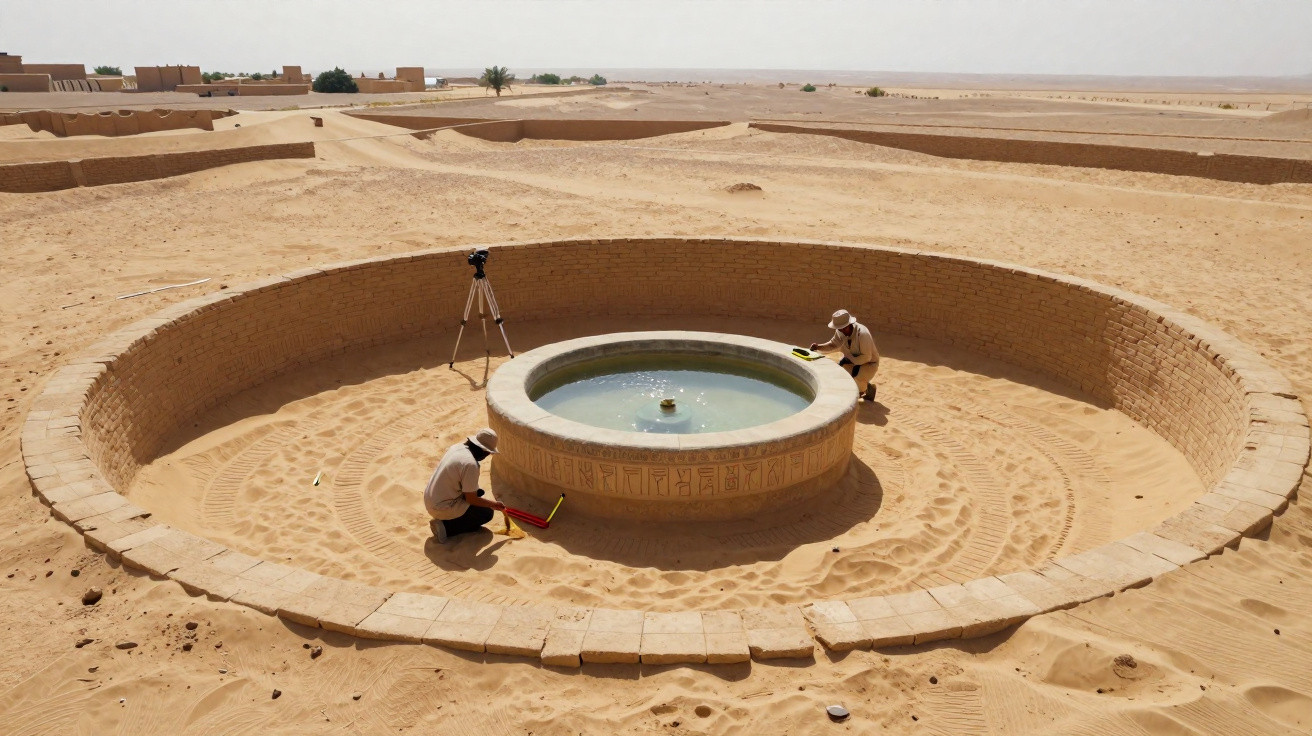
Beneath the sands of northern Sinai, archaeologists have uncovered a circular sanctuary associated with Nile water, revealing a forgotten shrine in ancient Pelusium.
The discovery reshapes understanding of the city: what had appeared to be a civic ruin is now seen as a religious site where water, mud and local worship converged.
Basin revealed at Pelusium
At Tell el-Farama, the archaeological site containing the remains of ancient Pelusium in northern Sinai, the uncovered basin measures roughly 35 metres across and remains connected to an old Nile channel.
Based on the excavated basin, Dr Hisham Hussein, the excavation supervisor, reinterpreted the building as a shrine.
Over six excavation seasons, Egypt’s Ministry of Tourism and Antiquities progressively exposed further areas as walls, channels and entrances were revealed.
Defining the structure as a shrine is significant because it puts ritual activity, rather than civic administration, at the heart of Pelusium.
Sacred meaning of water
Supplied by the former river branch, the basin probably contained silt-laden water connecting Pelousios with the fertile mud of the Nile.
Channels constructed around the circular feature directed and drained the water, while the square foundation in its centre likely supported a statue of the god.
As Pelousios may derive from the Greek term for clay, the design appears to give mud itself a religious significance.
Rather than meeting practical water requirements, the complex turned each refilling into a recurring devotional act.
Reclassified from hall to shrine
In 2019, the team had uncovered only a quarter of the circle, and this incomplete picture led to an incorrect interpretation.
After openings on the eastern, southern and western sides were found, neither the entrances nor the water network suited the idea of a senate building.
Further excavation, together with comparisons to comparable structures, led the researchers to abandon the senate interpretation.
“We now know this was a sacred water installation used in religious rituals, not a political structure,” said Dr. Hussein.
Pelusium as a frontier city
For ancient Pelusium, a shrine focused on water was fitting within a port city that protected Egypt’s eastern frontier.
Caravans, vessels, soldiers and migrants passed through the settlement, allowing religious concepts to move alongside merchandise and military forces.
The considerable movement through Pelusium helps account for a sanctuary that combined local worship with forms familiar under Greek and Roman rule.
In a city defined by passage and exchange, the basin was not merely an unusual layout: it gave a visible expression to belonging.
Design shaped by empires
Although ancient Egyptian construction traditions continued to influence the sanctuary, its broader layout also drew on later Mediterranean preferences.
Instead of arranging the temple on a linear axis, the design placed worship around movement beside water and a raised image.
The circular arrangement indicates that its architects did not reproduce one established model, but combined several traditions for a local deity.
This outcome suits a frontier city in which imported styles arrived regularly while older sacred practices retained their authority.
A deity linked to silt
Mud may seem unremarkable, yet it represented identity here, as Pelusium’s Greek name is connected with mud and silt.
Local deities were often associated with particular landscapes, and Pelousios seems to have been linked to the river that sustained the city.
By creating a sanctuary centred on muddy water rather than enclosed dry-stone chambers, worshippers incorporated the location itself into ritual practice.
That connection between environment and belief may clarify why the installation appeared so distinctive, even by Egyptian standards.
Centuries of continued use
Buried deposits indicate that the site remained in use from the second century BC until the sixth century AD.
During this extended period, builders made only limited alterations, suggesting that the central concept remained effective across generations.
Its prolonged use also indicates that the sanctuary endured political change, despite shifts in rulers, languages and trading partners.
Few religious sites demonstrate such continuity, giving this sanctuary particular significance in North Sinai.
Greater value for Sinai sites
Northern Sinai is frequently regarded as a passageway, but finds such as this continue to demonstrate its settled and layered religious history.
Minister Sherif Fathi described the discovery as evidence of the region’s strategic and archaeological importance, rather than a marginal footnote.
Architectural features that combine Egyptian, Greek and Roman traditions reinforce that view without reducing the site to a straightforward foreign imitation.
Every newly excavated trench makes the frontier seem less like vacant territory and more like a place that influenced culture.
Further excavation at Pelusium required
The northern portion suffered extensive damage, meaning that part of the sanctuary’s complete layout remains concealed.
Future research will need to establish how visitors entered, where offerings were placed and whether neighbouring structures formed part of the same cult.
Comparisons undertaken by the Sorbonne helped disprove the senate theory, but further excavation alone can reveal how the rituals were carried out.
Despite these remaining uncertainties, the sanctuary has already altered the questions scholars will pursue about Pelusium.
Fresh insight into Pelusium
The newly identified sanctuary makes Pelusium more intelligible as a city in which water, trade, memory and worship came together.
It also demonstrates how correcting a single error in an excavation can reopen a whole chapter in Egypt’s religious history.





Comments
No comments yet. Be the first to comment!
Leave a Comment