
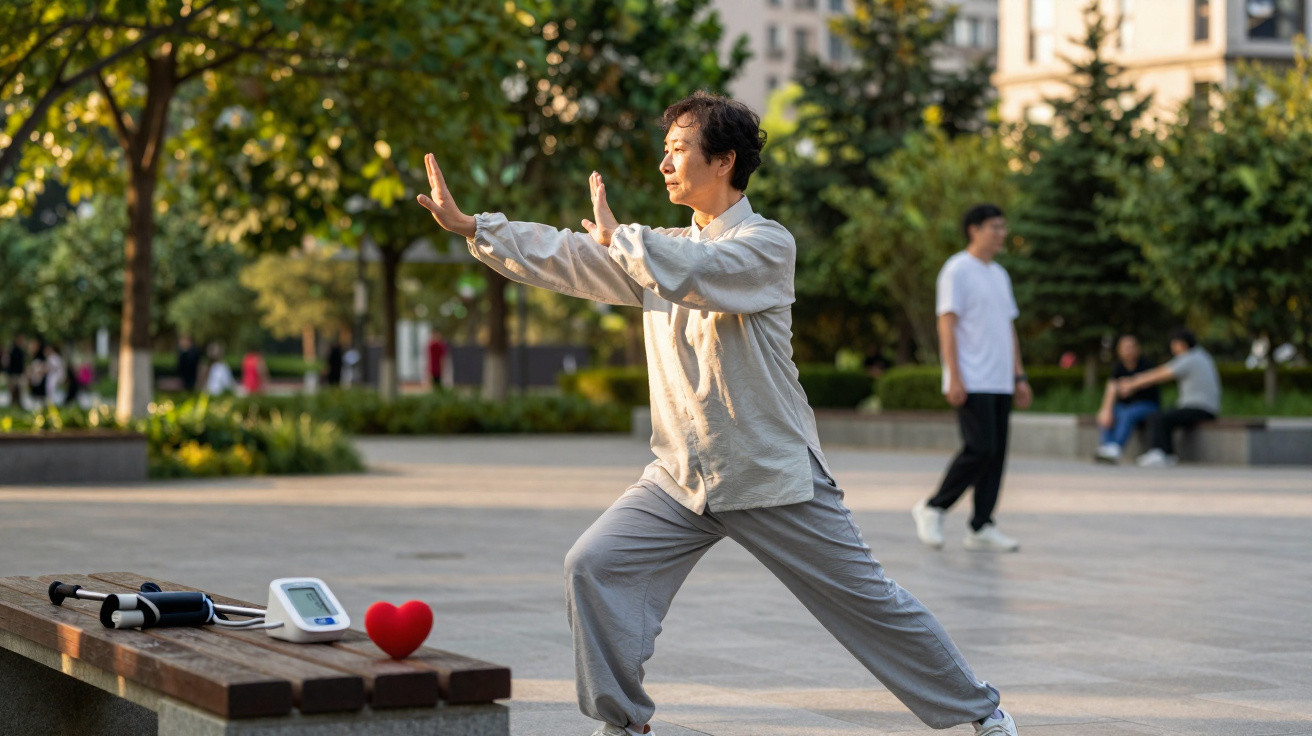
A high blood pressure reading should be a signal to your brain that it is time to get your body moving.
Doctors often advise walking on most days, at a pace brisk enough to raise your heart rate. For stage 1 hypertension, that is effectively the standard recommendation.
A year-long Beijing trial compared that advice with an ancient practice that resembles yoga more than a fast walk. It consists of eight gentle movements combined with regulated breathing.
It needs no gym, equipment or raised heart rate. After 12 months, researchers found that the results for the different groups were almost the same.
What is baduanjin?
Known as “baduanjin”, and sometimes rendered as “eight pieces of brocade”, this practice comprises eight set postures carried out slowly and with care, alongside deep breathing and focused attention.
One complete baduanjin routine lasts around 10 to 15 minutes. There is no jumping, hurrying, equipment or music: only movement and breathing.
Dr Jing Li heads the Department of Preventive Medicine at Beijing’s National Center for Cardiovascular Diseases (NCCD).
Her team created the new trial to establish whether this mild practice could deliver meaningful blood pressure benefits.
How the BLESS trial was designed
The BLESS study recruited 216 adults aged 40 and over from seven communities in China.
Every participant had stage 1 hypertension according to US guidelines, with a systolic, or top-number, blood pressure reading of 130 to 139.
The participants were randomly allocated to three groups. One group practised baduanjin five days each week, another completed brisk walks at the same frequency, and the third followed a self-directed exercise programme they selected themselves.
The intervention continued for 52 weeks. Blood pressure was measured over a full 24-hour period at baseline, after 12 weeks and again after one year.
Although participants knew their assigned group, the assessors reviewing the readings did not know which activity each person had completed.
The figures from the study
At the three-month point, 24-hour blood pressure in the baduanjin group had fallen by approximately 3 mm Hg compared with the self-directed group.
Clinic readings decreased by about 5 mm Hg and stayed at that level through to 52 weeks. Over the full year, the brisk-walking group achieved a blood pressure reduction that was nearly identical to that seen with baduanjin.
For decades, walking has been the conventional prescription for stage 1 hypertension.
The scale of the reduction matches the findings reported in earlier aerobic-exercise trials. A slow sequence performed indoors kept pace with those results.
Results comparable with medication
A fall of three to five points may seem modest when looking at one chart. Yet this range is close to the effect delivered by first-line blood pressure medicines in clinical trials.
“The blood pressure effect size is similar to that seen in landmark drug trials, but achieved without medication, cost or side effects,” said Dr. Harlan M. Krumholz of the Yale School of Medicine.
When applied across millions of adults with raised readings, a reduction of this kind becomes the sort of figure that public-health planners must monitor.
Overall findings
The self-directed exercise group showed very little improvement. This was not because exercise is ineffective, but because most participants did not keep it up regularly. The same pattern repeatedly appears in lifestyle trials.
Maintaining any routine is the difficult part, but those in the baduanjin group remained engaged.
The complete routine took no longer than making a coffee, did not require a gym, and could be practised alone or with neighbours in a park.
Nobody monitored participants during the second half of the trial. Even so, they continued to gain the benefits, an important point for public-health programmes.
Remaining questions about baduanjin
One issue the paper neither settles nor agrees on is why baduanjin is so effective.
In any case, the routine combines gentle aerobic movement, held postures, flexibility work and meditative breathing in one session.
Earlier research has associated each of these components with changes in blood pressure. Separating their individual effects within one trial is challenging.
The researchers can state that the practice produced a lasting blood pressure reduction that continued for a year. It also involved no coaching and zero check-ins.
Baduanjin and heart health
Before BLESS, no randomised trial had shown that a no-equipment mind-body exercise could produce such sustained reductions in blood pressure.
This broadens what doctors can recommend to people who decline medication, cannot afford a gym or find walking difficult.
It also provides community health programmes with a low-cost option to recommend. The movements are standardised, while the instructions fit on one page.
For communities without parks, treadmills or trainers, it offers a practical option and a public-health tool.
Comments
No comments yet. Be the first to comment!
Leave a Comment