
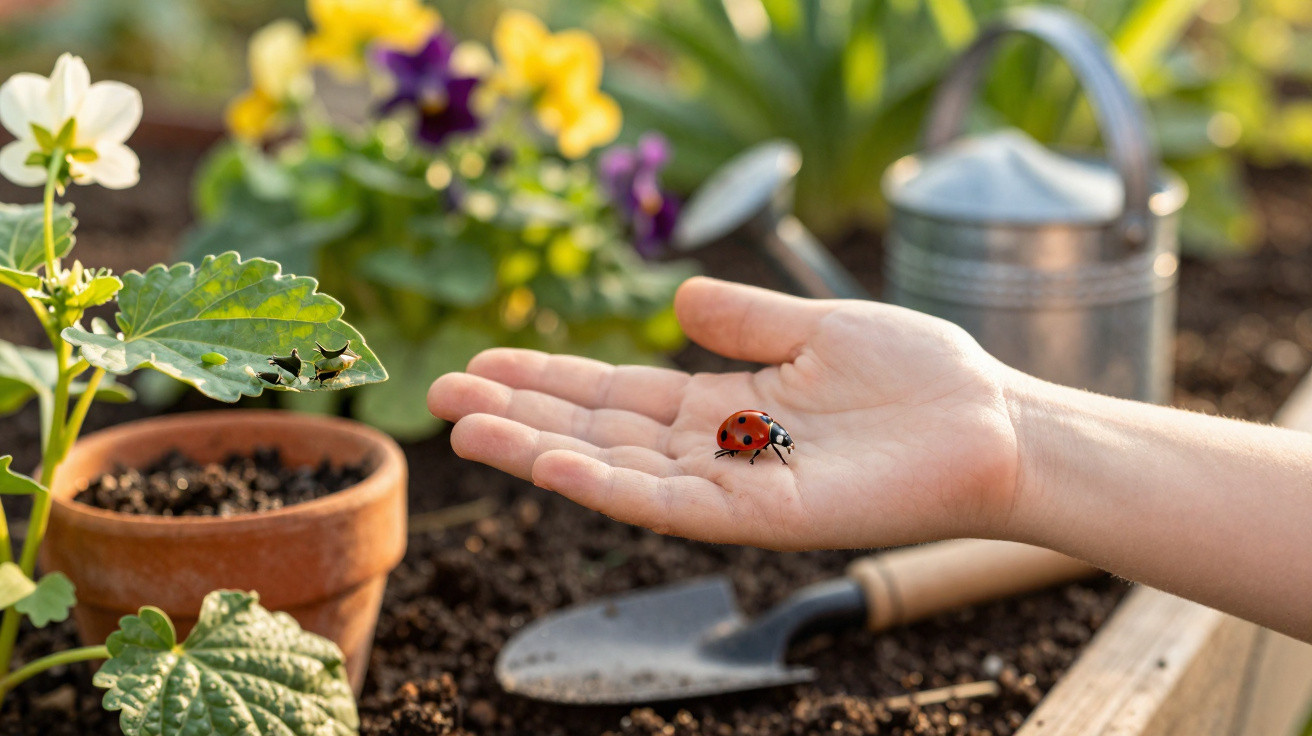
If you were watering your plants and suddenly spotted a ladybird slowly making its way across a leaf, you may have felt that flutter reserved for people who think luck has just paid them a visit. But what lies behind that belief? And what does science say about this much-loved garden insect?
The garden’s best-loved insect has a secret identity
The ladybird, scientifically classified within the Coccinellidae family, is a rounded beetle with the familiar black spots on a red background that everyone recognises. Despite its charming appearance, it performs a very serious role in ecosystems: it is a natural predator of aphids, scale insects and other tiny insects that damage plants.
In practical terms, finding a ladybird in your garden means the environment is healthy. It only turns up where there is food to eat - in other words, where there is life. This shows that your plants are attracting a beneficial insect rather than a pest.
- Natural predator: an adult ladybird can eat up to 50 aphids a day, protecting your plants without pesticides.
- A sign of balance: this insect’s presence suggests the garden has biodiversity and healthy living conditions.
- Its colour has a purpose: its vivid red colouring warns predators that it tastes unpleasant and may be toxic.
- Found around the world: there are more than 6,000 known ladybird species, present on every inhabited continent.
Where did the ladybird’s reputation as a lucky insect come from?
The connection between the ladybird and good luck has deep roots in cultures across the world. In medieval Europe, farmers believed the insect had been sent by the Virgin Mary to protect crops from pests, which is where the English names ladybird and ladybug came from. In Brazil, popular tradition inherited this belief and has kept it alive to the present day.
In many cultures, killing a ladybird is thought to bring bad luck. Allowing one to land on your hand and fly away of its own accord, meanwhile, is seen as a blessing or a sign that a wish will come true. It is remarkable that such a tiny insect carries so much cultural meaning.
The surprising truth about ladybird spots
A common question is whether the number of black spots reveals a ladybird’s age. The answer may surprise you: it does not. The spots are determined by the species, not by the insect’s lifespan. A seven-spot ladybird will always have seven spots, no matter how many months old it is.
Myth and fact about the spots
Spots identify the species, not its age
The seven-spot ladybird, Coccinella septempunctata, is the world’s most common and famous species. It emerges with seven spots and keeps them throughout its life. Other species may have two, four, ten or even sixteen spots, with each pattern fixed for that particular species.
There is another interesting variation: some ladybirds have black backgrounds with red or orange spots, reversing the colour pattern we are used to seeing. They are just as much ladybirds, simply wearing a different “outfit”.
Another little-known fact is that, when it feels threatened, a ladybird releases a yellowish liquid from the joints in its legs. The liquid has an unpleasant smell and taste for predators, making it a highly effective defence mechanism.
Ladybirds in the garden are better than any insecticide
From a practical perspective, having a ladybird among your plants is a gift for anyone tending a vegetable patch or garden. It provides natural biological control, removing pests without the need for chemical products. For people growing plants at home, this is even more valuable: less poison and greater balance in the garden ecosystem.
If you would like to attract more ladybirds, avoid using pesticides and grow small-flowered plants such as coriander, dill and fennel. These provide nectar when pests are scarce. A diverse garden is an inviting garden for this helpful insect.
When luck and nature point to the same thing
Perhaps the most fascinating part is realising that popular belief and ecology reach the same conclusion by different routes. Seeing a ladybird in your garden truly is a positive sign - not because of magic, but because the environment is balanced, the plants are alive and nature is doing its job.
The next time this small insect appears in your garden, it is worth pausing for a moment to watch it. It is probably hunting and carrying out an essential role in the garden that you may never have noticed before.
If this has sparked your curiosity, share it with someone else who enjoys discovering what lies behind the simplest things in everyday life.






Comments
No comments yet. Be the first to comment!
Leave a Comment