
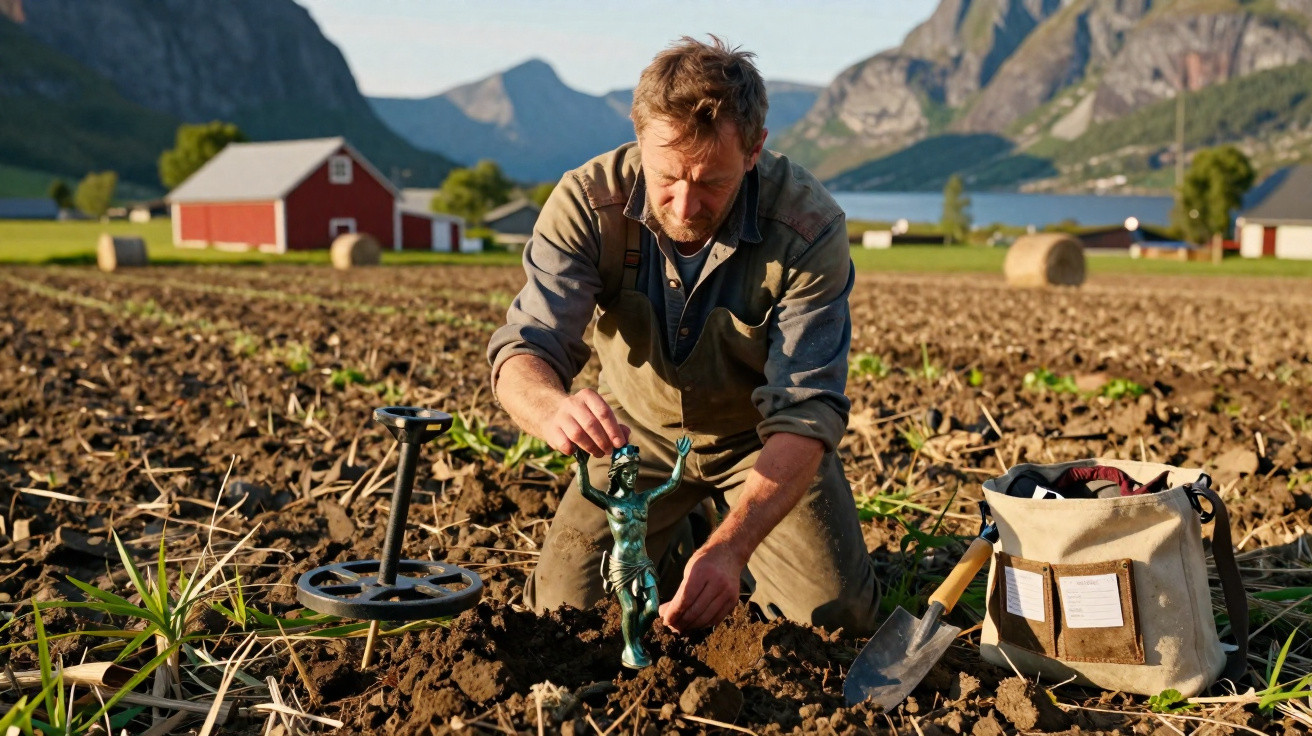
After hours crossing the same patch of land, with his boots pressing into wet earth, he had uncovered nothing beyond bits of metal and bottle tops. Then, as daylight began to fade, a weak detector signal transformed the day, bringing a long-lost medieval object back into view.
An ordinary search becomes an extraordinary discovery
The discovery took place outside Åndalsnes, a coastal town in western Norway surrounded by dramatic mountains and unhurried fjords. Kim Erik Fylling Dybvik, a local metal-detecting enthusiast, had been close to ending his search. The cultivated field seemed unremarkable: tractors cross it each year, and it was hardly the sort of place expected to generate news.
Dybvik has devoted more than ten years of his spare time to searching Norwegian agricultural land, hoping to save objects before modern farm equipment destroys them. He is thoroughly familiar with his detector’s sounds: muted tones usually indicate iron rubbish, while crisper signals can point to coins or jewellery. On that afternoon, however, almost every signal had proved unimportant.
A clear, persistent tone then sounded from the detector. He paused, crouched down and carefully removed the thin covering of dark earth. Just a few centimetres below the surface, he saw a small form still embedded in the soil.
What emerged from the ground was not simple scrap metal but a finely crafted medieval figure of Jesus, preserved against all odds under a working farm.
Measuring roughly 15 centimetres in height, the statue depicts Christ with outstretched arms and sharply rendered facial features. The figure is made of bronze, with surviving traces of gilding catching the light across its face and body. It feels fragile when held, but embodies centuries of Scandinavian faith and conflict.
A medieval Jesus discovered in a ploughed Norwegian field
Archaeologists who assessed the object soon proposed that it dates from the late 1100s to the early 1200s. Northern Europe was unsettled during this period. Christianity was established, although older religious traditions endured in isolated settlements. Churches were becoming increasingly elaborate, while priests, traders and craftspeople carried religious art across national boundaries.
Experts believe the figure may originally have belonged to a larger item, such as:
- a processional cross used in ceremonies;
- a portable altar carried by travelling clergy; or
- a devotional object belonging to a prosperous household.
Its carefully worked face, elegant pose and remnants of gold indicate that it was not simply an everyday possession. More likely, it played a central role in prayer, ritual and travel.
The find hints that this apparently modest field once lay inside a religious landscape much more complex than local memory suggests.
Just days earlier, a Viking brooch had been recovered from the very same field. Dybvik and another detectorist, Warren Schmidt, also found silver coins and more than seven metal buttons. Together, these objects suggest that the land was used repeatedly and in different ways, from the Viking Age through to the medieval era.
Why Åndalsnes has caught researchers’ attention
Before this discovery, historians considered the broader Åndalsnes area to be relatively well surveyed and understood. There are no imposing ruins beside the road, nor is there a renowned monastery attracting coaches of visitors. This modest statue, however, unsettles that apparently straightforward picture.
Documents refer to an old religious location nearby, though nothing is visible above ground today. The latest find provides a new basis for believing that further evidence may survive beneath the ploughed layer.
From agricultural field to possible research hotspot
Following its initial identification, the statue was sent first to a museum in Molde and subsequently to the cultural heritage department at the Norwegian University of Science and Technology (NTNU) in Trondheim. Researchers there intend to carry out a series of tests.
| Planned analysis | What it could reveal |
|---|---|
| Study of metal composition | The source of the bronze and the workshop traditions that shaped it |
| Examination of gilding | The method employed and the standard of materials used for the statue |
| Microscopic wear analysis | How frequently it was touched, carried or kissed in prayer |
| Comparison of contexts | Similarities with comparable medieval figures from Scandinavia and continental Europe |
Meanwhile, heritage officials are considering another form of investigation in Åndalsnes itself. Ground-penetrating radar could examine the field and neighbouring land without additional excavation. Minor variations in the ground could expose foundations, ditches or the vanished walls of a church, chapel or burial site.
If geophysical surveys confirm hidden structures, an anonymous patch of farmland could turn into one of western Norway’s most valuable medieval sites.
The ethics of amateur metal detecting
Dybvik has said to Norwegian media that he attaches no commercial worth to his finds. He promptly informs experts, complies with reporting requirements and surrenders artefacts rather than selling them. This approach is significant. Across Europe, hobby detectorists and archaeologists often have a strained relationship, particularly in places where unlawful excavation feeds the illicit market.
Norway, like several other nations, applies strict rules to discoveries of this kind. Objects exceeding a specified age threshold belong to the state and must be reported. Where amateur searchers comply, they can become valuable partners in official research. They can cover extensive areas, respond more rapidly than formal teams and notify authorities before ploughing or building works destroy vulnerable remains.
What one statue reveals about everyday faith
The Jesus figure from Åndalsnes also offers insight into ordinary religious practice during the High Middle Ages. Accounts of church history commonly concentrate on monarchs, bishops and theological disputes. Objects of this kind show that faith was also present in fields, barns and distant valleys.
An object of this scale could have been transported easily. A priest may have carried it over mountain tracks to serve dispersed farms. It could have accompanied a ship’s chaplain on journeys along the coast. Alternatively, a family may have stored it in a chest and brought it out at important times: Easter, Christmas, births, deaths and the beginning of the sowing season.
For medieval Scandinavians, faith was strongly bound to the land. They sought good crops, healthy animals and gentle winters through prayer. A gilded figure placed in a wooden church or on a modest altar could have concentrated such hopes. When a statue like this is lost in what later becomes a field, it can point to a history of change: perhaps a church relocated, a structure burned down or a ceremonial route slowly altered.
From Viking brooches to Christian icons
The Viking brooch from the same field presents an immediate question: why were artefacts from both pre-Christian and Christian eras found together? Archaeologists frequently encounter this kind of overlap in the conversion period. Accepting baptism did not mean that people instantly discarded older jewellery or domestic belongings. Instead, they repurposed, adapted or gave them new meanings.
This layered archaeological evidence reflects a complicated way of thinking. A farmer could attend mass on Sunday yet continue murmuring older protective words over livestock. Christian imagery gradually displaced earlier symbols in public settings, but smaller possessions, exchanged or passed down through families, kept older styles in use.
The Åndalsnes field, with its mix of Viking and Christian material, captures that slow, messy shift from one belief system to another.
Why discoveries like this matter beyond Norway
Accounts such as this have significance far beyond Scandinavia because they draw on widely shared themes. Someone using basic equipment walks over known ground, only for the soil to reveal a fragment of the distant past. Rural areas across Europe, North America and elsewhere may contain comparable layers created by everyday lives, rather than celebrated conflicts.
The case also demonstrates how contemporary technology is reshaping interactions with history. Metal detectors, drones and ground radar were once limited to specialist groups. Less expensive versions are now available to enthusiasts. This development creates risks, including looting, damage and the loss of archaeological context, but it can also enable major collaboration where clear regulations and mutual trust are in place.
For anyone interested in this type of work, the Åndalsnes find offers several practical points:
- Check the relevant local legislation before operating a metal detector or beginning any search.
- Note the precise location and depth of every discovery, as context enables archaeologists to reconstruct the past.
- Avoid cleaning artefacts harshly, since aggressive treatment can remove scientific evidence.
- Notify heritage authorities about important objects without delay rather than selling them or concealing them.
This lone Jesus statue, carefully raised from moist Norwegian earth, now moves between laboratories and offices instead of processions and chapels. Its path, however, continues to alter researchers’ understanding of an entire region. For one weary detectorist, it was only a moment: a glint of metal among loosened soil. For historians and believers, that instant spans nine centuries, linking a present-day farmworker at dusk to medieval hands that once lifted the same figure to the sky.






Comments
No comments yet. Be the first to comment!
Leave a Comment