
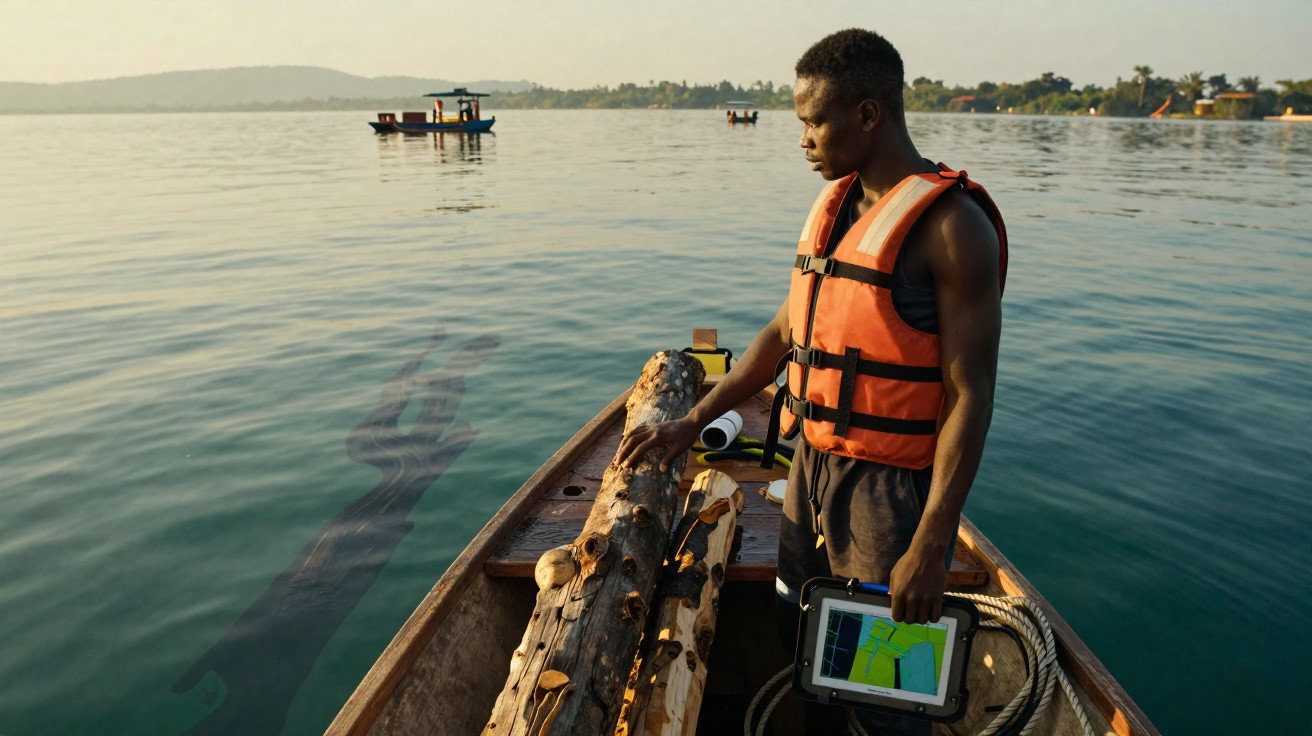
At daybreak on Lake Volta in Ghana, the water looks still, almost glassy. Yet beneath the canoes and fishing boats lies an entire forest: large trunks, roots trapped in the silt and tropical species that could never be harvested before the flooding. In 1965, the Akosombo Dam turned a vast valley into one of the world’s largest artificial lakes. Villages vanished, families were relocated and nearly 8,500 square kilometres of wooded land were submerged. Sixty years on, this drowned landscape is drawing investors, engineers and entrepreneurs. The forgotten timber may be worth as much as $3 billion. Underwater, time has not destroyed everything.
The silent treasure beneath Lake Volta
From the lake’s shores, there is little to suggest the scale of what rests below the surface. Local people know which areas to avoid: places where a propeller can strike a submerged trunk or where nets catch on old branches. We all know the moment when a lost object turns up at the back of a drawer, carrying a value we had not noticed before. Here, however, the scale is staggering: this is not a few neglected boards, but a tropical forest submerged for six decades. Deep, oxygen-poor water has slowed the deterioration of some timber. The lake has become a vast, unpredictable kind of natural vault.
The Akosombo Dam was built to generate electricity for Ghana and support the country’s industrialisation, particularly its aluminium sector. When the reservoir was filled, a process completed in 1965, it created Lake Volta, which spans roughly 8,500 square kilometres. At the time, felling and removing every tree would have required enormous resources in a region already disrupted by the relocation of tens of thousands of people. Much of the forest was therefore left where it stood. Estimates cited by specialist companies now suggest that millions of cubic metres of timber could be recovered, with potential commercial value reaching $3 billion, depending on the species, the volumes that can genuinely be extracted and market conditions.
That figure is enticing, but it calls for caution. A tree that has spent decades underwater does not automatically become high-end furniture: it must be found, removed safely, dried, cut and assessed for quality. Some species retain remarkable density; others have been weakened by currents, sediment or biological damage. Its worth also depends on its end use: flooring, furniture, joinery, structural timber or pieces for craftwork. The real treasure, then, is not simply the wood. It is the ability to recover it without harming the lake, endangering workers or reopening the wounds of a still-sensitive history.
Recovering Lake Volta timber without turning the lake into an uncontrolled worksite
To retrieve these trunks, responsible operators first map the lakebed. Sonar, aerial imagery and GPS surveys are used to identify trees, their depth and navigation routes already used by fishers. The most practical approach is to treat every area as a sensitive site, rather than merely a source of raw materials. Divers and cutting equipment operate under strict procedures, often from crane-equipped barges. Removing a tree can also make a navigation channel safer. This is a very practical issue: a stump concealed beneath a few metres of water is enough to damage a vessel and put lives at risk.
The common mistake is to assume that making money simply means ‘fishing’ trunks out of a lake. Let us be honest: nobody genuinely does that every day. The work requires licences, impact assessments, insurance, heavy equipment and an ongoing relationship with communities living around the lake. Extraction carried out too quickly can disturb sediment, disrupt fishing grounds or trigger local disputes over the income produced. Submerged timber must not become a new gold rush managed from offices far from Accra or overseas. People on the shore live with this lake every morning; their role in decisions cannot be merely symbolic.
Responsible recovery rests on one straightforward principle: every trunk raised should deliver more than commercial profit. Former Ghanaian President Kwame Nkrumah captured his national ambition in this well-known phrase:
“We face neither East nor West: we face forward.” - Kwame Nkrumah
- locate trees accurately before any work begins;
- give priority to areas that pose risks to local navigation;
- share a measurable proportion of revenue with lakeside communities;
- monitor the timber’s traceability through to the final customer.
These safeguards help prevent Lake Volta timber from being sold as a mysterious resource, with no clear origin and no lasting benefit for Ghana.
An industrial legacy that still raises human questions
Lake Volta tells a story that is more complex than a spectacular multibillion-dollar calculation. The dam delivered electricity, major infrastructure and an image of modernity to a newly independent Ghana. It also submerged farmland, changed fishing practices and moved whole populations into new villages. For generations who did not experience the flooding, the underwater trunks may represent an economic opportunity. For others, they remain tangible evidence of a forced departure. These overlapping memories deserve more than an attractive drone image or a price per cubic metre.
The global timber market is already pushing industry to seek alternative resources, particularly as forests on land come under pressure. Using an old stock without cutting down new trees is appealing, and the environmental argument has merit. However, it should not be repeated automatically: lifting timber from the water uses energy, requires machinery and alters a fragile aquatic environment. The right question is not only, “what is this forest worth?” It is also: who determines its value, who receives the revenue, and what mark will this second extraction leave on the everyday lives of lakeside residents?
The future of this submerged forest could offer lessons far beyond Ghana. It shows that a major infrastructure project never truly ends on the day it opens: its consequences can remain hidden for decades, beneath water or in people’s memories. Between energy ambitions, the timber trade and the memory of displaced villages, Lake Volta demands a more nuanced view. Sharing this story also prompts us to ask which ordinary landscapes near us already hold the quiet traces of choices made long ago.
| Key point | Detail | Added value for the reader |
|---|---|---|
| A forest beneath the lake | The Akosombo Dam created Lake Volta in 1965 across nearly 8,500 km². | Understand the origins of an exceptional natural and industrial legacy. |
| Enormous potential value | Submerged timber is sometimes valued at up to $3 billion, depending on volumes and species. | Distinguish between a striking estimate and wealth that can actually be exploited. |
| A major local issue | Extraction affects navigation, fishing, the environment and the memories of displaced populations. | Look beyond the timber: benefits must also reach lakeside communities. |





Comments
No comments yet. Be the first to comment!
Leave a Comment