
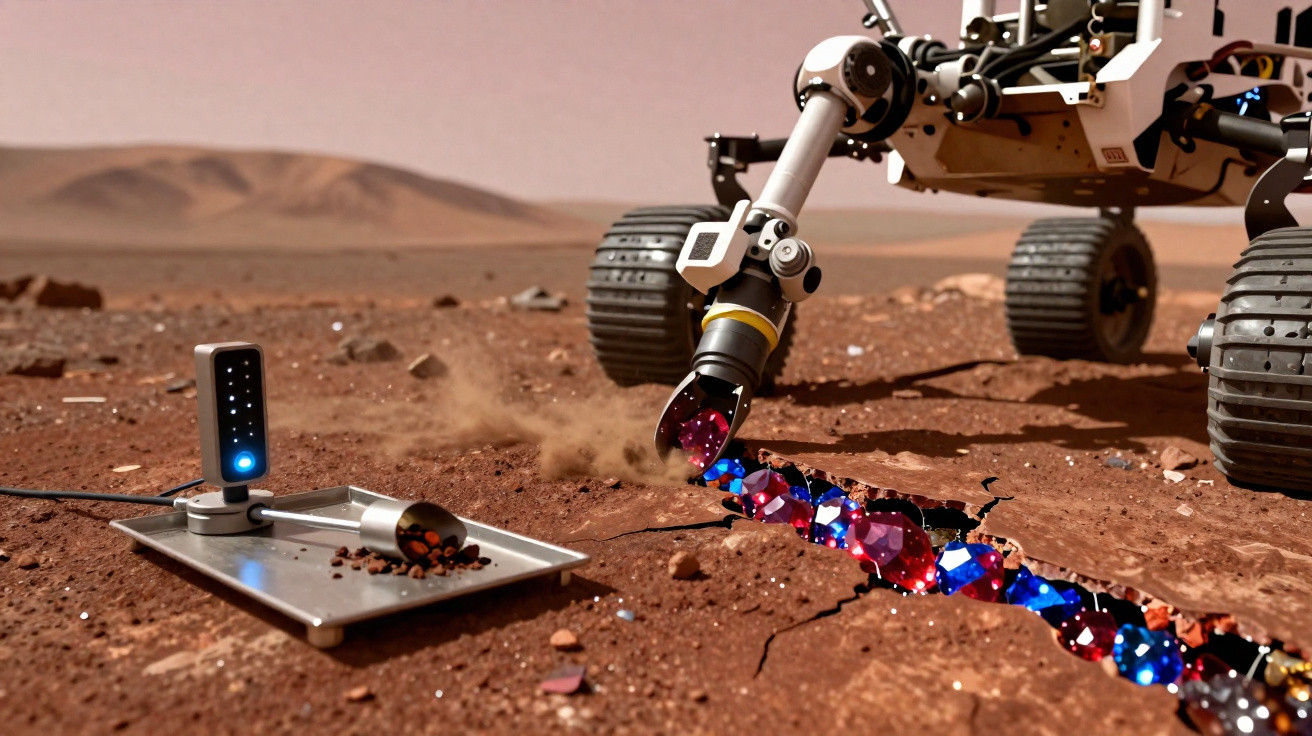
Study suggests corundum, including rubies and sapphires, may be present in Martian rocks
Astronomers have identified tiny crystals resembling rubies in rocks on Mars. The discoveries were made through laser analysis by the Perseverance rover in Jezero Crater. The study was presented at the 57th Lunar and Planetary Science Conference in Texas and is being prepared for publication in Geophysical Research Letters.
The crystals were detected in so-called “float rocks” - fragments that may have been moved by meteorite impacts or geological activity. Examination with the SuperCam laser indicated that three of the samples studied contain corundum, a mineral made up of aluminium and oxygen with chromium inclusions.
Corundum, rubies and sapphires in Martian rocks
Corundum is among the hardest naturally occurring substances, surpassed only by diamond. In its pure state it is colourless, although impurities such as chromium, iron or titanium give it vivid colours. Chromium, for instance, produces red rubies, while iron and titanium create blue sapphires.
Researchers stress that the crystals’ precise chemical composition has not yet been established. This makes it difficult to determine conclusively whether they are rubies or another variety of corundum. The detected crystals are smaller than 0.2 mm, making them challenging to examine.
Possible formation through meteorite impacts
On Earth, corundum forms through metamorphic and igneous processes associated with tectonic activity. On Mars, however, where tectonic processes have not been confirmed, scientists suggest that the crystals may have formed under the extreme temperatures and pressures produced by meteorite impacts.
The study also proposes that hydrothermal fluids generated by impacts may have aided corundum formation. Further samples found within their original geological setting will be needed to confirm this hypothesis.
Jezero Crater’s potential rare minerals
Signs of quartz, opal and other potentially precious minerals have previously been found in Jezero Crater and elsewhere on Mars. This suggests that Mars may be a “laboratory” for the formation of rare minerals.
Scientists hope that future work will reveal how corundum forms on Mars and establish how widespread it is. It could also provide fresh evidence about the geological history of the Red Planet.




Comments
No comments yet. Be the first to comment!
Leave a Comment