
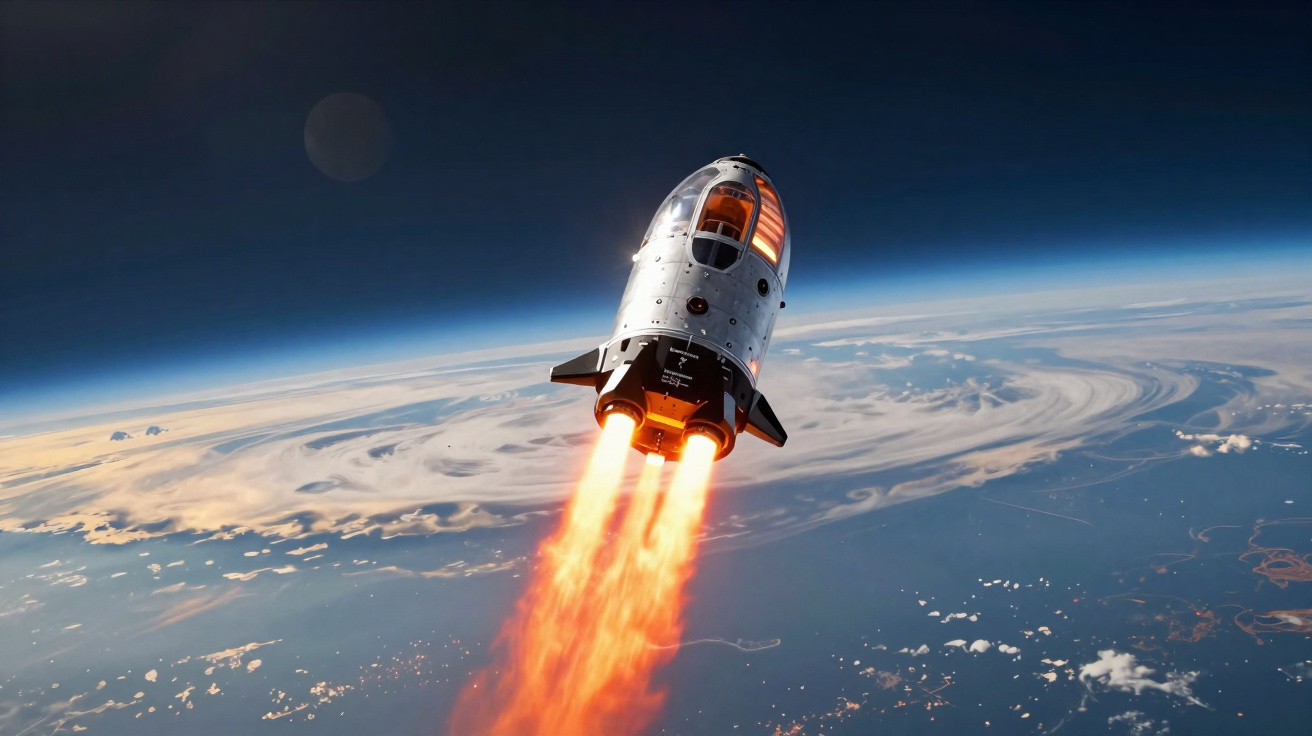
‘Integrity’ capsule to enter the atmosphere at nearly 40,000 km/h, surpassing the Apollo 10 record
The Orion spacecraft on the Artemis II mission, carrying astronauts Reid Wiseman, Victor Glover, Christina Koch and Jeremy Hansen, is nearing the end of its landmark journey following its lunar fly-by. The final phase of their 1,118,624-kilometre voyage - re-entry into Earth’s atmosphere - is the mission’s most hazardous and crucial stage.
At an altitude of roughly 120 km, Orion’s capsule, named Integrity, will enter the atmosphere at about 40,000 km/h, narrowly exceeding Apollo 10’s record of 39,937 km/h. That speed is comparable to travelling from New York to Tokyo in under 20 minutes. The capsule is due to splash down in the Pacific Ocean off the coast of San Diego at around 20:07 EDT on Friday, 10 April 2026 (03:07 Moscow time on 11 April 2026).
On 8 April, Orion carried out a trajectory correction manoeuvre. A 15-second engine burn changed its velocity by 50 cm/s, placing the spacecraft on the precise return path. NASA says that the USS John P. Murtha, which will recover the crew, has already left port and is heading for the splashdown zone.
Orion’s revised atmospheric re-entry profile
The capsule had originally been expected to re-enter using a ‘stone-skipping’ trajectory, gradually shedding speed. That approach was reconsidered after Orion’s heat shield developed unexpected cracks during the Artemis I mission. Integrity will now enter at a steeper angle, reducing the duration of exposure to extreme heat and easing the strain on the crew.
Orion’s heat shield has a titanium-aluminium base covered by 186 blocks of Avcoat composite material, each 3.8 cm thick. During re-entry, temperatures around the capsule will reach 2,760 °C, while a cloud of plasma will envelop it and temporarily interrupt communications with Earth.
Parachutes and crew recovery after splashdown
At 8,077 metres, the first parachutes will deploy, slowing the capsule from supersonic speed to 523 km/h. At 7,620 m, two 7-metre-diameter stabilising parachutes will open, followed at 2,896 m by the 35.3-metre-diameter main parachutes. These will reduce the speed to below 32 km/h for a safe splashdown.
The crew recovery operation will begin immediately after splashdown, with US Navy helicopters deployed two hours before the planned time. Rescue teams have already completed 12 rehearsal operations, including tests using a capsule mock-up.
The Artemis II crew will be the first people to return to Earth after a lunar fly-by since Apollo 17 in 1972. Their flight is paving the way for Artemis IV, planned for 2028, which is intended to land people on the Moon nearly 60 years after the last visit.
Further information on the capsule’s atmospheric re-entry and splashdown will be released as weather conditions are refined and the trajectory continues to be monitored.





Comments
No comments yet. Be the first to comment!
Leave a Comment