
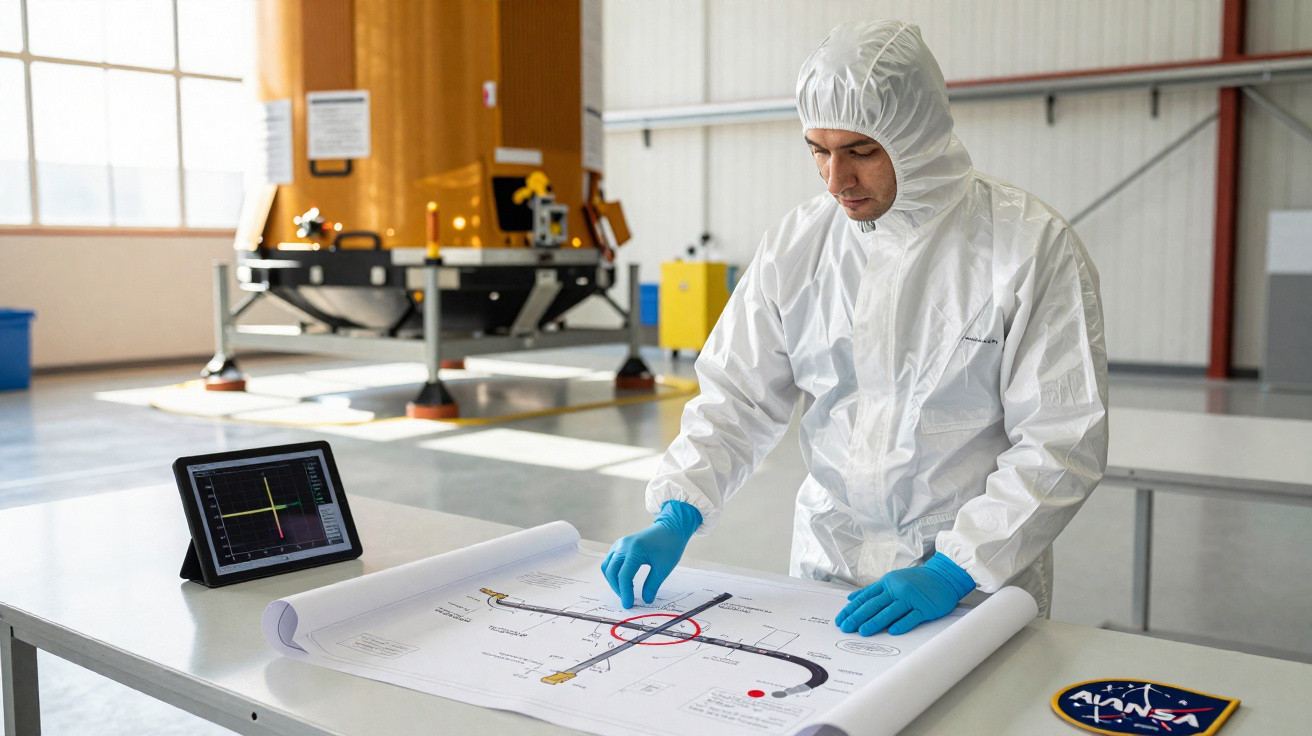
“Houston, we have a leak”
During the crewed Artemis 2 mission, which has sent people towards the Moon for the first time in decades, a helium leak has been detected in the Orion spacecraft’s propulsion system. The issue was identified on the journey back to Earth, although the mission itself is continuing almost exactly as planned.
The crew had originally been scheduled to carry out a demonstration of manual spacecraft control, but NASA chose to cancel that activity. The available time was instead used for further propulsion-system checks, allowing engineers to collect more data on the leak.
Artemis 2 helium leak in Orion’s propulsion system
Helium is used in Orion’s system to provide the pressure that forces propellant components through tanks and pipework to the engines. The fuel is hydrazine, while nitrogen tetroxide acts as the oxidiser. The leak developed in the circuit that supplies pressure to the oxidiser. It is occurring internally within the system, through the valves. Engineers need to establish its nature in order to determine whether the design will need altering for later missions.
The valves are located in the European-built service module. That module will be jettisoned before atmospheric re-entry and will burn up, while the crew will return to Earth in the crew capsule and splash down in the Pacific Ocean.
Flight performance and checks of the Orion valves
Despite the fault, the propulsion system is operating normally. Every engine firing has taken place without deviation, and the flight path has matched calculations so accurately that some planned correction manoeuvres have been cancelled. By the time Orion returns, it will have used only around 40% of its propellant.
Engineers had been aware of the possibility of a minor leak even before launch: a similar issue was recorded during the uncrewed Artemis 1 mission in 2022. At that point, the risk was judged acceptable because the current flight follows a “free-return” trajectory, in which the Moon’s gravity directs the spacecraft back towards Earth and the return journey should not require complex manoeuvres.
Once in flight, however, the leak proved to be roughly an order of magnitude greater than had been observed on the ground. It remains within acceptable limits, but NASA is already considering whether the valve design will require major modification.
The fact that the service module will not return to Earth makes matters more difficult, as engineers will be unable to inspect the valves directly. In place of the manual-control demonstration, specialists therefore carried out a series of tests, including checks of the effects of temperature and spacecraft orientation, such as when Orion turns towards the Sun.
What the Artemis 2 findings mean for future missions
Artemis 2 is primarily a test flight. It is Orion’s second launch into space and its first carrying a crew, so the mission’s central purpose is to gather as much data as possible on how the spacecraft’s systems perform in flight.
The results obtained will directly shape the programme’s next stages. Artemis 3 is currently planned for 2027 in Earth orbit, where Orion is expected to dock with commercial lunar modules. Artemis 4, scheduled for 2028, is intended to return people to the lunar surface for the first time since 1972. The valve issue must be resolved by then. NASA expects the modification will not take long and will be completed more quickly than the two-year investigation into heat-shield problems after Artemis 1.
Such faults are not unusual in space hardware: leaks and valve failures have also occurred in other programmes. In the case of Artemis 2, though, the situation remains under control, and the mission is fulfilling its primary role by providing engineers with real flight data on the spacecraft’s operation.






Comments
No comments yet. Be the first to comment!
Leave a Comment