
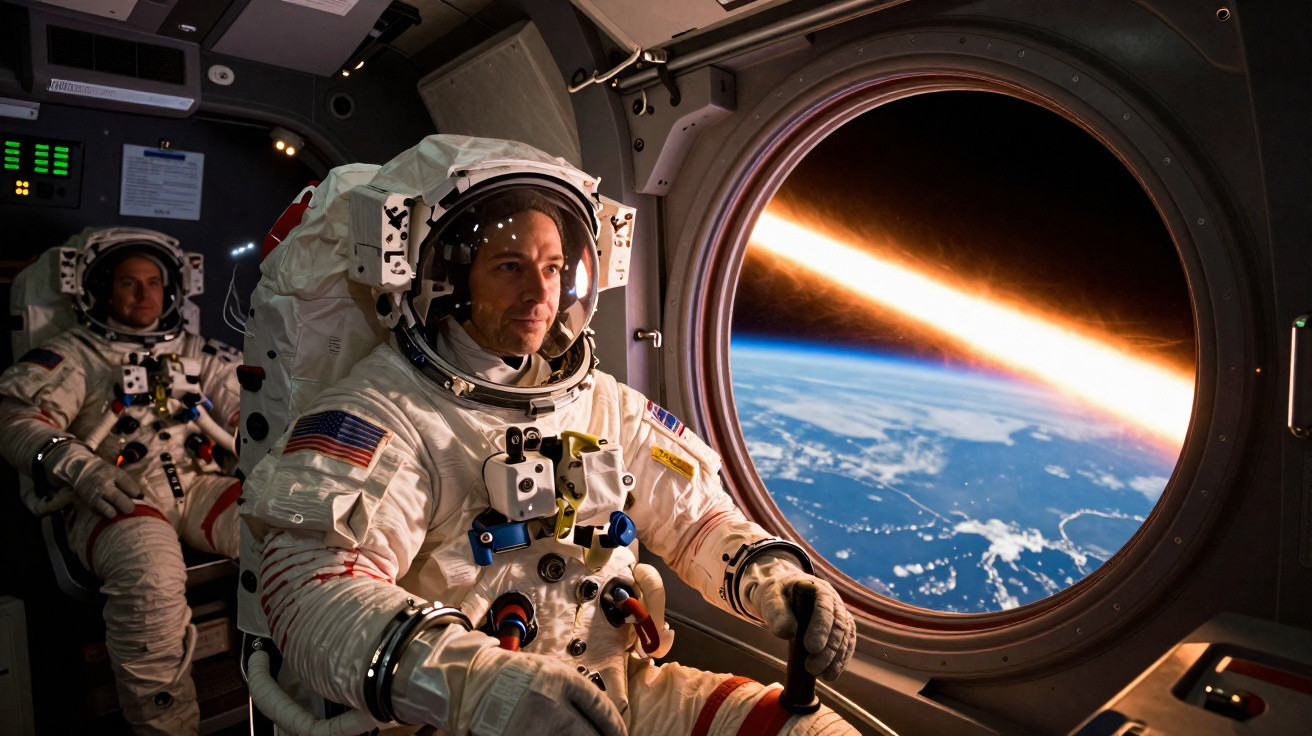
Orion capsule carrying crew enters the atmosphere after a lunar flight for the first time in 50 years - full return timeline
After a ten-day journey to the Moon and back, the Artemis II mission is reaching its final phase: the return to Earth. It is the first crewed lunar flyby in more than half a century, as well as the first test of the Orion spacecraft with people aboard. The capsule carrying four astronauts will splash down in the Pacific Ocean off the coast of California on 10 April.
The defining part of the mission is its final 13 minutes: atmospheric entry at almost 40,000 km/h, intense heat and a temporary communications blackout. NASA stresses that this stage will determine whether the entire mission succeeds. Every system, from life support to navigation, must perform without fault.
Preparing Orion for Earth re-entry
Landing preparations begin well before atmospheric entry. In the morning, the astronauts configure the spacecraft for landing by stowing equipment and checking its systems. Later in the day, they carry out the final trajectory correction manoeuvre, placing Orion precisely on course for its splashdown area. The crew then puts on its spacesuits and completes the final checklist.
An hour before entry, communications with the spacecraft are transferred to a satellite system. The critical sequence then begins: at 19:33, the crew module separates from the service module, which will burn up in the atmosphere; at 19:37, the capsule makes a brief manoeuvre to move away from it; and at 19:53, Orion enters the atmosphere at hypersonic speed.
At this point, the heat shield reaches around 2,760 °C and the crew experiences forces of up to 3.9 g. Contact with the spacecraft is lost for several minutes as plasma forms around it. Ten minutes after entry begins, the parachutes start deploying: first the drogues, followed by the main parachutes. They slow the capsule to a safe speed.
Artemis II splashdown and crew recovery
Splashdown takes place at 20:07 - the first time astronauts have returned from the Moon this way since 1972 (times are in GMT; splashdown will occur at 03:07 Moscow time the following day).
Immediately after landing, recovery teams will secure the capsule and remove the crew. The astronauts will be taken to a US Navy vessel, where they will undergo medical checks.
Artemis II return timeline (times in EDT/GMT)*
- 11:35 / 15:35: Crew wake-up. The final day in space begins.
- 13:50 / 17:50: Spacecraft preparation. Orion is switched to its Earth atmospheric-entry configuration.
- 14:53 / 18:53: RTC-3 manoeuvre and final trajectory correction.
- 17:05 / 21:05: The crew puts on its spacesuits.
- 18:30 / 22:30: NASA broadcast begins.
- 19:15 / 23:15: Communications channels are switched to NASA’s Tracking and Data Relay Satellite System (TDRSS).
- 19:33 / 23:33: Service module separation.
- 19:37 / 23:37: The capsule performs a short manoeuvre to move a safe distance away from the separated service module.
- 19:53 / 23:53: Atmospheric entry. The critical 13 minutes begin.
- 19:53–19:59: The spacecraft temporarily loses contact with Earth because of plasma generated during atmospheric entry.
- 20:03 / 00:03: Drogue parachutes deploy.
- 20:04 / 00:04: Main parachutes deploy.
- 20:07 / 00:07: The capsule splashes down in the ocean, completing the flight.
- 20:22 / 00:22: The crew progressively shuts down the spacecraft’s systems after landing.
- 21:06 / 01:06: Recovery teams remove the crew from the capsule after splashdown. The astronauts are taken to a US Navy vessel for medical checks.
22:30 / 02:30: NASA holds a final briefing to review the mission’s results.
Moscow time is 7 hours ahead of US Eastern Daylight Time (EDT).
The successful completion of Artemis II is an important step for the entire Artemis programme.




Comments
No comments yet. Be the first to comment!
Leave a Comment