
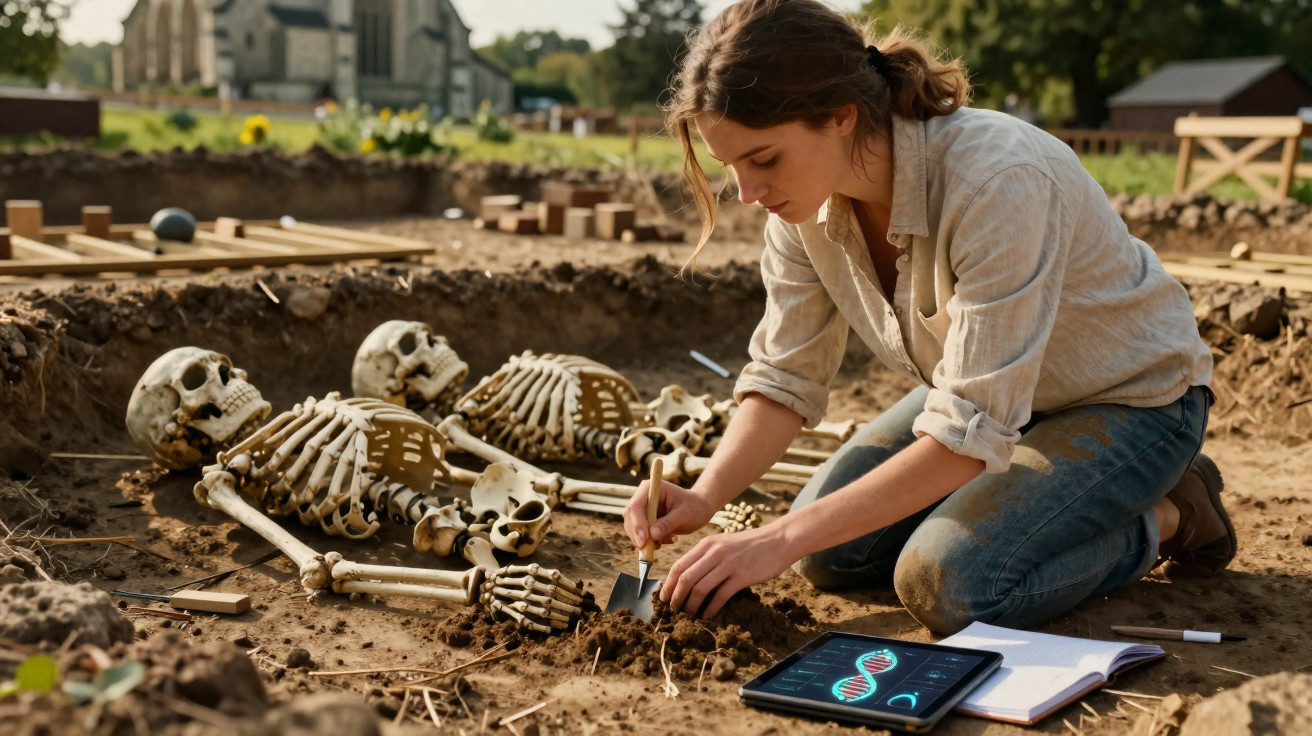
For roughly 800 years, two people lay side by side beside the walls of a Polish cathedral, their bodies arranged as though they were still sharing an embrace. A new ancient DNA study has now established that the two skeletons belonged to unrelated women, making the grave even more enigmatic.
Where were the embracing skeletons discovered?
The burial was uncovered during excavations carried out from 2022 to 2025 at the Cathedral of the Exaltation of the Holy Cross in Opole, Poland. The church dates back to the 13th century, and the grave was positioned close to its walls, an area regarded as prestigious in the Middle Ages and usually reserved for people of importance.
One woman had been laid on her back with her arms by her sides, in a conventional Christian burial position. The other was placed on her side, facing her, with one arm beneath the first woman's head. This deliberate arrangement led archaeologists to conclude that they were buried together, most likely during the same ceremony.
What did the DNA study establish?
Published in 2026 in the Journal of Archaeological Science: Reports, the study led by anthropologist Agata Cieślik examined genetic fragments that had survived in the remains. The researchers established that both individuals were biologically female and that they had no close genetic relationship.
The finding makes the grave the first known medieval double burial of people of the same genetically confirmed sex in Poland. It also demonstrates how skeletal appearance and body positioning can prompt premature conclusions, particularly when double graves are automatically assumed to contain a husband and wife.
How did scientists reconstruct such ancient DNA?
After centuries underground, genetic material breaks down into countless tiny pieces. Researcher Joanna Romeyer-Dherbey compared the task to rebuilding a book that has been torn into thousands of fragments. The team took samples from the bones, sequenced the surviving material and used computational tools to piece together sections of the genetic code.
To reduce the likelihood of mistaken interpretations, the analysis brought together several forms of evidence:
- DNA fragments preserved in the human remains
- Genetic markers associated with biological sex
- Comparisons used to identify kinship between the women
- Examination of the skeletons' original positions
- Archaeological study of the grave and the cathedral grounds
This combined approach was vital because DNA alone cannot reveal emotions, occupations or social ties. It can identify biological traits and family relationships, but the fuller story depends on the burial location, nearby objects, the positioning of the bodies and known funerary customs from that period.
Were the two women a couple?
Their embrace-like posture makes that interpretation tempting, but the researchers state that there is not enough evidence to define their relationship. They may have been friends, members of the same religious community, work companions or people connected through a form of social kinship despite having no blood ties.
The authors note that same-sex relationships were strongly condemned by medieval religious and legal authorities. If the women had been publicly regarded as lovers, it would be difficult to account for a burial so close to the cathedral. At the same time, this does not rule out an affectionate relationship kept secret, so the mystery remains unresolved.
Why does this embrace alter views of the Middle Ages?
The grave suggests that medieval relationships may have been more varied than official records reveal. The lack of evidence of punishment, decapitation or rituals intended to prevent the dead from returning also indicates that the women were not buried as feared figures. Instead, they were given a respected burial space together.
Further examination of coins, jewellery, pottery and other burials found in Opole may yet provide clues. Until then, easy answers should be avoided: DNA has revealed who they were not, but it has not explained why they were embraced in death. Following this investigation means watching science restore complexity to two lives almost erased by time.

Comments
No comments yet. Be the first to comment!
Leave a Comment