
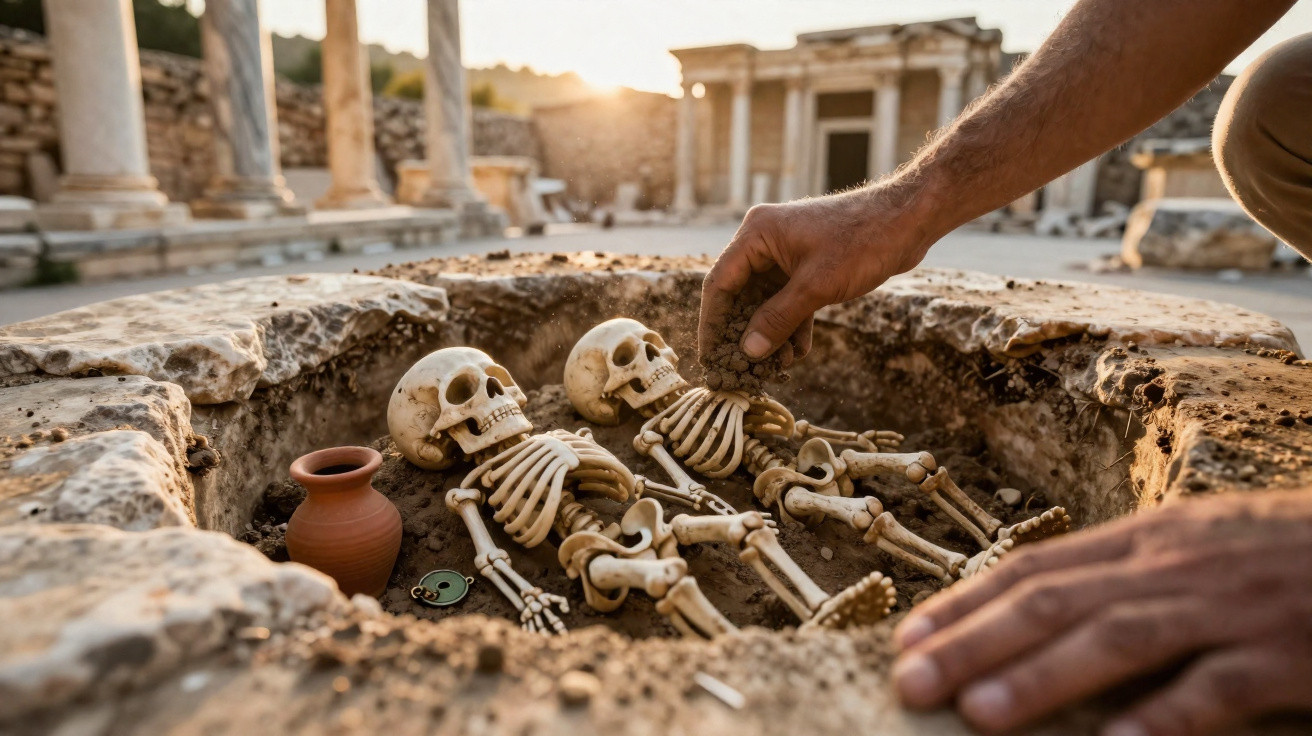
Two tiny skeletons, laid side by side in a stone-lined grave, remained concealed for around 1,200 years in an unexpected setting: the disused channel of an ancient latrine in Ephesus, Turkey. The find suggests the infants may have been premature twins and has revealed an even rarer feature: one had an extra rib.
Where were the two babies found?
The burial was discovered close to the sacred precinct of the Temple of Artemis, one of the Seven Wonders of the Ancient World. The grave lay inside the former latrine of a Roman odeon, a building used for musical performances. The structure had ceased to serve its original purpose centuries before the bodies were placed there.
According to Lilli Zabrana, an archaeologist at the Austrian Academy of Sciences, the grave’s location is highly unusual. Other known burials in Ephesus were concentrated in cemeteries beyond the temple area, whereas these infants had been carefully laid in a small stone-lined cist.
Why do researchers believe they may have been twins?
A study published in the journal Childhood in the Past estimated that the babies were born between the 33rd and 34th weeks of pregnancy. This assessment was based chiefly on the size and development of their bones, which matched those of premature infants who died close to the time of birth.
Caroline Partiot, a bioarchaeologist at the Austrian Academy of Sciences, said the skeletons were of very similar ages and had been buried in direct contact with one another. These signs support the possibility that they were twins, although only future DNA testing can establish whether they were biologically related.
What was unusual about one of the Ephesus skeletons?
During the examination, the team identified a supernumerary cervical rib: a small extra bone that develops in the neck region. This variation occurs in a small proportion of the population and often causes no symptoms in adults. In babies, however, it can be linked to changes that occurred during embryonic development.
- The skeletons belonged to premature babies;
- The bodies were laid side by side;
- One had an extra cervical rib;
- No obvious signs of trauma were found;
- Confirmation of kinship will depend on genetic analysis.
Partiot connected this feature with research into changes in Hox genes, which guide the development of different body parts. Earlier studies have indicated links between cervical ribs, prematurity and other complications. According to the authors, no comparable archaeological case involving possible twins had previously been recorded.
Why were they buried in a latrine?
The researchers suggest that the babies may have died before baptism, a circumstance that could have made burial in a formal Christian cemetery more difficult. Using the abandoned channel may have been a compromise between the religious rules of the time, local customs and the family’s wish to provide some protection for the bodies.
This explanation remains a hypothesis, however. No remains of the mother were found nearby, and archaeologists do not know whether she survived the birth. Maternal and infant mortality were high in the Byzantine period, but the grave alone cannot fully reconstruct the ordeal faced by that family.
The grave shows care amid loss
The stone-lined construction protected the skeletons for more than a millennium and demonstrates that they were not simply discarded. Zabrana notes that the arrangement of the grave points to a respectful burial. Despite their extremely brief presence in the community, the two babies were given a protected space of their own.
The discovery turns fragile bones into rare evidence of childhood, grief and religion in the Byzantine world. Genetic testing and further research may now clarify the relationship between the babies and their physical condition. Preserving this grave means safeguarding a human story that nearly vanished beneath the ruins of Ephesus.





Comments
No comments yet. Be the first to comment!
Leave a Comment