
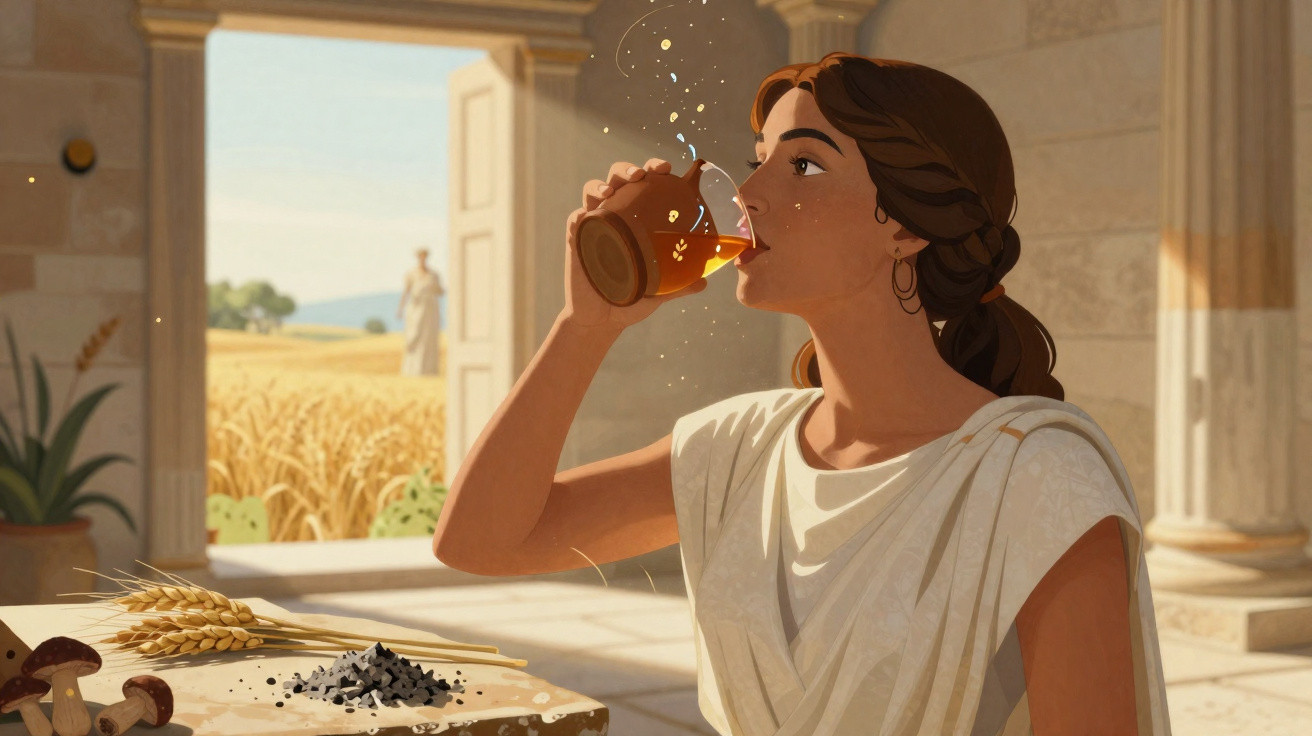
On the outskirts of Athens, a closely guarded ceremony promised to transform forever the way people viewed death.
For almost two millennia, the Eleusinian Mysteries brought together Greeks from every social class for an enigmatic nocturnal rite centred on a single sip of a sacred drink. A recent study has now revived a troubling yet compelling suspicion: part of this “spiritual revelation” may have come from a toxic fungus converted into a psychoactive substance.
The sanctuary where death seemed less frightening
Just a few kilometres from Athens, the sanctuary at Eleusis served as a kind of spiritual centre for ancient Greece. Each year, a procession departed from the capital along the Sacred Way towards this place of worship.
Free men, women, enslaved people and political figures walked together, an unusual sight in such a deeply stratified society. The promise was alluring: initiates would leave with a new understanding of the cycle of life and death.
Those being initiated fasted, underwent purification rites and took an absolute vow of silence about what occurred during the ceremony’s central stage. The heart of the mystery was never fully disclosed, not even by classical authors who had experienced it.
Ancient accounts repeatedly make one point: after the ritual, death seemed less frightening and life more bearable.
Greek and Roman philosophers wrote that initiation at Eleusis gave existence a new meaning. It was not merely a religious spectacle, but an experience described as an intimate change with a powerful emotional effect.
Kykeon, the unusual drink that may have changed everything
At the centre of the Eleusinian night was kykeon, a sacred drink. Its official recipe was straightforward: water, barley and mint. On their own, however, these ingredients do not explain visions, collective catharsis and such a profound shift in attitudes towards death.
Since the twentieth century, this inconsistency has fuelled a persistent theory: kykeon may have contained a concealed ingredient, known only to priestesses and protected as a religious state secret.
In 1978, some researchers proposed a candidate: ergot, a fungus that infects grains such as rye and barley. Centuries later, that same fungus was linked to the development of LSD. It produces alkaloids that can alter perception and induce visions and intense mental states.
Yet ergot presents a major problem. It is also notorious for causing ergotism, a severe poisoning that produced medieval outbreaks of gangrene, delirium and mass deaths. How could a successful cult lasting millennia have relied on something so dangerous?
A possible chemical method using ash and water
That difficulty began to be addressed by research published in February 2026 in the journal Scientific Reports, produced by a team from the National and Kapodistrian University of Athens in collaboration with European laboratories.
The scientists chose to test an idea raised decades earlier: what if the priestesses of Eleusis had learned empirically how to “tame” ergot?
The study shows that a simple alkaline treatment, using something as ordinary as wood ash and water, can drastically reduce the fungus’s toxicity.
In practical terms, the process converts ergot’s most dangerous molecules into compounds with a profile much closer to lysergic acid amide, a chemical relative of LSD. These substances act on brain receptors associated with perception, emotion and feelings of transcendence, but with a far lower risk of necrosis or fatal convulsions.
According to the authors, such treatment could have been carried out using materials available in ancient Greece, without sophisticated equipment. Ritual cookery, agricultural knowledge and generations of observing practical effects may gradually have produced a relatively stable method.
How much fungus would be needed for a “revelation”?
One key issue in the research is quantity. The experiments indicate that around one gram of treated ergot could be enough to produce noticeable psychoactive effects in one person.
On that basis, a controlled amount of fungus mixed into kykeon could have been consistent with distribution to thousands of initiates without causing an epidemic of poisoning. The agricultural setting of the Thriasian Plain, where Eleusis stood, also favoured localised ergot in crops, rather than the devastating outbreaks seen centuries later in northern Europe.
- Available resource: ergot found in barley and rye fields.
- Possible technique: alkaline treatment with water and wood ash.
- Likely aim: reduce the poison while retaining the psychoactive effect.
- Intended result: an intense ritual experience without high mortality.
Religion, chemistry and the body: a more permeable boundary
The research does not prove that ergot was genuinely used at Eleusis. So far, no chemical analysis has identified traces of the fungus at the sanctuary’s archaeological site. Instead, the study demonstrates that the procedure would have been technically possible with the knowledge and resources of that period.
This changes the tone of the debate. The fungus theory no longer appears to be purely modern fantasy, gaining practical grounding in experimental chemistry.
In this scenario, ancient religion ceases to be merely belief and metaphor, and comes to include the intelligent handling of substances capable of reshaping conscious experience.
What emerges is a more complex picture: prolonged fasting, intense expectation, a charged collective atmosphere, mythic narrative, the use of light and shadow and, finally, a drink with a controlled psychoactive effect. Together, these factors may have created the very concrete sensation of having “seen” the invisible structure of life and death.
Ancient accounts of the Mysteries speak less of chaotic hallucinations than of an ordered revelation, understood as contact with a profound truth. This corresponds with experiences now reported in clinical psychedelic studies conducted in guided settings: visions are accompanied by meaning rather than simply disconnected imagery.
From LSD to mystical experiences: modern parallels
Ergot’s importance does not end with antiquity. In the twentieth century, LSD was derived from it and became central to research on depression, death anxiety and trauma. In several such studies, patients describe something that remotely recalls what was said of Eleusis: a sense of reconciliation with mortality and with their own life story.
This does not mean the Mysteries can be “explained” by a molecule alone. It does, however, suggest that ancient societies may have discovered practical combinations of ritual, narrative and chemistry that science is now attempting to understand in laboratories.
Terms and concepts that help explain the debate
A few recurring terms in this discussion merit a brief explanation:
| Term | Meaning |
|---|---|
| Ergot | A fungus that attacks grains and produces alkaloids with toxic and psychoactive effects. |
| Ergotism | Ergot poisoning, involving convulsions, severe pain and the risk of gangrene and death. |
| Alkaline treatment | A chemical process using basic substances, such as water mixed with ash, to alter compounds. |
| Kykeon | The ritual drink of Eleusis, officially made from water, barley and mint. |
| Psychoactive | A substance that changes mood, perception or cognition by acting on the central nervous system. |
Risks, limits and contemporary lessons
Today, any association between religious rites and psychoactive substances raises warnings. Raw ergot is extremely dangerous. Attempting to recreate any “Eleusinian experience” at home is a recipe for disaster, because the margin between an active dose and a toxic one is narrow.
On the other hand, the research highlights something uncomfortable for modernity: ancient societies may have handled altered states of consciousness in more structured ways than is often assumed, using protocols, myths and trained figures to guide the experience.
For those following today’s debate on the therapeutic use of psychedelics, Eleusis offers a distant mirror. On one side, it shows the potential of certain substances to reshape people’s relationship with the fear of death. On the other, it is a reminder that such practices always carry biological, social and political risks when removed from controlled contexts.
Whatever the final answer about the Greek fungus, the recent study broadens the discussion of how chemistry, agriculture and spirituality developed side by side in antiquity - and how this history still resonates in laboratories, clinics and ethical debates today.






Comments
No comments yet. Be the first to comment!
Leave a Comment