
The noise starts early.
First comes your phone alarm, which does not even sound like an alarm: it is a notification from a meditation app. Then the family group posts a “GOOD MORNING” in capital letters, followed by a flood of stickers. Your email buzzes. The calendar beeps. Your banking app flags a suspicious purchase that you made yourself. Within less than 15 minutes of waking up, your brain has already completed an invisible marathon. You are still in your pyjamas, yet it feels as though you are late for everything. It is as if a constant, silent siren is blowing in your ear: hurry, reply, react. In this cloud of flashing signals, urgency is born, grows and takes over the day.
The siren effect: when everything feels urgent
There is a huge difference between something actually being urgent and merely seeming urgent. In notification-heavy environments, that boundary vanishes. Every phone vibration and every red number in the corner of an icon triggers a small internal alarm. Your body responds as though there is an emergency, even when it is only a meme in the work group. Gradually, this chain of minor alarms becomes a permanent state of alert. Your heart beats a little faster, your mind jumps from one window to another and your attention becomes fragmented. Nothing truly serious is happening, but it feels as though everything could blow up if you do not check it immediately.
Consider a simple example: you are working from home one afternoon and trying to concentrate on an important presentation. In 30 minutes, WhatsApp pings five times, your email sends three alerts, a delivery app offers a voucher, your bank recommends a new card and Instagram announces that “someone started a live”. Each interruption appears minor, but they add up. By the end of an hour, you have barely progressed with the main task and feel as if you have been putting out one fire after another. We have all had that moment when you look at the clock and think: “How is it already this late and I have done nothing?”. The urgency did not come from the clock; it came from the torrent of signals demanding your attention.
From the brain’s perspective, this is no exaggeration. Notifications use bright colours, distinctive sounds and vibrations designed to break through any bubble of concentration. They activate mechanisms associated with reward and the fear of missing something. A flashing icon can trigger the same anxiety pathway as a genuine deadline approaching. The pressure is not rational; it is sensory. A high volume of notifications, even when their content is trivial, creates a feeling of diffuse danger: something is happening, you need to look, you may be falling behind. Urgency therefore stops being a feature of the tasks themselves and becomes the atmosphere of the environment.
How to slow down without disappearing from the world
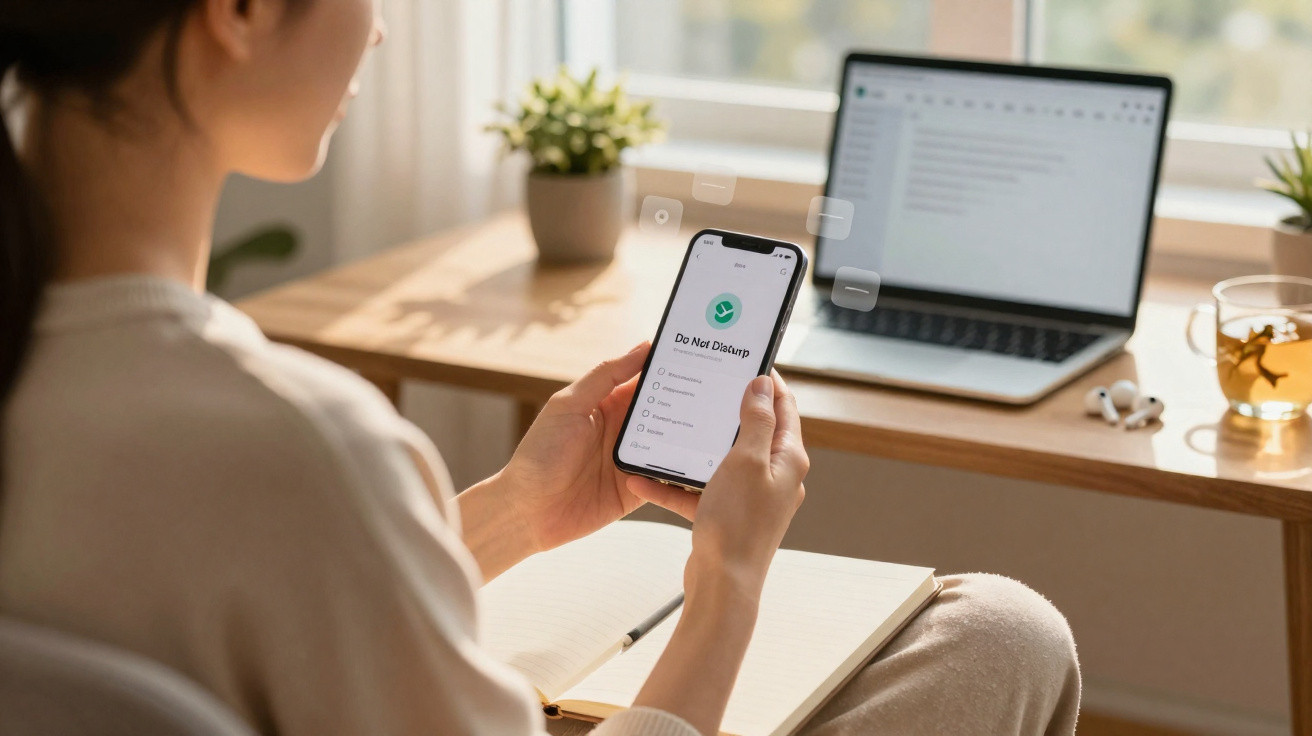
One practical way to reduce this sense of urgency is to create “islands of silence” throughout the day. You do not need to become a digital monk. Simply choose 30- or 45-minute blocks during which no notification is allowed through your mental door. That means turning off sounds, disabling vibrations and closing tempting tabs. It is not a radical move; it is almost an experiment: what happens if no one can nudge you through a screen for less than an hour? At the end of that time, you decide when to check everything at once. The order is reversed: rather than being interrupted constantly, you choose when to expose yourself to the stream of alerts. It may seem like a small change. For your brain, it is an enormous relief.
Many people feel guilty at the very thought of muting notifications, as though it signals a lack of commitment or consideration for others. Let us be honest: no one can respond to everything in the exact second it arrives, not even people who claim they can. Usually, the opposite happens. When someone tries to keep up with everything in real time, they spread themselves across ten conversations, forget important messages and reply quickly but badly. Urgency becomes a lifestyle rather than an exception. A common mistake is believing, “I can handle it, I just need to organise myself better”, when the problem is not only organisation but an environment that is shouting all the time. Adjusting notifications is not a luxury; it is mental hygiene.
As one digital behaviour researcher put it, “it was not the world that became more urgent, it was our alerts that became louder”.
A practical next step is to review notifications by category rather than individually. Ask yourself: what genuinely needs to interrupt me in real time? Personal emergencies? Critical work matters? Everything else can wait. A straightforward list can help:
- Notifications that interrupt: only what is genuinely urgent.
- Notifications that can build up: social media, promotions and newsletters.
- Notifications that can disappear: games and apps you do not even remember installing.
When you put each type of alert in its proper place, you send a quiet message to your own brain: not everything deserves siren status. Some things can simply knock and leave again.
Living with fewer alarms and more choice
When your environment is full of flashing signals, the feeling of urgency is not a character flaw; it is a logical response. No one remains calm in a room where ten doorbells ring intermittently all day. Change begins by noticing this without blaming yourself. Instead of thinking, “I am too anxious”, it may make more sense to think, “my environment is asking me to react all the time”. Small choices, such as muting the group that only shares jokes or reviewing an app’s permissions, create pockets of calm throughout your routine. This is not about escaping the world, but choosing the volume at which you want to hear it.
| Key point | Detail | Value for the reader |
|---|---|---|
| Notification-heavy environments create artificial urgency | The brain responds to sounds, colours and vibrations as though everything were a top priority | Helps explain why the day feels rushed even without many critical tasks |
| “Islands of silence” reduce the constant state of alert | Short blocks without interruptions restore focus and a feeling of control | Shows a simple way to reduce anxiety without becoming completely isolated |
| Filtering notifications by category changes your relationship with your phone | Decide what can interrupt, what can wait and what should be removed | Makes it possible to tailor the digital environment so it works for you rather than against you |
FAQ:
- Question 1 Why do I feel behind even when I start the day early? Because your brain enters response mode with the first notifications, jumping from one stimulus to the next. The sense of being behind comes from fragmented attention, not just the clock.
- Question 2 Will muting notifications make me miss important things? Not if you carefully choose what remains active. The idea is to keep genuine alerts, such as calls, and leave promotions, social media and non-urgent messages for set times.
- Question 3 I work on my phone all the time; can I still use this approach? Yes, by adapting the method. Rather than taking long periods offline, you can create very short interruption-free windows and use work-specific focus modes.
- Question 4 How many notifications a day are “too many”? There is no magic number, but if you notice that you can hardly finish a task without checking your phone several times, the volume has already gone beyond what is healthy.
- Question 5 What should I do if I feel anxious when my phone is on silent? Start with very short periods of 10 or 15 minutes, then gradually extend them. This adjustment takes time, and anxiety usually eases as you test it and realise that nothing falls apart.






Comments
No comments yet. Be the first to comment!
Leave a Comment