
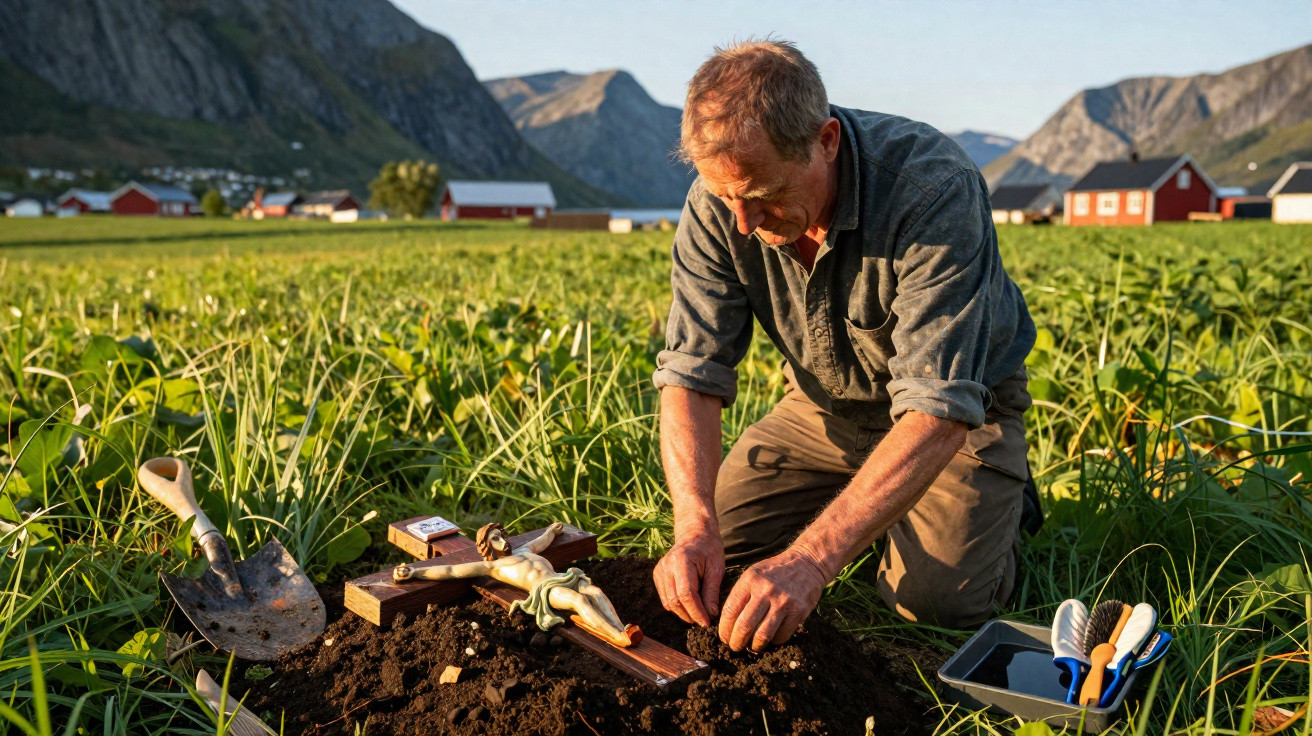
Minutes later, a small figure transformed how local people see their own landscape.
The story starts in a field that had been searched for hours, precisely the sort of place from which nobody expects a headline. What emerged there has prompted new questions about faith, memory and the long, complex religious past of rural Scandinavia.
A figure emerges from the soil after a long day
In Åndalsnes, a small town set between fjords and steep mountain slopes, metal detectorist Kim Erik Fylling Dybvik was nearly ready to stop for the day. He had covered the same furrows repeatedly, hearing the familiar mix of weak signals and disappointing finds.
As the light began to fade, his detector produced a crisp, powerful signal. He paused, removed a few centimetres of dark, recently turned soil, and noticed what seemed to be a small, solid form.
Resting in his hand was a bronze figurine about 15 centimetres tall, with outstretched arms and facial details still visible after centuries underground. Faint golden flashes remained on its face and torso. Soil marked the robe, but the figure itself was whole. It scarcely weighed anything, although the discovery carried real weight.
From a distance, the field looked like any other. Under the surface, it held a piece of medieval devotion, almost untouched by time.
Dybvik is familiar with this sensation. For more than eleven years, he has searched Norwegian fields with a detector, seeking to recover artefacts before ploughing and heavy equipment break them into pieces. His persistence now seems to have preserved one of the most unusual religious artefacts found in western Norway in recent years.
A medieval Jesus found in a modern field
Archaeologists soon confirmed Dybvik's suspicion. The figurine almost certainly belongs to the High Middle Ages, most likely dating from between 1100 and 1200. This was a pivotal era in Scandinavia: Christianity was established, while older beliefs continued to influence imagery and everyday rituals.
The object's design indicates that it was probably once attached to something larger. Experts at NTNU University Museum in Trondheim will examine the metal alloy, gilding and any evidence of fittings on its reverse and base.
Several possibilities are being considered:
- a figure fixed to a processional cross used during church festivals and funerals
- the main image on a compact portable altar carried by travelling clergy
- a private devotional object belonging to a prosperous farmer or local notable
The open arms and detailed shaping of the figurine resemble continental European art from the same period, pointing to accomplished workmanship and extensive cultural connections. Its preservation, however, was due more to fortune than artistic quality.
The statue lay just beneath plough depth. One badly timed pass with heavier machinery might have shattered it beyond recognition.
Historical layers beneath an ordinary Norwegian field
The Jesus figurine was not the first unexpected object from this land. Just days earlier, a Viking-age brooch had been recovered from the same field, extending the story of the site back by several more centuries. On the afternoon the statue was found, Dybvik and fellow detectorist Warren Schmidt had also uncovered silver coins and at least seven metal buttons.
Together, these scattered finds suggest activity continuing across a remarkably long span of time. Over centuries of change, people evidently travelled, traded, worshipped and worked in this place.
A lost religious landscape
Local historians had long suspected that some form of medieval worship existed nearby. Historical sources refer to a religious site in the area, yet no standing remains survived and the location gradually faded from regional archaeological research.
This latest find demands a reassessment. Officials now regard the field as a possible site for wider investigation, beginning with non-invasive methods. Ground-penetrating radar and magnetometry may identify buried walls, ditches or foundations without disturbing the ground.
| Clue | What it could indicate |
|---|---|
| Medieval Jesus figurine | Presence of a church, chapel or processional route |
| Viking-age brooch | Earlier settlement or burial, pre-dating full Christianisation |
| Silver coins | Trade connections, market activity or church offerings |
| Metal buttons | Everyday use of the field or nearby paths over several generations |
Should underground surveys reveal walls or rows of graves, archaeologists may seek permission for a full excavation. Farmland that farmers currently consider unremarkable could soon be recognised as an important medieval site in western Norway.
From a private hobby to shared heritage
Dybvik has told specialist publications that he places no commercial value on such discoveries. His straightforward principle is that anything with historical importance should be handed directly to the authorities. Norway's cultural heritage legislation supports this approach, regarding these artefacts as part of a collective national history.
The figurine has already been moved from Åndalsnes to the museum in Molde, before travelling onwards to Trondheim. Conservators there will stabilise the metal, measure microscopic remnants of gold and compare the Christ figure with related objects from across northern Europe.
In a few seconds, a quiet autumn hobby turned into a chain of events involving detectors, museums, laboratories and new research projects.
The case illustrates the distinctive relationship between amateur detectorists and professionals in Scandinavia. Where that co-operation functions well, routine walks across farmland can simultaneously support scholarly research, local identity and national museum collections.
Why small religious objects matter
One bronze figurine may appear insignificant beside ship burials or treasure hoards. Objects of this type, though, can answer entirely different questions.
They may reveal how faith travelled from stone churches into everyday lives, how craftspeople adopted ideas from faraway places, and how rural communities expressed belief where written evidence is incomplete. When such objects are recovered from properly documented sites, they help trace Christianity's spread beyond royal courts and major monasteries.
What the find means for Åndalsnes and its history
For Åndalsnes, the discovery is more than an intriguing headline. It indicates that land which now seems peripheral may once have stood within a religious and political network spanning fjords and mountain passes.
Schools, churches and tourism offices in the area now confront a familiar issue: to what extent should a community build its story around one striking discovery? Local residents often appreciate the attention, but archaeologists caution against creating grand narratives from limited proof.
Instead, they generally treat the statue as one piece of evidence among many. Alongside earlier studies of place names, isolated finds and church records, it may help revise maps of medieval routes, parish boundaries and zones of influence in this part of Norway.
How comparable discoveries emerge elsewhere
Across northern Europe, thousands of small religious artefacts remain just beneath plough level. When they come to light, the sequence is often similar:
- land is ploughed more deeply or more often than it was previously
- a farmer or detectorist notices an unusual glint or signal
- local museums are contacted to assess the context and date
- a formerly ordinary field begins to receive a different sort of scrutiny
Discoveries of this kind offer opportunities as well as dangers. They may deepen local connections to a place, encourage responsible cultural tourism and generate new research. Equally, they can attract looters or encourage exaggerated interpretations, particularly when social media turns every “miracle” found in the soil into a major story.
Looking beyond the headline of an “appearance”
The scene of a man leaning over a field and suddenly encountering a tiny Jesus figure is almost self-writing. It draws on powerful cultural patterns: the sacred appearing in ordinary surroundings, and the past disrupting daily labour. The truth is more technical, but no less remarkable.
The figurine did not appear through magic. It moved through trade networks, passed between artisans and clergy, crossed political frontiers and endured successive agricultural revolutions. That it lay only centimetres from destruction shows researchers just how vulnerable archaeological evidence remains, even in nations with robust legal protection.
For anyone using a detector, or simply walking over old farmland, the case provides a restrained lesson. A field feeding a family today may once have hosted a procession, a mass or a burial. A clear signal from the earth may indicate more than metal: it can offer a brief encounter with the customs, fears and hopes of people who crossed the same ground a thousand years ago.






Comments
No comments yet. Be the first to comment!
Leave a Comment