
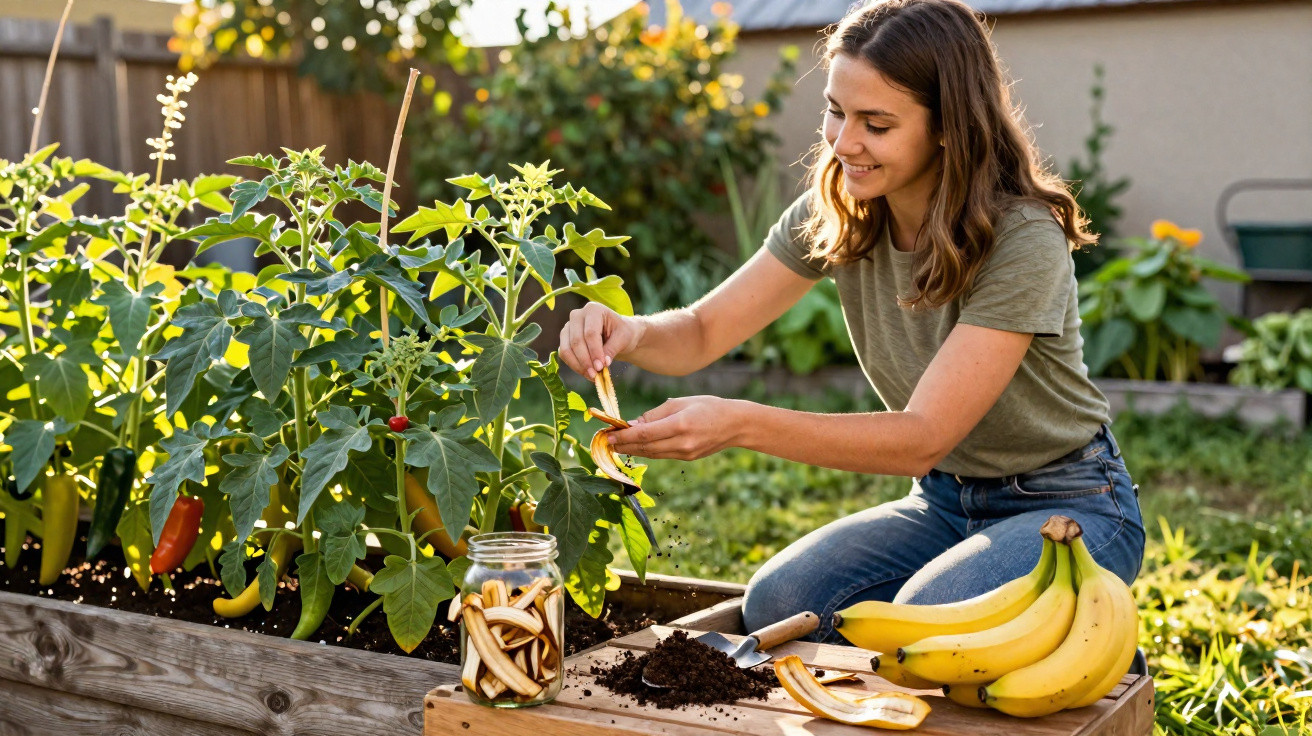
Every banana peel thrown into the bin discards a ready-made fertiliser that has been shown to improve plant and crop growth.
Research indicates that simply incorporating banana peels into soil can enhance plant health and development beyond what is seen in standard untreated conditions.
Bananas rank among the world’s leading fruit crops, with annual harvests of roughly 116 million tonnes in recent years.
As the peel accounts for one quarter of a banana’s weight, vast quantities of skins are discarded in household kitchen bins rather than reused as plant fertiliser.
Banana peels, plants, and soil
The recent review was led by Nokuthula Khanyile, a researcher at the University of Mpumalanga in South Africa.
Her work examines ways to convert agricultural waste, including banana peels, into safer fertilisers that benefit crops as well as soil organisms.
For the review, her team compiled findings from 126 studies investigating banana peel-based fertilisers across a wide range of crops.
In these experiments, plants treated with peel-based products frequently grew taller, developed more leaves or germinated more quickly than those cultivated in untreated soil.
Macronutrients and soil chemistry
Banana peels contain substantial quantities of macronutrients, the nutrients plants require in comparatively high amounts.
Chemical analysis has identified abundant potassium, alongside nitrogen, phosphorus, calcium and magnesium - the same elements farmers purchase in commercial fertiliser formulations.
At present, most banana peels are sent to landfill, where decomposing food waste contributes to greenhouse gas emissions while all these nutrients are lost.
Using the peels as fertiliser instead connects an everyday activity - eating bananas - with cleaner agriculture and reduced demand for newly mined or manufactured nutrients.
From kitchen scraps to biofertiliser
Researchers describe many peel-derived products as biofertilisers, meaning fertilisers produced from living or formerly living material.
Certain approaches are straightforward: peels can be dried in the sun, ground into a rough powder and incorporated directly into the soil before sowing.
The review repeatedly identified one formulation: fertiliser made by combining dried banana peels and dried orange peels. In the trials covered, this fruit-peel blend often improved leaf area and root length compared with untreated soils.
Other research groups blend fresh peels into a slurry, heat it with basic ingredients and then filter the mixture to create a concentrated fertiliser.
This liquid may be diluted with water and applied to soil, allowing plants to absorb its nutrients through their roots.
Some projects take the process further by fermenting banana peels with coffee grounds or other plant waste. Microbes gradually release nutrients into the liquid during fermentation, and early tests suggest that these fertilisers can accelerate the growth of leafy vegetables.
Testing banana peels on plants
In one pea-plant experiment, banana peels were allowed to decompose in soil for varying periods.
Peels broken down for approximately two months produced the strongest germination and growth, whereas longer decomposition weakened the plants.
The same research also examined peels decomposed in water rather than soil. These produced the highest germination rate after about six months, although plant height no longer improved with continued decomposition.
For fenugreek, researchers assessed dried banana peel powder against liquid extracts made from the same material. Over the same timeframe, plants receiving the liquid extract grew taller and yielded more greens than those treated with dry powder.
In okra trials, banana peel powders were mixed with other fruit peels and applied before planting, then added again later around the stems.
This application pattern resulted in deeper leaf colour, greater leaf area and heavier pods than soil receiving only conventional chemical fertiliser.
Implications for fertilisers
Contemporary agriculture remains strongly dependent on synthetic NPK fertilisers: factory-made blends of nitrogen, phosphorus and potassium that rely on fossil fuels.
Although these products have increased yields for decades, excessive use allows surplus nitrogen to run into waterways and cause eutrophication, an algal overgrowth that damages fish populations.
One worldwide assessment calculated that synthetic nitrogen fertilisers account for about 2 percent of all human greenhouse gas emissions. That is a considerable proportion for a single agricultural input, making any safe substitute for part of that nitrogen important.
The Environmental Protection Agency (EPA) has associated excess fertiliser nitrogen with smog, fine-particle pollution and unsafe nitrate concentrations in drinking water.
As banana peel-based fertilisers release nutrients gradually and use recycled waste, they could help reduce these losses while maintaining stable yields.
Gardening lessons from banana peels
For domestic gardeners and small-scale farms, the lesson is clear: banana peels, orange peels, coffee grounds and comparable scraps can become useful fertiliser with basic equipment rather than being thrown away.
The research also identifies a less effective option. Banana peel biochar, a charcoal-like soil amendment created by heating plant waste, often made little difference to plant height at the tested application rates.
Many reviewed trials ended during the seedling or early-growth phase. Long-term field studies are still required to track crops through to harvest and assess not only yield, but nutrient content and shelf life as well.
Banana peel chemistry varies according to variety, climate and storage conditions, meaning future studies must establish recipes farmers can rely on from one season to the next.
This requires measuring the nutrient content of fertilisers as well as the effects each formulation has on soil structure and root microbes.
If even a small share of the world’s banana peels were converted into thoroughly tested fertilisers, farmers could reduce their reliance on expensive synthetic products.
The latest research into kitchen-waste-based fertilisers indicates that part of a cleaner fertiliser future may already be waiting in compost caddies on kitchen worktops.






Comments
No comments yet. Be the first to comment!
Leave a Comment