
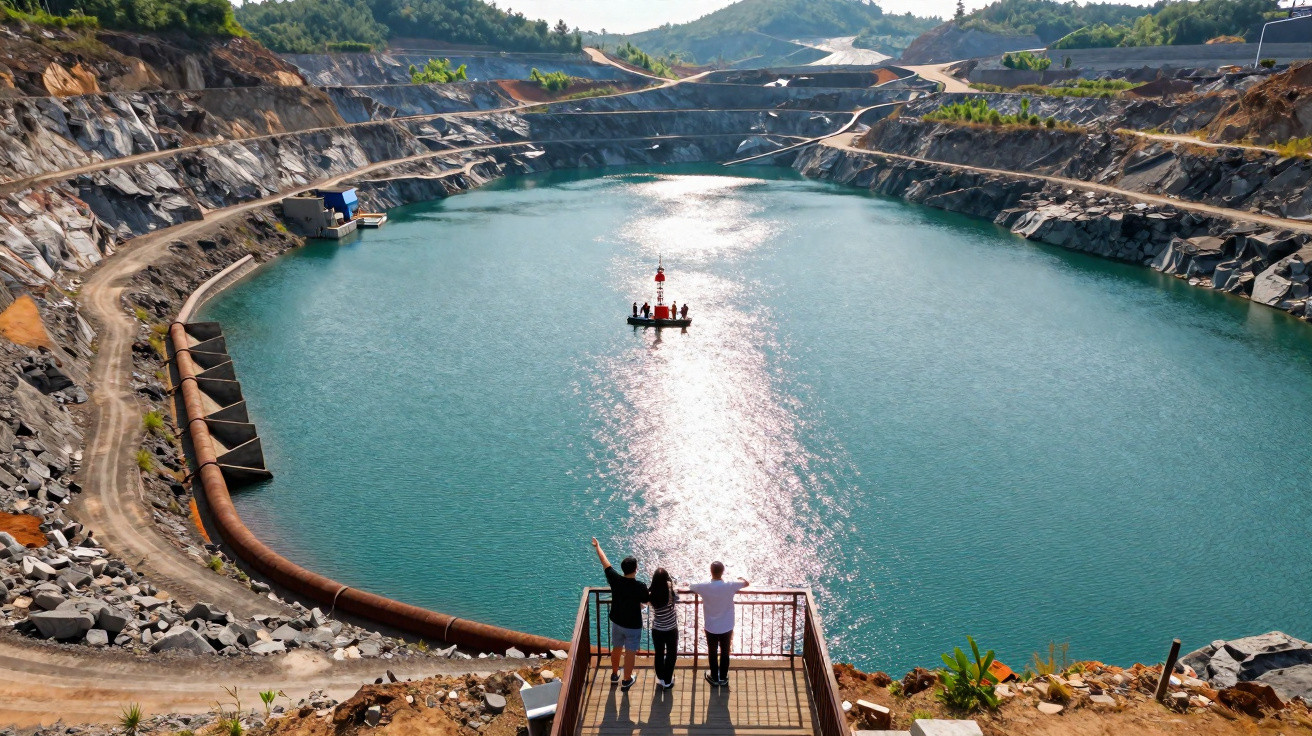
In Galicia, north-western Spain, an old lignite mine left behind an excavation more than 300 metres deep after decades of extraction. In January 2008, a vast environmental restoration scheme began: the void at the As Pontes mine was to be turned into a lake. By the time filling was completed in April 2012, roughly 547 billion litres of water occupied the former mining site.
How did such a deep mine become a lake?
Open-cast mining at As Pontes created an enormous pit. Between 1976 and 2007, approximately 261 million tonnes of lignite were extracted, while vast quantities of material were moved to reach the coal seams. Once operations ended, simply leaving a site of that scale abandoned was not considered an appropriate solution.
The selected approach was to flood the excavation in a controlled way and reconnect it to the region’s water system. Before filling began, studies assessed slope stability, water quality, available flow rates and the chemical behaviour expected in the future lake.
- Filling began in January 2008;
- The planned capacity was approximately 547 million cubic metres;
- The final surface area reached around 865 hectares;
- The lake has a perimeter of approximately 17.8 kilometres;
- The maximum water depth is around 200 metres.
Where did the 547 billion litres of water come from?
The project did not involve simply pumping water into the mine. Lake As Pontes was supplied by the River Eume, rainfall, surface run-off, groundwater and other catchments that had been altered by mining activity. The system was designed to manage both the rate of filling and the water’s chemical composition.
Why was water quality one of the greatest challenges?
Former mining areas can generate acidic water when minerals exposed by excavation come into contact with oxygen and water. At As Pontes, therefore, reaching a particular water level was not enough: it was necessary to forecast metal concentrations, sulphates, acidity and other characteristics before the lake began overflowing into nearby watercourses.
Monitoring revealed an interesting feature. The lake developed two water zones separated by what is known as a chemocline. The upper layer has oxygenated conditions and comparatively low acidity, whereas deeper water is more acidic and contains less oxygen. Even so, measurements of overflow water remained within the limits set out in the project.
- Water chemistry was monitored throughout the filling process;
- Models calculated how water from different sources would mix;
- The stability of the former mine slopes was also assessed;
- Watercourses diverted by mining were incorporated back into the system;
- Monitoring continued after the lake reached its final level.
Is the As Pontes lake really 300 metres deep?
The headline refers to the depth reached by the mine excavation, which exceeded 300 metres in certain areas. The lake formed within it is shallower: technical plans describe a depth of approximately 206 metres. With around 865 hectares and 547 cubic hectometres of water, Endesa describes it as Spain’s largest lake by volume and surface area among those created through this type of restoration.
What now stands where a coal mine operated for decades?
The conversion of the former As Pontes mine created a landscape radically different from the one left by mining. Alongside the vast body of water, restoration of the surrounding land has established vegetation, wildlife habitats, and areas for swimming and recreational activities. Surveys published by the company responsible for the project identified hundreds of plant and vertebrate species in the restored area.
The outcome does not erase the decades of change caused by lignite extraction, nor does it automatically turn a mine into a natural ecosystem. It does, however, demonstrate the scale that post-mining restoration can achieve: a huge industrial void received 547 billion litres of water in just over four years and became a permanent new feature of the Galician landscape, where one of Spain’s largest open-cast coal mines once stood.


Comments
No comments yet. Be the first to comment!
Leave a Comment