
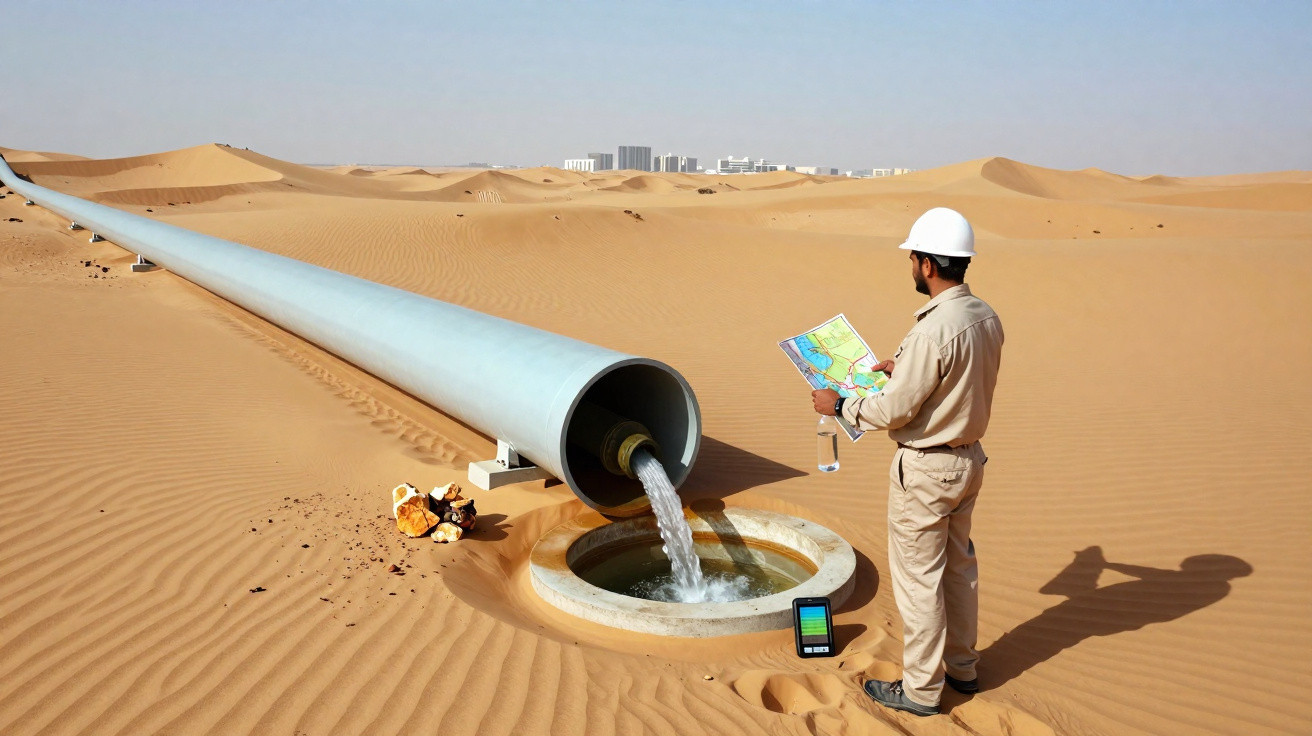
Beneath one of the driest landscapes on Earth lies a water reserve created when the Sahara bore little resemblance to today’s desert. Some of this water has remained cut off for around 40,000 years. It is now carried to Libyan cities and farmland through a vast network of pipes, yet there is a crucial issue: almost none of what is extracted is replenished.
What ancient water lies beneath the desert?
This reserve belongs to the Nubian Sandstone Aquifer System, an enormous underground formation beneath Libya, Egypt, Chad and Sudan. The International Atomic Energy Agency (IAEA) describes it as the world’s largest known fossil-water aquifer system, spanning roughly 2 million square kilometres.
NASA notes that geological changes can separate an aquifer from the sources that would usually recharge it. Radiocarbon dating has shown that some of the water found in Libya has been stored for about 40,000 years, dating back to before the end of the last ice age. Drawing on it today is much like uncovering a liquid reserve preserved since prehistory.
How did Nubian Sandstone Aquifer water reach Libya’s cities?
Major underground reserves were identified during oil exploration in the 1950s. Faced with water shortages in its most heavily populated regions, Libya chose to pump the water from the heart of the Sahara. Construction of the project known as the Great Man-Made River began in the 1980s, supported by an extensive network of wells and pipelines.
Its foundation stone was laid in 1984, and supplies began flowing at the start of the following decade. Water then travelled vast distances northwards to serve urban centres and agricultural schemes. Terra satellite images released by NASA in 2006 even captured reservoirs and irrigated fields linked to the use of this groundwater.
Why can this reserve not recover?
The key difference is timescale. Renewable aquifers can be replenished by rainfall and infiltration, even if the process is slow. In the Nubian Sandstone system, however, much of the supply is fossil water and lies outside the active hydrological cycle. The IAEA states that this share is ancient and non-renewable, meaning that extraction produces a real reduction in the available reserve.
Its scale is striking, but that does not remove the concern. The IAEA estimated that the system holds a volume equal to around 500 years of Nile River flow, and about 20 times the volume of North America’s Great Lakes. The agency itself likens its use to oil: it is a resource that can be exploited, but cannot simply be replaced afterwards.
- The aquifer extends beneath Libya, Egypt, Chad and Sudan.
- Some of Libya’s groundwater has been dated to approximately 40,000 years old.
- A large proportion of the reserve is fossil water and does not take part in the present-day recharge cycle.
- Exploitation must take account of impacts that may cross the borders of all four countries.
Watch the video shared by the YouTube channel Pandora BR, showing how Libya made great rivers run beneath the Sahara.
What did scientists discover when studying the aquifer?
In 2006, a project involving the IAEA, the United Nations Development Programme, the Global Environment Facility and UNESCO began investigating the system through isotope hydrology. This method examines naturally occurring forms of elements in water to trace its origin, underground routes, recharge rates and vulnerability.
Researchers also created a three-dimensional computer model able to simulate water movement and potential changes in water levels over time. The concern is not only determining how much water exists, but also understanding how extraction in one country may affect the others. In 2013, the four nations signed a joint aquifer management programme.
Could the hidden giant beneath the Sahara eventually run out?
The scientific answer requires caution, since establishing precisely how long the usable supply will last depends on pumping rates, water distribution and characteristics of the aquifer itself. Even so, the IAEA acknowledges that the system could ultimately be depleted, warning that increased abstraction without appropriate management threatens water quality, ecosystems and land across the region.
The Great Man-Made River turned a reserve hidden beneath the desert into water available for millions of human needs, but it also presented the region with a long-term decision. Every extraction uses up part of an inheritance formed thousands of years ago. Recognising that limit now is essential, because no engineering project can quickly create what nature took geological ages to store.





Comments
No comments yet. Be the first to comment!
Leave a Comment