
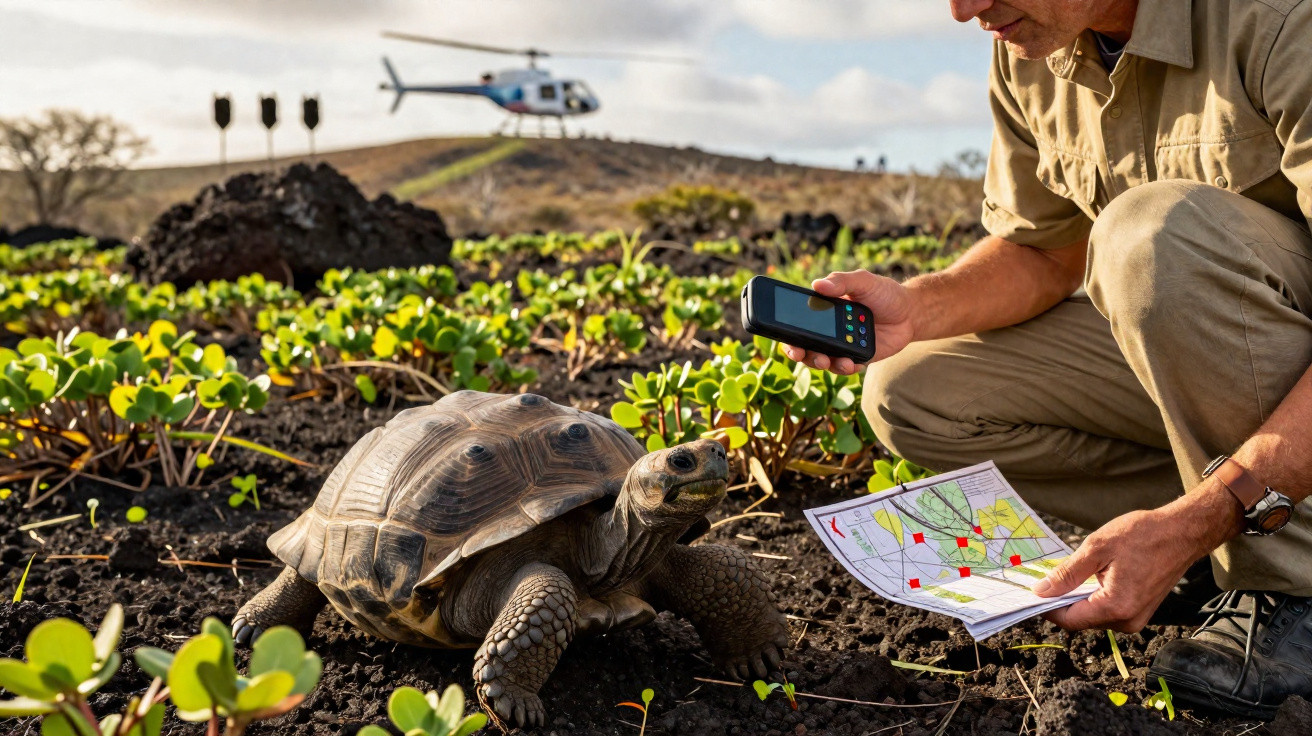
In the Galápagos Islands, one of the largest invasive-mammal eradication operations ever undertaken removed more than 140,000 goats that had been devastating native vegetation. The effects were also visible among the giant tortoises of Alcedo Volcano: young animals, which made up roughly 5% of tortoises recorded from 1995 to 1999, accounted for 24% between 2000 and 2005 - almost five times the previous share.
How did goats inflict such extensive damage on the Galápagos Islands?
Brought to the archipelago during the 19th century, goats multiplied in habitats that had not evolved under such heavy grazing pressure. They ate shrubs, saplings, cacti and trees, caused erosion, and directly competed for the food consumed by giant tortoises. On Alcedo Volcano, forests vital for providing shade and water during the dry season were destroyed.
- Goats ate native plants and saplings before they could grow.
- Overgrazing left areas of soil exposed to erosion.
- Giant tortoises had less food available.
- Trees that provided shade and helped retain moisture vanished from some locations.
- The degradation also affected endemic birds, insects and plants.
What was Project Isabela, and how did it remove more than 140,000 goats?
Project Isabela was planned from 1997 and completed in 2006 to remove introduced large mammals from Pinta, Santiago and northern Isabela. At the beginning of the programme, northern Isabela alone was estimated to hold around 100,000 goats. The operation combined ground hunters, helicopters, geographical tracking systems and continual monitoring.
The greatest difficulty came towards the end, when only a small number of animals remained scattered across vast, hard-to-reach areas. To locate them, teams used so-called “Judas goats”: sterilised goats fitted with transmitters were released because, as social animals, they sought out other goats. Operatives followed the signal to find concealed groups. Around 770 of these goats were used on Isabela.
Did young giant tortoises really increase fivefold?
The figure needs an important clarification: it does not mean researchers counted five times as many hatchlings across the whole of the Galápagos. On Alcedo Volcano, the proportion of juveniles among sampled tortoises rose from about 5% in the first phase of the campaign to 24% in the later phase. The study also found improvements in individual growth and body condition after goats and donkeys were removed.
- From 1995 to 1999, juveniles made up around 5% of sampled tortoises.
- From 2000 to 2005, their share reached approximately 24%.
- Young tortoises also showed improved growth rates.
- A comparison population on Santa Cruz showed no similar improvement over the same period.
Why did removing goats help giant tortoises so quickly?
Giant tortoises and goats competed for some of the same plant resources, but competition was only part of the issue. By removing trees and shrubs, the invaders changed how the habitat itself functioned. On Alcedo, highland vegetation helped capture the mist known as garúa, creating damp, shaded areas used by tortoises during the dry season.
Once grazing pressure declined, small tree trunks began to resprout, tree seedlings reappeared, and shrubs, Opuntia cacti and other native plants became more abundant. The study’s authors acknowledged that a rare climatic event also temporarily increased food availability, but the lack of an equivalent improvement in the Santa Cruz comparison population supported invasive-animal removal as the main explanation for the recovery recorded on Alcedo.
What does the recovery of the Galápagos Islands show about invasive species?
The Galápagos Islands case demonstrates that safeguarding a threatened species may require restoring the entire environment on which it relies. Project Isabela did not focus solely on tortoises: by removing invasive goats, pigs and donkeys from certain areas, it allowed natural processes to resume and enabled plants formerly confined to craters or protected enclosures to return to the landscape.
The shift from 5% to 24% in the proportion of young tortoises provides a concrete measure of this effect, but it is not the only outcome. The return of trees, shrubs, cacti and other species illustrates how an introduced population can reshape an entire ecosystem - and how its removal can make space for a recovery that continues years after the last invasive animal has disappeared.




Comments
No comments yet. Be the first to comment!
Leave a Comment