
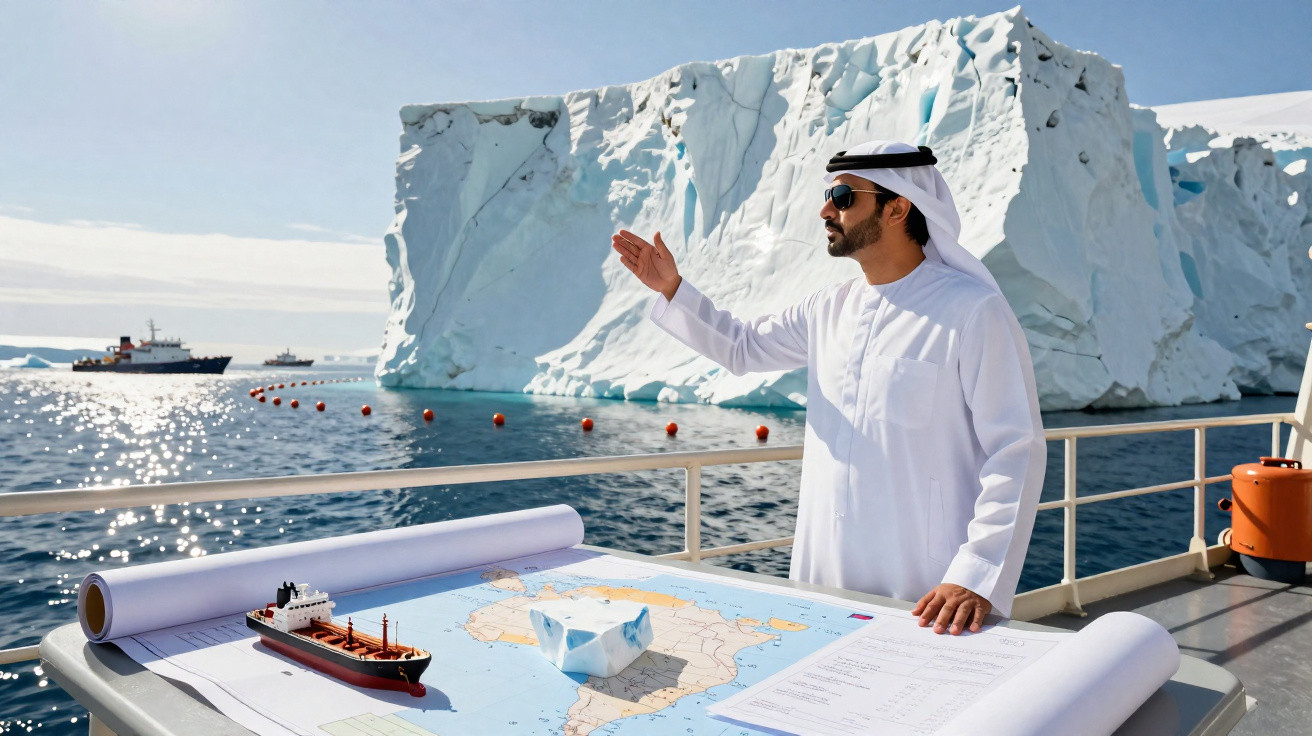
In 1977, Saudi Prince Mohammed Al-Faisal helped turn what appeared to be an impossible idea into a subject for scientific investigation: towing vast Antarctic icebergs to the Saudi Arabian coast, then melting them to provide fresh water. The proposal brought together engineers and glaciologists, transported a block of Alaskan ice to a university in the United States, and even envisaged icebergs weighing 100 million tonnes travelling across thousands of kilometres of ocean.
Why did Saudi Arabia want to tow an iceberg to the desert?
The challenge of securing fresh water lay at the heart of the scheme. Saudi Arabia was already investing heavily in desalination, yet Mohammed Al-Faisal believed that the enormous volumes of naturally calved Antarctic ice could offer an alternative supply. In a study published that year, he considered everything from where the icebergs should be sourced to methods of shielding them from melting on the journey.
The proposed scale was striking. The prince discussed bringing an iceberg of roughly 100 million tonnes close to the Saudi coast and using it as a source of drinking water.
- The iceberg would be chosen in the Antarctic region;
- Tugboats would pull the ice mass northwards;
- Insulating materials would limit melting en route;
- The block would be moored near a coastal area;
- Water created by melting would be collected for supply.
How did a piece of glacier reach the middle of Iowa in 1977?
Before any full-scale attempt could be considered, the organisers staged a far smaller demonstration. Around one tonne of ice taken from Alaska’s Portage Glacier travelled thousands of kilometres by several forms of transport to Ames, Iowa, in the United States. The block was delivered for the First International Conference on Iceberg Utilisation, held from 2 to 6 October 1977.
What did scientists need to solve before towing a mountain of ice?
The conference brought together about 175 researchers from several countries to address a problem far more complex than attaching a rope to an iceberg. They needed to understand its stability, determine the force required to move it, forecast ice loss, track its route by satellite, and prevent the mass from breaking apart during months at sea.
One proposal examined covering the sides and part of the underside with insulating material once the iceberg entered warmer waters. Even with this protection, the voyage from Antarctica to the Arabian Peninsula could have taken many months.
- Identifying a large block that was structurally stable;
- Calculating the towing force required;
- Preventing cables and mooring points from fracturing the ice;
- Restricting melting losses during the passage;
- Anticipating winds, ocean currents and route changes;
- Guiding an enormous mass without endangering shipping.
How much would it cost to transport an iceberg to Saudi Arabia?
At the time, one estimate put the research and engineering required for the first tow at around US$ 100 million, an immense sum in 1977. Mohammed Al-Faisal predicted that an iceberg could be producing water off the Saudi coast within three to five years. The central challenge was to prove that the volume of water delivered would justify the tugboats, insulation, losses during transit and all the infrastructure required at the destination.
- The ice would steadily lose mass throughout the journey;
- Tugboats would need to operate for months;
- Coastal infrastructure would have to collect the meltwater;
- A break-up could jeopardise the entire operation;
- Desalination was rapidly advancing as a competing alternative.
Why did the gigantic iceberg never reach the Saudi desert?
The Iowa experiment showed that ice could be moved over long distances on a small scale, but it did not demonstrate that an Antarctic iceberg could cross the ocean economically. Over the following years, technical obstacles, insufficient support and advances in desalination diminished interest in the plan. By the early 1980s, the initiative led by the prince had lost momentum, without the major tow ever taking place.
Although no mountain of ice was positioned beside the desert, the project became a distinctive episode in engineering history. Scientists examined towing speed, thermal insulation, iceberg shape, satellite monitoring and even the potential climatic effects of placing such a cold mass near the coast. Mohammed Al-Faisal’s ambition never supplied a Saudi city, but it revealed how far engineers were prepared to pursue a very simple question: if so much fresh water was already frozen in the ocean, could it be transported to where it was needed most?





Comments
No comments yet. Be the first to comment!
Leave a Comment