
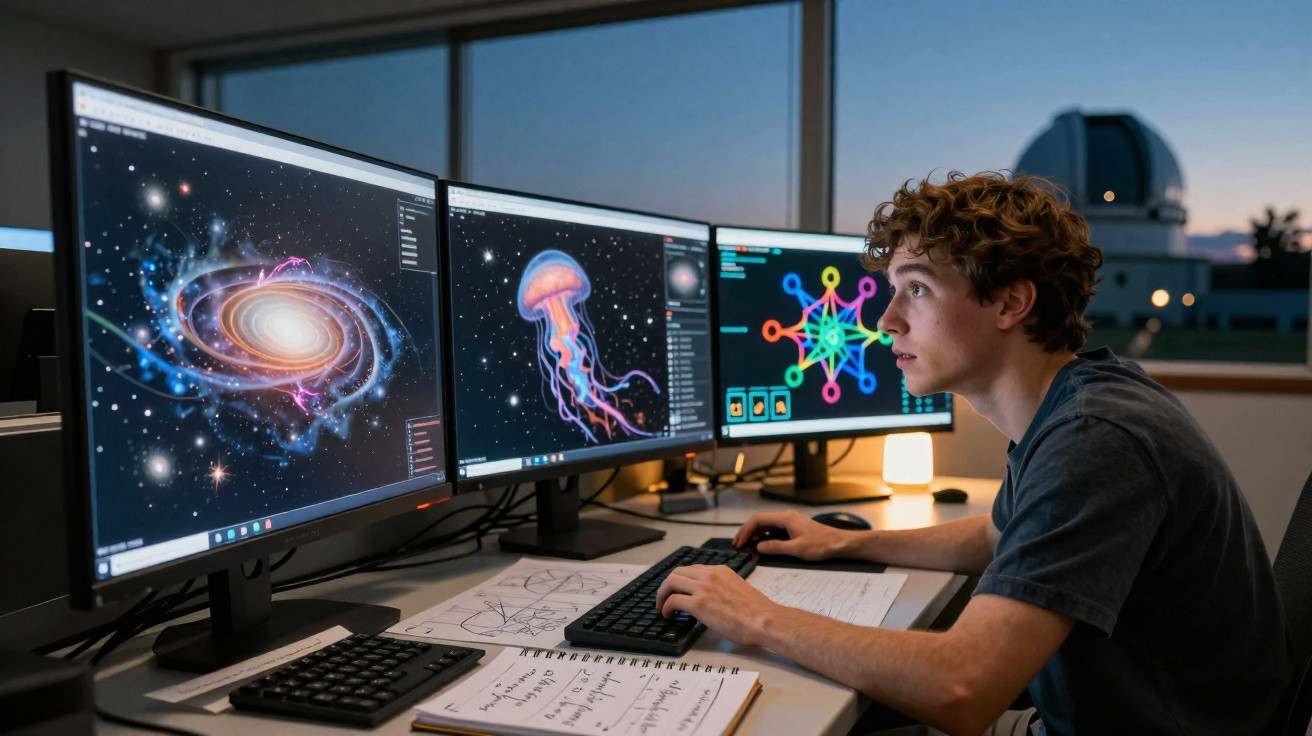
NASA’s Hubble Space Telescope archive has yielded more than 1,300 cosmic anomalies through the use of a powerful AI system, with over 800 of those objects previously unknown to science.
David O’Ryan and Pablo Gomez of ESA, the European Space Agency, describe the findings in Astronomy and Astrophysics.
“Archival observations from the Hubble Space Telescope now stretch back 35 years, providing a treasure trove of data in which astrophysical anomalies might be found,” says O’Ryan.
Astrophysical anomalies matter because, as outliers, they can reveal an unfamiliar aspect of nature. A suitably trained scientist may be able to spot such objects relatively easily, but the sheer volume of information gathered by modern astronomical telescopes makes this increasingly impractical.
The James Webb Space Telescope (JWST), for example, produces around 57 GB of data each day, depending on the observations scheduled.
Growing astronomical data from Hubble and new observatories
The Vera Rubin Observatory will greatly exceed that output. Equipped with the largest digital camera ever constructed, it is expected to create roughly 20 terabytes of raw data every night, requiring dedicated infrastructure simply to manage the volume.
With powerful facilities including the Giant Magellan Telescope and the Extremely Large Telescope due to begin operating soon, the amount of astronomical information requiring scientific examination is becoming a flood.
These enormous datasets are likely to contain many concealed surprises. Technology has advanced beyond the ability of human brains to process every observation, yet AI is increasingly able to match astronomy’s capacity for mass data generation.
“Astronomical archives contain vast quantities of unexplored data that potentially harbour rare and scientifically valuable cosmic phenomena,” the authors write.
“We leverage new semi-supervised methods to extract such objects from the Hubble Legacy Archive.”
AnomalyMatch searches the Hubble Legacy Archive
For their study, the team employed AnomalyMatch, a recently developed anomaly-detection framework, to examine nearly 100 million image cut-outs from the Hubble Legacy Archive, whose images span approximately 35 years.
AnomalyMatch is a neural network: a machine-learning system modelled on the human brain.
“AnomalyMatch is tailored for large-scale applications, efficiently processing predictions for ≈100 million images within three days on a single GPU,” the authors wrote in an earlier paper introducing the tool.
The system processed this enormous dataset in just 2 to 3 days, far less time than people would need. This marks the first systematic anomaly search of the Hubble Legacy Archive.
AnomalyMatch produced a shortlist of probable anomalies containing almost 1,400 unusual objects, a total that humans can assess far more readily.
O’Ryan and Gomez then inspected all 1,400 candidates by hand. They concluded that 1,300 were genuine anomalies and that more than 800 had not been documented before.
Gravitational lenses and rare galaxy anomalies
Merging and interacting galaxies were the most frequently identified anomaly class in the archive, accounting for 417 objects.
The researchers additionally identified 86 new possible gravitational lenses. These are valuable because they can make otherwise unobservable, highly distant objects accessible to astronomers.
They can also enable researchers to investigate how dark matter is distributed throughout the Universe, determine distances and cosmic expansion, and test general relativity.
“We identify many gravitational lenses that are already identified in the literature – but many candidate new lenses,” the authors write.
The archive contained other unusual objects as well. AnomalyMatch located rare examples such as jellyfish galaxies, which occur in galaxy clusters where ram pressure removes gas from a galaxy and leaves behind an extended tail illuminated by star formation. The archive included 35 of these.
The work also revealed anomalies whose nature remains uncertain. Among them is an unusual galaxy displaying a swirling core and open lobes.
Examining immense astronomical datasets is especially well suited to AI and is unlikely to be reproducible using human minds alone.
Beyond the anomalies already noted, the researchers found overlapping galaxies, clumpy galaxies, ring galaxies, and high-redshift galaxies lying so close to detection thresholds that they are hard to distinguish. They also detected jetted galaxies and galaxies hosting AGN.
Even if every astronomical observation ceased tomorrow, discoveries would not. Increasingly capable AI systems are set to become more powerful, while the enormous existing datasets from Hubble and other missions, including ESA’s Gaia, provide fertile material for future tools.
What else may be waiting within all those observations?
“This is a powerful demonstration of how AI can enhance the scientific return of archival datasets,” Gómez said.
“The discovery of so many previously undocumented anomalies in Hubble data underscores the tool’s potential for future surveys.”
This article was originally published by Universe Today. Read the original article.




Comments
No comments yet. Be the first to comment!
Leave a Comment