
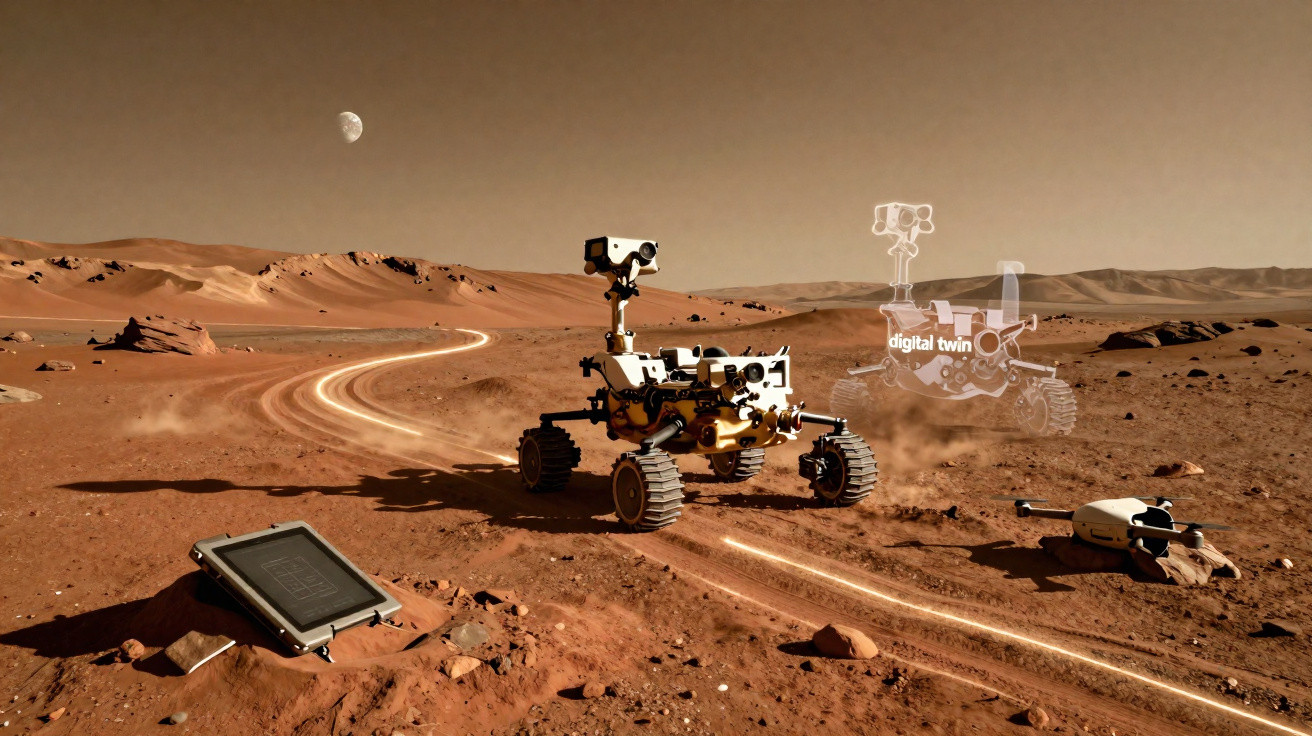
In December, NASA made a further modest advance towards autonomous surface rovers.
During a demonstration, the Perseverance team relied on AI to create the rover’s waypoints. On two different days, Perseverance followed those AI-produced waypoints and covered 456 metres (1,496 feet) in total without human control.
“This demonstration shows how far our capabilities have advanced and broadens how we will explore other worlds,” said NASA Administrator Jared Isaacman.
“Autonomous technologies like this can help missions to operate more efficiently, respond to challenging terrain, and increase science return as distance from Earth grows. It's a strong example of teams applying new technology carefully and responsibly in real operations.”
AI waypoints for the Perseverance rover
Mars is distant from Earth, with a round-trip communications delay of roughly 25 minutes. As a result, rovers must manage by themselves for brief intervals.
That delay determines how routes are planned. Rover drivers on Earth review images and elevation information before programming a sequence of waypoints, normally spaced no more than 100 metres (330 feet) apart.
The resulting driving plan is delivered to NASA’s Deep Space Network (DSN), which sends it to one of several orbiters. Those orbiters then relay the instructions to Perseverance.
For this test, the AI examined orbital photographs taken by the Mars Reconnaissance Orbiter’s HiRISE camera alongside digital elevation models. Built on Anthropic’s Claude AI, the system recognised hazards including sand traps, boulder fields, bedrock and rocky outcrops. It then produced a route made up of waypoints designed to steer clear of those dangers.
Perseverance’s auto-navigation system then assumed control. The rover has greater autonomy than earlier missions, enabling it to process images and driving plans while it is moving.
Testing autonomous navigation on Earth
Before the waypoints could be sent to Perseverance, the team had to complete another significant stage. NASA’s Jet Propulsion Laboratory maintains a Perseverance “twin”, known as the “Vehicle System Test Bed” (VSTB), in JPL’s Mars Yard.
This engineering model allows the team to address problems on Earth and to carry out work such as this demonstration. Such engineering versions are standard on Mars missions, and JPL also has one for Curiosity.
“The fundamental elements of generative AI are showing a lot of promise in streamlining the pillars of autonomous navigation for off-planet driving: perception (seeing the rocks and ripples), localization (knowing where we are), and planning and control (deciding and executing the safest path),” said Vandi Verma, a space roboticist at JPL and a member of the Perseverance engineering team.
“We are moving towards a day where generative AI and other smart tools will help our surface rovers handle kilometer-scale drives while minimizing operator workload, and flag interesting surface features for our science team by scouring huge volumes of rover images.”
AI is quickly becoming commonplace in everyday life, including in applications where its purpose is not necessarily compelling.
However, this is not a case of NASA simply joining the AI trend. The agency has had to develop automatic navigation systems for some time. Indeed, Perseverance primarily drives using its self-driving autonomous navigation system.
A key obstacle to completely autonomous travel is the growing uncertainty that develops when the rover operates without human help. The farther it drives, the less certain it becomes of its precise location on the Martian surface.
The answer is to re-localise the rover against its map. At present, people carry out that task. It is time-consuming, as it requires a full communications cycle between Earth and Mars, and ultimately restricts the distance Perseverance can travel without assistance.
AI’s future role in planetary exploration
NASA/JPL is also developing a method that would allow Perseverance to use AI for re-localisation. The principal challenge is matching orbital photographs with images captured by the rover at ground level. AI appears highly likely to be trained to perform this task particularly well.
It is clear that AI will take on a far bigger part in planetary exploration. The next Mars rover could differ greatly from today’s vehicles, incorporating more sophisticated autonomous navigation and additional AI capabilities. Concepts already exist for a rover to release a swarm of flying drones, extending its ability to explore Mars. AI would direct these swarms so they could cooperate and operate autonomously.
Mars is not the only destination where AI will prove useful. NASA’s Dragonfly mission to Titan, Saturn’s moon, will make extensive use of AI. As well as autonomous navigation while the rotorcraft flies, the mission will use it for autonomous data curation.
“Imagine intelligent systems not only on the ground at Earth, but also in edge applications in our rovers, helicopters, drones, and other surface elements trained with the collective wisdom of our NASA engineers, scientists, and astronauts,” said Matt Wallace, manager of JPL’s Exploration Systems Office.
“That is the game-changing technology we need to establish the infrastructure and systems required for a permanent human presence on the Moon and take the US to Mars and beyond.”
This article was originally published by Universe Today. Read the original article.




Comments
No comments yet. Be the first to comment!
Leave a Comment