
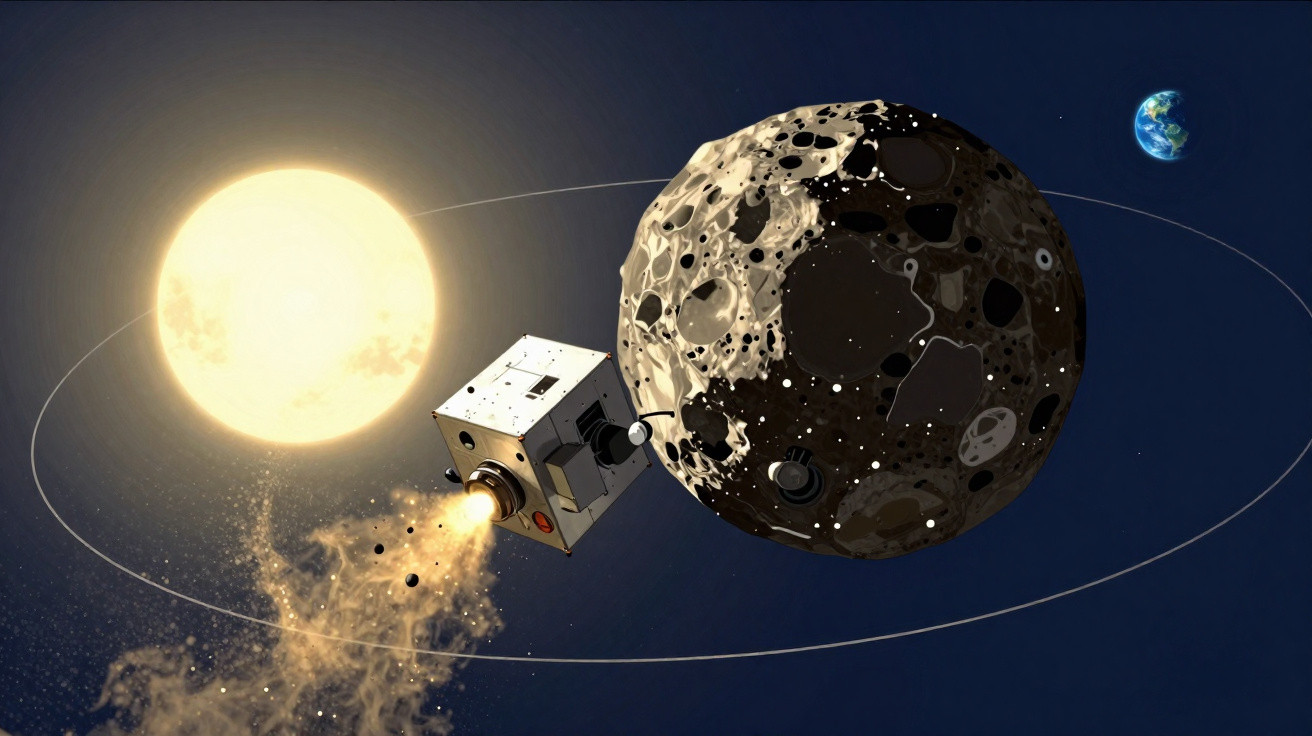
Nearly four years after the DART mission, scientists have found that the impact produced far greater effects than expected.
In 2022, NASA reached a landmark moment for its planetary defence programme, which had been established in the 1990s. For the first time, the US agency sought to alter an asteroid’s path through a controlled collision. The DART (Double Asteroid Redirection Test) mission involved sending a 610 kg spacecraft at high speed into Dimorphos, a small rocky body roughly 170 metres across that orbits the larger asteroid Didymos. On 26 September that year, the probe struck its target at more than 22,000 km/h, creating such a powerful impact that it was observed by the world’s largest ground-based telescopes.
Initial post-impact assessments had already confirmed DART’s success: Dimorphos’s orbit around Didymos, previously about 12 hours long, was shortened by 33 minutes, proving that an object’s orbit can be changed using kinetic energy. Dimorphos has remained under observation ever since, allowing scientists to better assess the impact’s consequences. A new study published in Science Advances on 6 March 2026 has now shown that the collision released enough energy to slightly alter the route followed by the Dimorphos-Didymos pair around the Sun, despite Didymos not being hit directly.
DART: the collision that changed the course of the Didymos system
Neither asteroid posed any danger to Earth, unlike, for instance, 2024 YR4, but they provided an ideal test environment. The smaller body, Dimorphos, circles the larger Didymos, which is 805 metres in diameter, giving scientists a fixed reference point from which to time the deflection to the nearest second.
When the spacecraft collided with Dimorphos, the energy released was estimated at around 11 gigajoules, equivalent to 2.5 to 3 tonnes of TNT. The asteroid’s surface was shattered, and between 1,000 and 10,000 tonnes of debris-dust and rocky fragments-were thrown out by the impact. Ejected into space in the direction opposite to the collision, this material generated an additional push on the asteroid, rather like the recoil from a cannon.
Debris amplified the DART impact on Dimorphos
This effect is known as the “momentum enhancement factor”. In this particular case, the factor was estimated at around two: material blasted from the asteroid boosted the collision, making it almost twice as effective as the spacecraft’s impact alone.
The new study’s data indicate that the vast volume of matter expelled by the collision did more than alter Dimorphos’s orbit around Didymos. As that debris escaped the binary system, it also carried away a small share of its energy and momentum. That imbalance was enough to change the asteroid pair’s speed through space by an infinitesimal amount.
According to the researchers’ calculations, the two bodies took around 770 days-approximately 2 years and 1 month-to complete an orbit around the Sun. Following the collision, that orbital period fell very slightly: it is now about 0.15 seconds shorter.
The Didymos-Dimorphos pair now travels slightly faster around the Sun
This may appear insignificant on the scale of the Universe, or for the paths of two asteroids of this size, yet the pair now circles the Sun marginally faster. The researchers calculate that the difference represents a speed increase of around 11.7 µm/s, or 0.00004212 km/h.
Although the change is extremely small, Rahil Makadia, a researcher at the University of Illinois Urbana-Champaign, says it could have major implications. “Over time, such a small change in an asteroid’s motion can make the difference between a dangerous object striking Earth and missing it entirely.”
For planetary defence specialists, this is excellent news. The latest research demonstrates that kinetic energy, when applied in the right place, is now one of our most convincing tools for diverting an asteroid or near-Earth object. Testing that proposition was precisely the purpose behind the DART mission, whose origins date back to 2011. The next stage for the Didymos-Dimorphos pair will be the European Hera mission, launched in October 2024 and expected to reach the system at the end of 2026, to closely examine the internal structure of both asteroids. The data collected will also enable scientists to measure Dimorphos’s exact mass-the missing element needed to fully assess the effectiveness of the DART impact and establish how far kinetic energy can be used to protect our planet.





Comments
No comments yet. Be the first to comment!
Leave a Comment