
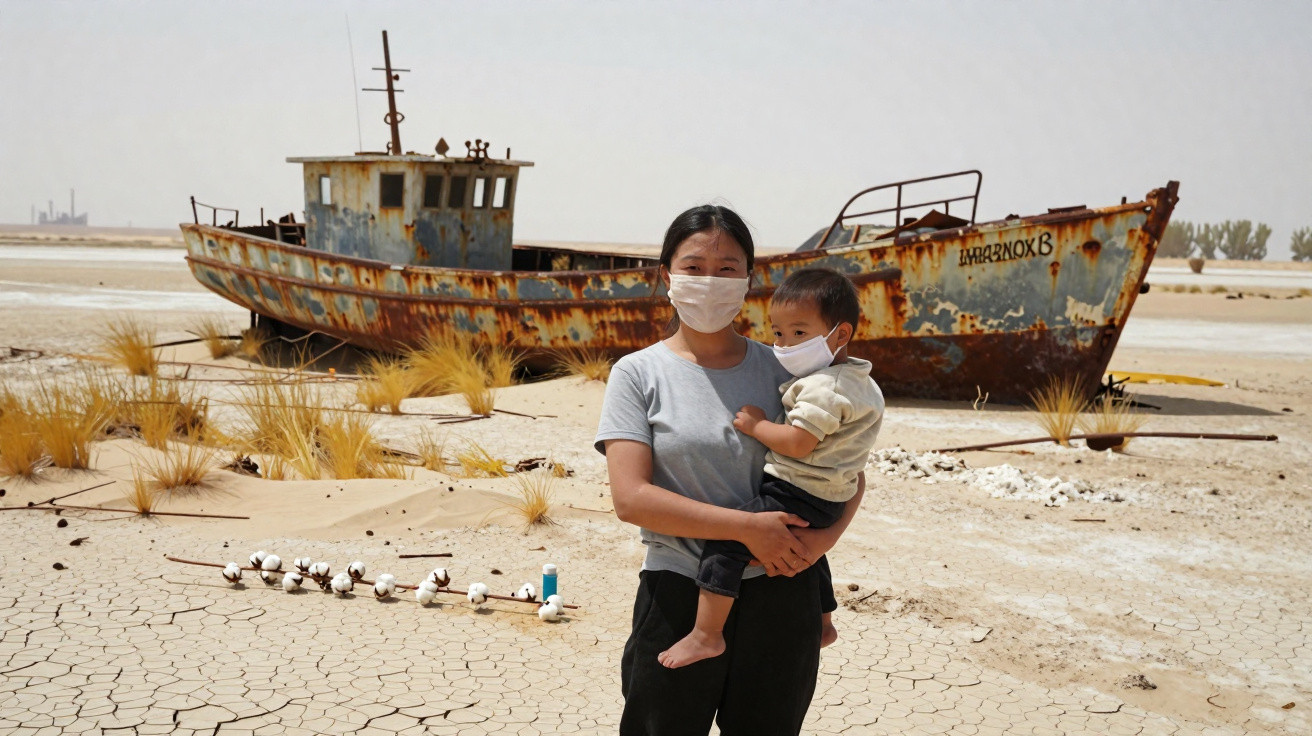
In Central Asia, a once-vast sea has been replaced by a contaminated desert whose winds still threaten local communities.
The Aral Sea disaster remains one of the clearest examples of human development causing lasting consequences. Within a few decades, an agricultural policy intended to increase cotton production transformed the landscape, local economy, public health and climate across a huge region.
A sea sacrificed for plantations
At the start of the 1960s, the Aral Sea was one of the world’s largest bodies of fresh water. Lying between Uzbekistan and Kazakhstan, it covered an area roughly equivalent to Belgium and the Netherlands combined. Its waters supported a major fishing industry and softened the harsh continental climate of this part of Central Asia.
Its fate changed when the Soviet authorities introduced an extensive irrigation programme. The aim was to greatly expand cotton cultivation in naturally arid areas. To supply the fields, engineers diverted water from the two major rivers that fed the sea: the Amu Darya and the Syr Darya.
Thousands of kilometres of canals were built, including the Karakum Canal. A substantial share of the water then leaked from poorly maintained infrastructure or passed through highly permeable ground. Gradually, the sea was no longer receiving enough inflow to offset evaporation.
“Deprived of its essential inflows, the Aral Sea has lost more than 90% of its volume since the 1960s.”
The retreat of the water was dramatic. Ports were left stranded dozens of kilometres from the shoreline. Boats once used for fishing now rust on dry, salty land. For residents, the sea’s disappearance did more than alter the scenery: it wiped out an entire economy.
The Aralkum Desert, an expanse laden with pollutants
As the water receded, it exposed a vast dried-up seabed. This newly formed area is known as the Aralkum Desert. It covers around 60,000 square kilometres, an area that did not exist only a few generations ago.
The threat comes not only from salt concentrated on the former seabed. For decades, cotton farms used large quantities of pesticides, herbicides and fertilisers. Run-off carried some of these substances into the Aral Sea.
Once the water vanished, it left these chemical residues mixed with salt and sediment. The resulting ground became extremely inhospitable to vegetation. Without adequate plant cover, particles can be easily picked up by the wind.
- Salts concentrated at the ground surface;
- Fertiliser residues from intensive farming;
- Traces of persistent plant-protection products;
- Fine sediments that gusts can readily carry away.
Ground that no longer protects residents
In a natural desert, sand can already be troublesome during storms. In the Aralkum, however, the problem has another dimension because the dust contains materials left by decades of agricultural activity. Gusts lift this mixture and spread it through the air breathed by villages near the former shoreline.
Residents experience episodes in which the horizon disappears behind a pale haze of dust and salt. These events can last for several hours. They make travel more difficult, disrupt crops and force some families to keep their doors and windows shut whenever possible.
43 million tonnes released into the atmosphere
Nearly 43 million tonnes of dust, salt and contaminated sediment are blown from the Aralkum each year. This figure illustrates the scale of the issue: it is not pollution confined to a dried-up former sea, but an atmospheric phenomenon extending far beyond the local area.
“Central Asian winds can carry dust from the former bed of the Aral Sea for thousands of kilometres, as far as the Himalayas or Scandinavia.”
The precise route varies according to the season, wind strength and upper-air currents. Nearby areas remain the most exposed, especially Uzbek and Kazakh territories close to the desert. Yet particles from this region have also been detected far beyond Central Asia.
Salt deposited on farmland creates an additional challenge. It steadily damages soils, lowers yields and leads some farmers to use more water in an effort to flush their plots. This response can perpetuate a difficult cycle in a region already affected by water scarcity.
Direct health effects
Fine dust irritates the eyes, nose and throat. For people with asthma, bronchitis or heart conditions, windy periods can worsen existing symptoms. Children and older people are among those most at risk.
Local doctors have long reported a high incidence of respiratory illnesses in areas closest to the former coast. Repeated exposure to salt and chemical residues also raises concerns about long-term effects. Drinking-water quality is another sensitive issue, as salinisation also affects groundwater and the supply networks used by some communities.
| Consequence | Observed or feared effect |
|---|---|
| Salty dust | Irritation, coughing and respiratory problems |
| Agricultural pollutants | Chronic exposure to chemical residues |
| Soil salinisation | Reduced agricultural fertility |
| Disappearance of the body of water | Greater temperature extremes |
A profoundly altered regional climate
A large body of water acts as a thermal regulator. It absorbs some heat during warm periods and releases this energy slowly as temperatures fall. By disappearing, the Aral Sea removed this natural balance from neighbouring territories.
Summers have become drier and hotter, while winters can be colder. This wider temperature range affects crops, livestock and residents’ living conditions. Drought periods also leave soils even more susceptible to wind erosion.
Limited restoration efforts
Measures have been taken to save a northern section of the former sea in Kazakhstan. Building a dam has made it possible to retain more water in the northern basin and to improve fishing conditions locally. This progress remains limited when set against the scale of the southern basin’s disappearance.
Planting shrubs suited to saline soils is also among the responses considered for the Aralkum. The principle is straightforward: stabilise sediment to reduce the amount of dust carried by the wind. This approach requires time, resources and sustained co-ordination among the countries concerned.
The history of the Aral Sea shows how an agricultural project can permanently reshape an area when it disregards the limits of water resources. In this region, cotton brought income and infrastructure, but its intensive irrigation created a health, climate and economic legacy whose effects residents still experience every day.





Comments
No comments yet. Be the first to comment!
Leave a Comment