
In south-eastern Spain, a prehistoric jewellery hoard contains two pieces whose origin reshapes the local history of metals.
At first glance, the Treasure of Villena appears to be an extraordinary collection of valuable artefacts. Yet, among its gold, silver and amber, two small items have puzzled specialists for many years. Their composition has now been established: they were made from iron that fell from the sky, long before ironworking became widespread on the Iberian Peninsula.
A treasure uncovered near Villena in 1963
The story began in 1963 during foundation work near Villena, in the province of Alicante. An engineer discovered a buried assemblage of 66 objects, dated to the late Bronze Age, between roughly 1400 and 1200 BCE.
The hoard is now held by Villena Archaeological Museum. It mainly consists of vessels, bracelets, ornaments and jewellery made from precious metals. The amount of gold is remarkable for the period: the treasure contains almost ten kilograms of it. Silver objects and amber beads complete the group, which was probably associated with a local elite.
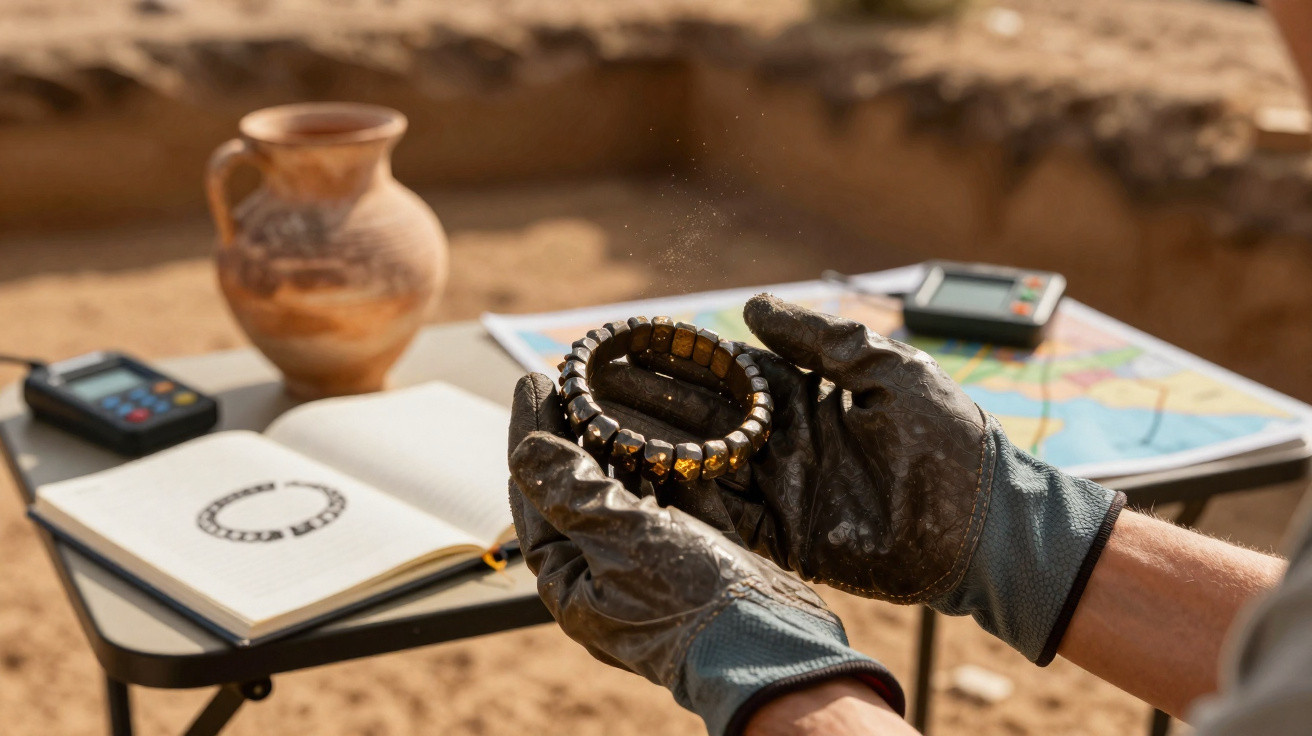
Two artefacts, however, stood apart from the rest. One is an iron bracelet measuring about 8.5 centimetres across; the other is a small hollow, hemispherical piece, probably used as a decorative fitting.
“These two objects do not come from ore extracted in the region: their metal belongs to a meteorite that fell to Earth.”
Nickel identifies the metal’s celestial origin
For decades, the iron artefacts were catalogued as unusual elements within the hoard. Their presence raised an obvious question: how could Bronze Age craftspeople have worked this material when iron derived from mines was still exceptionally rare and difficult to produce?
A research team led by Salvador Rovira-Llorens examined their chemical composition. In particular, the specialists investigated the proportion of nickel in the metal. This element is a dependable clue, since metallic meteorites commonly contain a natural iron-nickel alloy.
The findings match that profile. The bracelet and small hemisphere have nickel levels inconsistent with the terrestrial iron normally used at the time. They therefore appear to be the first identified objects made from meteoritic iron on the Iberian Peninsula.
- The bracelet was formed by hammering, demonstrating skilled and precise metalworking.
- The hemisphere has a smooth, gleaming surface that was carefully polished.
- Thanks to its distinctive composition and relative resistance to corrosion, the iron retains its appearance more effectively.
- Both pieces date from an age in which bronze still dominated weapons, tools and personal adornment.
A rare material before the arrival of forges
Meteoritic iron held a special status in ancient societies. At that time, communities knew how to make bronze by combining copper and tin. They had not yet broadly mastered the methods required to extract iron from ore, a process demanding high temperatures and complex expertise.
When a metallic meteorite was found, it offered material that could be used directly, although it remained difficult to shape. It must also have seemed remarkable: harder than gold, unlike bronze, lustrous when polished and perhaps connected with the sky in contemporary beliefs.
“Before forging techniques became widespread, a meteorite fragment could be worth far more than a simple raw material: it became a mark of prestige.”
The Villena craftspeople did not, of course, know that they were handling a piece from the core of a small celestial body. Even so, they recognised the unusual value of this metal. The decision to turn it into ornaments rather than tools suggests ceremonial or symbolic use, or use restricted to a powerful group.
A clue to trade around the Mediterranean
This identification also transforms the interpretation of the deposit. The Treasure of Villena is not merely a concentration of wealth buried three millennia ago. It points to a society capable of gathering rare materials, working them and giving them considerable social value.
Two possibilities remain. A local community may have recovered a meteorite that fell in the area. The alternative involves exchange networks. The peoples of the Iberian Peninsula were already trading with other Mediterranean regions. Indeed, the amber in the hoard shows that materials from far away travelled over very long distances.
The iron from space may therefore have passed through many hands before reaching Villena. Its limited quantity supports this view: it was not a metal used in everyday manufacture, but an exceptional material reserved for a few selected objects.
The precedent of Tutankhamun’s dagger
The Spanish case is not unique. The best-known ancient example remains the dagger found in the tomb of the Egyptian pharaoh Tutankhamun. Its blade also contained a high level of nickel, a characteristic of meteoritic iron.
These artefacts demonstrate that several civilisations used fragments that had fallen from the sky at different times. They do not prove that a vast, organised meteorite trade existed. Instead, they illustrate the lasting fascination exerted by rare, visible materials that were difficult to acquire.
| Observed feature | What it indicates |
|---|---|
| High nickel content | A probable meteoritic origin |
| Dating between 1400 and 1200 BCE | Manufacture before terrestrial iron became commonly used |
| Personal adornments | Use associated with prestige or ritual |
| Hoard of gold, silver and amber | A concentration of rare wealth in one place |
Why meteoritic iron withstands time better
A metallic meteorite is often composed of a natural iron-nickel alloy. Nickel does not make an object indestructible, but it can alter the way it reacts to oxidation. This is one reason why Villena’s two pieces have retained an appearance distinct from that of other ancient metal fragments.
This resistance does not account for everything. The way the artefacts were buried, the moisture of the soil and conservation conditions after their discovery also matter greatly. Laboratory analysis therefore remains essential: appearance alone can never establish that a metal came from a meteorite.
At Villena, two small elements can now tell a much broader story: one of craftspeople able to work an exceptionally rare material, leaders seeking to display their status, and a prehistoric hoard in which earthly gold already sat alongside a fragment of the sky.




Comments
No comments yet. Be the first to comment!
Leave a Comment