
By Horacio Hernández Otaño
Argentina has claimed sovereignty over the Malvinas, the extended continental shelf and the resources contained within it since 1833, continuously and under governments of every political persuasion. Yet sovereignty is not merely a formal declaration: it is the practical ability to exercise authority over what is claimed as one’s own - to monitor it, make decisions about it and, if necessary, defend it using one’s own assets. Where a claim exists without the operational capacity to underpin it, sovereignty stops being a fact and instead becomes what Aristotle called an entelechy: a potentiality that is never realised, a form that never becomes an act. Put less classically, it is declared sovereignty without effective control.
Argentina’s sovereignty and defence planning
This is not a philosophical exercise. It is a question that the current National Defence planning process can no longer sidestep.
The gap is literal rather than metaphorical. Decree 1.729/2007 stipulated that the National Defence Planning Cycle begins with a National Defence Policy Directive (DPDN), which the Executive must issue in September of the first year of each term. Decree 1.112/2024 itself - issued by the current administration in December of that year - acknowledged that the cycle needed renewal: its transitional provisions instructed the Ministry of Defence to draft a new DPDN and a new Planning Cycle to replace the 2007 framework. Twenty months later, neither has been made public; in practice, the previous administration’s 2021 DPDN remains in force. Without its own DPDN, the new cycle cannot be completed: it cannot generate the Military Strategic Assessment, the Military Strategic Directive or the medium- and long-term plans that should follow from them.
That omission represents both a difficulty and an opportunity. It is a difficulty because, in the meantime, the armed forces operate without a directive from this administration that clearly defines employment scenarios and the Joint Chiefs of Staff’s investment priorities. It is also an opportunity, because the document still unwritten can incorporate something no previous administration - regardless of its political alignment - has ever given the prominence it deserves: an explicit strategic assessment of the living and non-living resources over which Argentina claims sovereignty.
The extended continental shelf and Argentina’s OPVs
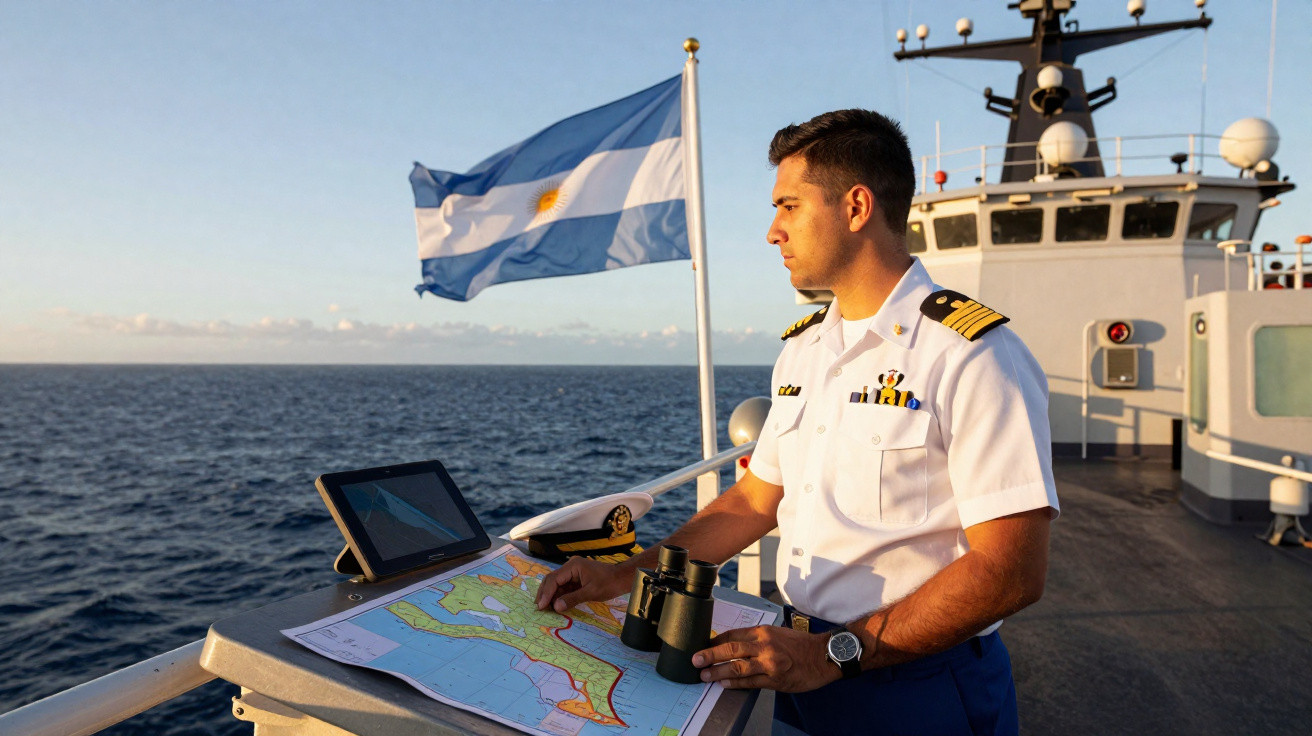
The clearest example is not what is absent, but what is already in place. In 2016, the UN Commission on the Limits of the Continental Shelf issued recommendations allowing Argentina to establish the outer limits of much of its continental shelf beyond 200 nautical miles. This added around 1.78 million km² of maritime area subject to its sovereign rights over the seabed and subsoil - hydrocarbons, minerals and sedentary species - an area comparable in size to a substantial part of Argentina’s continental territory. Between 2019 and 2022, meanwhile, the Argentine Navy received four Gowind 90-class offshore patrol vessels (OPVs) - ARA Bouchard, Piedrabuena, Almirante Storni and Contraalmirante Cordero - under Decree 1.078/2018, representing an investment of €319 million and each offering a range of 7,500 nautical miles. It is worth being precise about their nature: a 30 mm Leonardo gun and two 12.7 mm weapons, with no anti-ship missiles, area air defence or dedicated anti-submarine warfare (ASW) capability. They are not combat vessels; they are a suitable tool for situational awareness and an effective state presence across a maritime area - precisely what is needed to exercise a sovereignty claim on a day-to-day basis. The means to control maritime spaces already exists. The OPVs sail and carry out policing and state-presence roles. What does not exist is the document that places this tactical patrolling within a national defence strategy capable of turning presence into deterrence, while expressly prioritising the protection of this 1.78 million km² asset.
The issue is not confined to the sea: the same question can be asked of other recently acquired capabilities, including the F-16s purchased from Denmark - which employment scenarios, deriving from which political guidance, justify bringing them back into service?
The same pattern - a declared claim, an installed or available capability, and no directive linking the two - is repeated across other strategic resources and spaces: lithium, rare earths, the living marine resources of mile 201 and the Malvinas, over which the Argentine state exercises or claims rights, jurisdiction or sovereignty, depending on the case. However, the sea is the most developed case because the presence capability has already been established. The inter-agency coordination mechanisms enabled by Decree 1.112/2024 - the National Defence Council (CODENA) and its Secretariat (SECODENA) - are in place. There is no public evidence that they have been convened to produce an integrated assessment of these resources and spaces. The law is not what is missing. What is missing is the call to convene them.
What the next DPDN must establish
For that reason, the next DPDN - when it finally emerges - should not be viewed as simply another overdue administrative procedure. It will test whether the sovereignty Argentina declares every day will, for the first time, have the operational counterpart needed to exercise and sustain it effectively: an assessment identifying what is to be defended, a directive giving it priority, and an allocation of assets - many of which have largely already been acquired - explicitly intended to support it. Should that document once again describe sovereignty without connecting it to any specific procedure, the entelechy will not be rectified: it will be signed into effect.






Comments
No comments yet. Be the first to comment!
Leave a Comment