
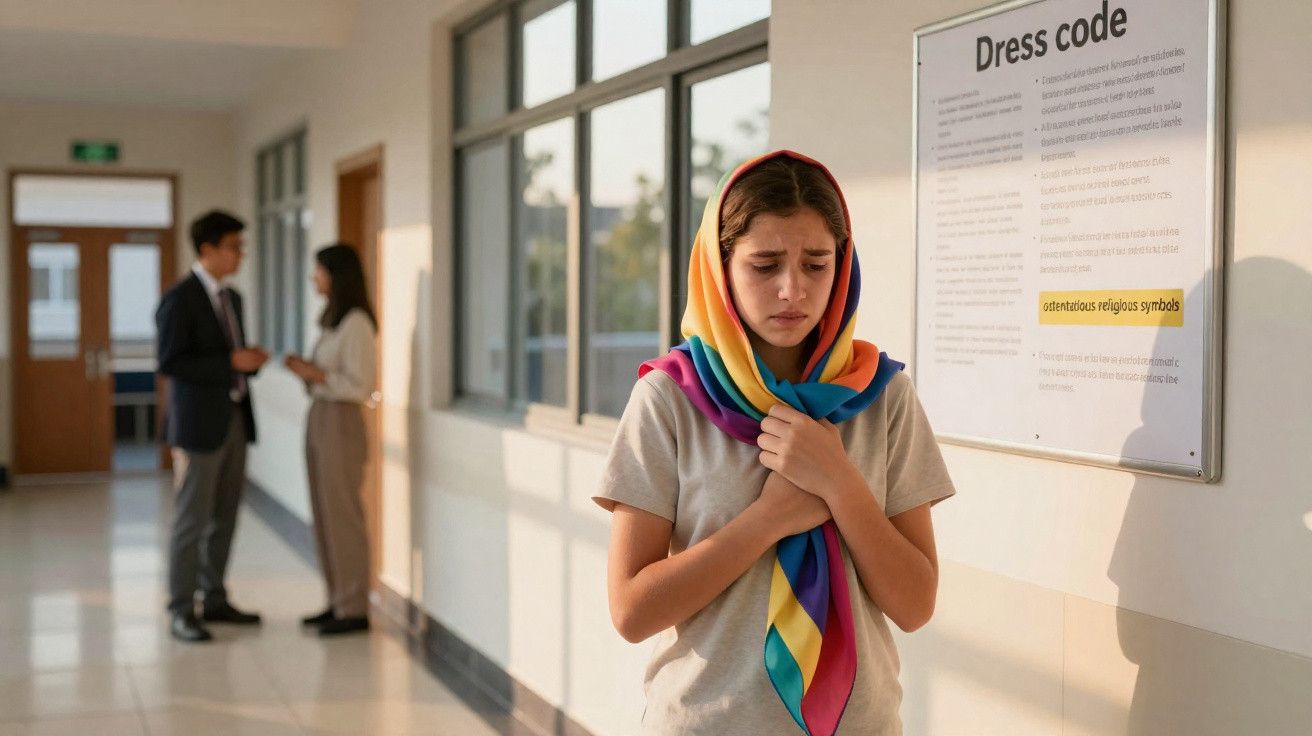
The girl lingered in the corridor, twisting the end of a navy-blue scarf that she was no longer permitted to wear. The bell had gone, classroom doors were shutting, but she remained stranded between the headteacher’s office and the toilets: the kind of no man’s land where abstract rules become painfully real. The new policy had arrived in parents’ inboxes the previous evening: no “overt religious dress” on school premises, supposedly “for students’ safety and wellbeing”.
Her mother thought it read like a threat.
Her teacher regarded it as progress.
The girl simply felt exposed, her hair uncovered beneath fluorescent lights buzzing far too loudly.
Online, the story was already trending. At school, the fire was only beginning.
Some described it as bravery.
Others saw control.
At the heart of the uproar sat one sentence that could not be overlooked.
“This is for your own good,” the headteacher had said.
When “neutral” rules suddenly affect real lives
It often begins with an oddly tranquil email: a policy review, a “clarification” of the dress code, an assurance that nothing is truly changing. The stated aim is merely a more neutral learning environment, a safer space and a sharper boundary between private belief and state education.
On the page, such language appears reasonable and balanced.
In a corridor, it can feel like a slap.
The class photographs fixed to doorways are not neutral at all. They show actual teenagers with braids, turbans, crucifixes, kippahs, hijabs, purity rings and prayer bracelets discreetly tucked beneath sleeves. A new rule does not remove religion from the school; it simply determines which forms of expression now count as “too much”.
One father I spoke to still keeps a screenshot of the school’s message. His 15-year-old daughter was taken aside for wearing her headscarf once the ban came into force. The email referred to a “gentle reminder” and labelled the scarf a “non-compliant accessory”.
Accessory.
That term hurt more than the ban itself. To his daughter, the scarf was not an ornament. It represented commitment, reassurance and identity: the thing that had finally helped her look on the outside as she felt within. That day, she returned home and asked whether they could move to another district. He had no answer.
Behind decisions like these, governing boards commonly say they are pursuing one outcome: cohesion. They want a tidy, friction-free classroom where faith never becomes bullying or pressure. They speak of “protecting minors from religious influence” and “preventing sectarian tension”.
But efforts to remove visible markers of faith can make them more conspicuous. Pupils begin whispering about who “used to wear” what. Teachers abruptly find themselves monitoring sleeves, scarves and chains.
Honestly, no one chooses to teach algebra because they want to measure skirt lengths and police necklaces.
The boundary between protection and control does not shift by itself. Adults shift it.
How schools turn a student’s choice into an institutional battle
From the school’s perspective, the language is often familiar. Administrators say they are caught between court decisions, outspoken parents and a political atmosphere that turns every corridor into a front in a wider “culture war”. They therefore reach for the phrase that sounds safest: “for their own good”.
They claim that removing visible religious dress protects children from peer pressure and damaging doctrine, limits distraction in lessons, and prevents extremist recruiters from “marking” vulnerable pupils.
Yet their discussions with families frequently take place in cramped, old-coffee-smelling offices, while a secretary sits close enough to hear voices rise.
One mother recalled sitting opposite the headteacher while her son’s black skullcap lay between them on the desk, treated as though it were evidence. The 13-year-old stared down as two adults discussed what his identity might “do” to other children. The headteacher was courteous, even warm. He repeatedly said that the policy applied equally to every religion and that no one was being singled out.
Even so, the boy left feeling like a problem requiring a solution.
We have all experienced that point when a rule is explained so gently that you nearly forget it still causes pain. The delivery is soft; the effect is not.
For him, the message was unmistakable: your faith is acceptable, provided nobody can see it.
When parents object, they are often accused of “politicizing” an ordinary dress code. But restricting visible faith is already a political act, whether or not the school admits it.
Religious dress bans do not appear in isolation. They happen in towns where particular communities already feel under scrutiny, and in countries where immigration, secularism and safety dominate front-page debate.
The classroom becomes the testing ground for anxieties adults have failed to settle beyond its walls.
Pupils soon grasp the implication. They notice which forms of belief are linked with danger, which are treated as tradition and which are dismissed as “just culture”. Once that ranking is felt, confidence in the institution does not quietly return. It unravels, one subdued encounter at a time.
Practical ways to protect children without erasing who they are
This tension can be approached differently, without starting from prohibition. Begin with questions. Rather than writing blanket rules behind closed doors, schools can involve pupils and families before making changes.
Run listening circles, anonymous surveys and small focus groups, where a shy 14-year-old can say, “I feel safer wearing this,” while an equally shy classmate can acknowledge, “I don’t understand it and that confuses me.”
Policies can then focus on conduct rather than clothing. Address behaviour that causes harm: coercion, harassment and proselytising during lessons. Keep rules firmly directed at what people do to one another, not at what they quietly choose to wear for themselves.
A scarf, cap or pendant is a sign. The difficulty begins when those in power decide which signs are permitted.
Parents often arrive at such meetings prepared for conflict. They have seen headlines about “radicalization” and “indoctrination”. They worry that their child will be marked as either victim or threat, with no space to be simply… a child.
Schools can reduce that anxiety by stating two points with absolute clarity. First, a pupil’s right to believe, or not to believe, is not negotiable. Second, every rule will be enforced consistently rather than used by one group against another.
The usual error is to assume neutrality requires invisibility. It does not. In a diverse society, genuine neutrality means an institution takes no side between beliefs while accepting that pupils in one classroom will still look, pray and question differently.
“Neutrality doesn’t mean everyone has to look the same,” says one veteran teacher who has worked in both strict secular schools and more relaxed campuses. “It means I don’t grade you, trust you, or fear you based on what you wear on your head.”
- Shift the focus from symbols to safety
Establish clear rules against pressure, bullying and hate speech rather than targeting particular garments. - Open up channels for quiet complaints
Provide confidential routes for pupils to report being forced, excluded or mocked for their beliefs by peers or adults. - Train staff beyond the headlines
Deliver workshops on religious literacy, unconscious bias and conflict de-escalation, so that enforcement does not turn into profiling. - Bring students into the conversation
Form diverse student councils able to identify how new rules actually feel in practice, not only on paper. - Separate safety checks from stigma
Where security requires a face to be seen or an item to be checked, create respectful procedures that do not repeatedly single out one faith.
When a fight over a scarf is really about who defines “good”
At first, the story of a prohibited scarf, turban or cross can appear minor: a local news item, a strained PTA meeting, a hashtag that trends for a day or two before another outrage takes over. What remains is more subtle: a pupil who no longer trusts their school, a teacher who questions every interaction, a parent who passes the gates with shoulders held slightly tighter.
Culture wars feed on symbols because symbols are simple to photograph, debate and weaponise in televised arguments. What is harder to show is the lasting cost when children learn that their deepest convictions are permitted only when they cannot be seen.
Some readers will feel conflicted. Others will recognise this instinctively.
Wherever you stand, the real issue goes beyond the dress code: who has the authority to decide what is “for their own good”? And what follows when those most affected by that claim never had a meaningful voice in it?
| Key point | Detail | Value for the reader |
|---|---|---|
| Dress codes carry hidden values | Policies presented as “neutral” often reflect particular fears, histories and political pressures. | Helps you assess school decisions with a more critical, informed perspective. |
| Focus on conduct, not clothing | Rules aimed at harmful behaviour are fairer and less divisive than bans on symbols. | Provides a practical framework for arguing for more equitable school policies. |
| Dialogue reduces damage | When pupils and families are included early, bans are less likely to trigger culture wars. | Offers practical approaches to use within your own school community. |
FAQ:
- Question 1 Can a state school legally ban all visible religious dress?
- Answer 1 This depends greatly on the country and region. Courts in some places permit strict secular rules in public institutions; elsewhere, such bans conflict with constitutional safeguards for religious expression. Local legal advice and recent case law are essential.
- Question 2 Is banning every religion equally not the fairest approach?
- Answer 2 Equal wording does not necessarily produce equal effects. A “universal” ban may disproportionately affect groups whose faith requires visible signs, while barely affecting others. Fairness lies in results, not merely in how rules are written.
- Question 3 What if some pupils feel pressured by peers to adopt religious dress?
- Answer 3 This is a genuine concern, but it is better addressed by targeting the pressure itself. Robust anti-coercion policies, trained counsellors and confidential reporting channels can safeguard those pupils without removing voluntary expression from others.
- Question 4 How can parents challenge a dress code they consider discriminatory?
- Answer 4 Begin by requesting the written policy and its legal basis, then record particular incidents. Build support with other families, contact civil liberties or faith organisations, and consider mediation before taking legal action. Calm persistence often achieves more than one explosive confrontation.
- Question 5 What can teachers do if they personally oppose a ban?
- Answer 5 Teachers are often contractually required to enforce rules, but they can still act respectfully and limit harm. They can apply policies as gently and consistently as possible, offer emotional support to affected pupils, and use their professional voice in staff meetings and unions to argue for change.




Comments
No comments yet. Be the first to comment!
Leave a Comment