
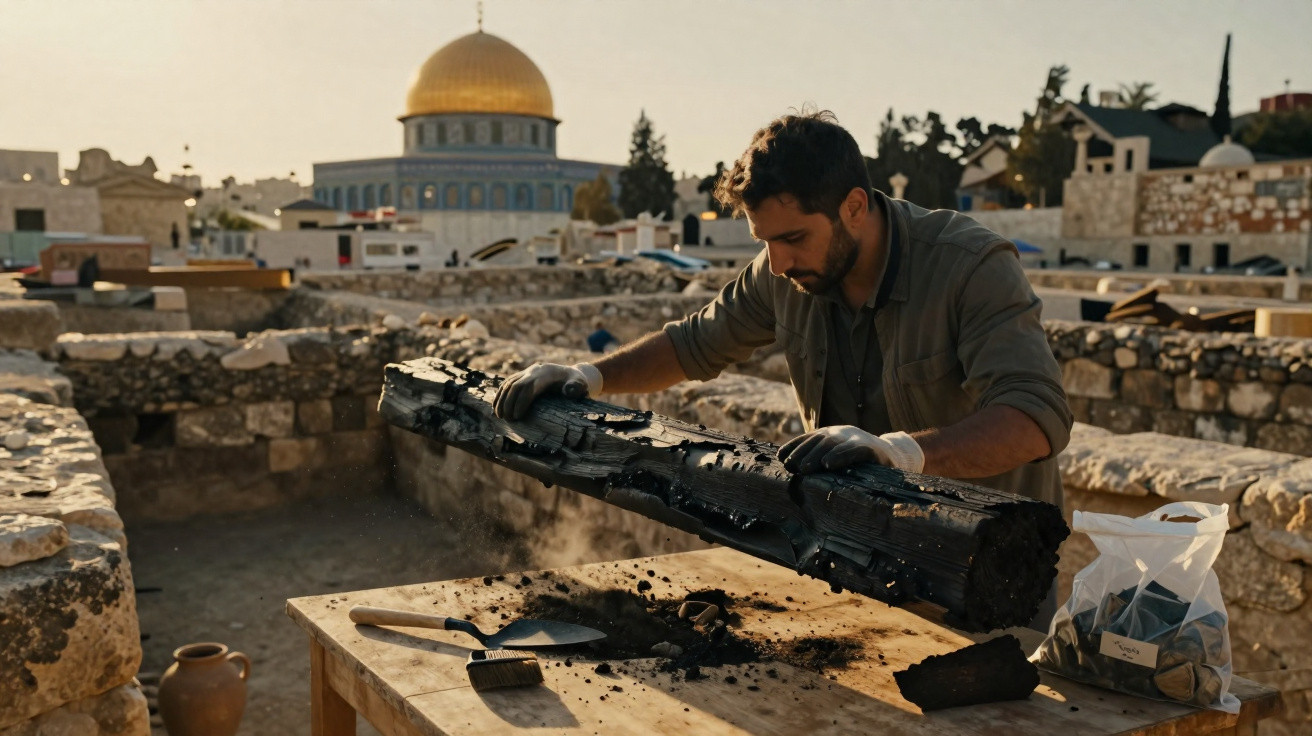
Carbonised wooden beams lay concealed beneath a layer of plaster for roughly 2,600 years. Unearthed in Jerusalem, they may preserve the moment when a substantial building collapsed during the Babylonian assault linked to the destruction of the First Temple, one of the defining events in Jewish history.
What did archaeologists discover in Jerusalem?
The beams emerged during excavations at the Givati car park in the City of David, an area beyond today’s Temple Mount. The Israel Antiquities Authority and Tel Aviv University are leading the project. The timber was found charred amid the remains of a building destroyed by an intense blaze.
According to excavation director Efrat Bocher, the timbers most likely supported the roof above an internal courtyard. As the building burned, the roof fell onto the floor. Heated wall plaster then covered the burnt wood, effectively sealing it and preserving material that would usually have vanished over time.
Did the beams belong to Solomon’s Temple?
The find was not made on the Temple Mount and, so far, researchers have not claimed that the beams formed part of the sanctuary. Instead, they are being presented as unusual evidence of Jerusalem’s destruction in the First Temple period, from within an important building standing in the city before the Babylonian invasion.
This distinction matters because archaeological restrictions on the Temple Mount make it difficult to search for direct traces of the structure traditionally connected with King Solomon. The newly uncovered timbers therefore do not demonstrate the temple’s architecture, but they do help reconstruct the cityscape and the violent fire that struck Jerusalem.
How did the Babylonians destroy Jerusalem?
At the beginning of the sixth century BC, the Kingdom of Judah was under the authority of the Neo-Babylonian Empire. Following repeated revolts, King Nebuchadnezzar II sent his forces against Jerusalem. Before its capture, the city endured a lengthy siege, food shortages and weakening defences.
The final assault, commonly dated to 586 BC, brought destruction on a vast scale. Major events associated with the episode include:
- Burning of public buildings and important homes;
- Destruction of the First Temple and royal structures;
- Demolition of sections of Jerusalem’s fortifications;
- Deportation of part of the population to Babylon;
- End of the Kingdom of Judah’s political autonomy.
Biblical accounts portray the city as being consumed by fire, while archaeology offers another way to examine the event. Ash layers, burnt pottery, collapsed stones and abandoned buildings show that the attack was not simply a change of ruler, but a profound break in the life of Jerusalem.
Watch the video shared by the YouTube channel Roman Histories, which recounts part of Jerusalem’s history up to its destruction.
Why is the carbonised wood so important?
Preserved Iron Age timber is unusual in this region, because wood quickly decays when exposed to moisture, oxygen and soil organisms. Carbonisation and the plaster covering safeguarded the beams, enabling researchers to examine physical elements from a building that stood before the city fell.
The wood may also provide samples for radiocarbon testing and tree-ring studies. Where sequences are well preserved, modern methods can greatly narrow dating margins. Beyond determining age, these examinations may identify the tree species and reveal how the timber was sourced and used in construction.
The beams bring the ancient destruction closer to the present
The carbonised pieces do not, by themselves, answer every question about the First Temple, but they make the Babylonian devastation more tangible. They indicate that the blaze reached prominent buildings and was powerful enough to bring down roofs, melt finishes and leave marks that endured beneath the ruins for many centuries.
Each new analysis may now add a lost detail about Jerusalem in 586 BC. Following this research closely is essential, because preserving and investigating the remains helps distinguish evidence, tradition and hypothesis. In a city surrounded by memory and faith, even a burnt beam can reopen entire chapters of history.




Comments
No comments yet. Be the first to comment!
Leave a Comment