
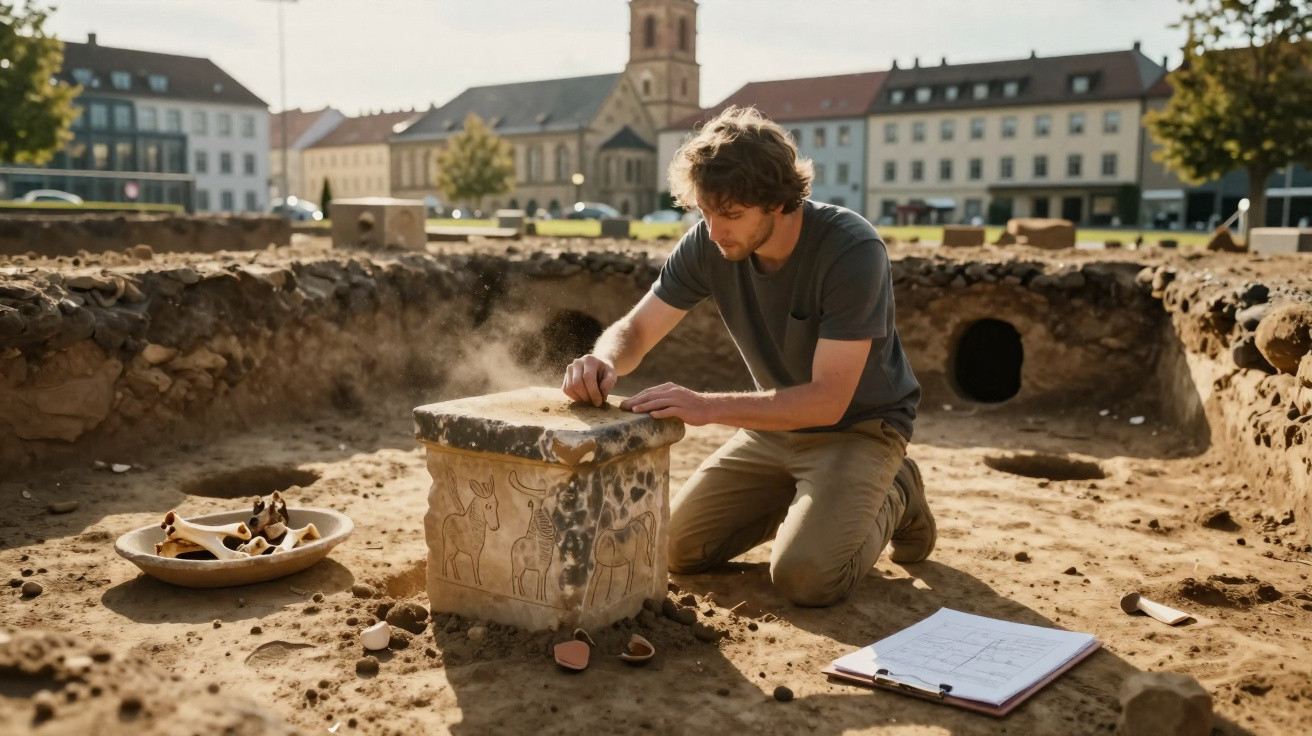
Scientists have discovered Bavaria’s oldest known Mithraeum beneath a site in Regensburg. The sanctuary, devoted to Mithras – a Roman mystery god associated with light, loyalty and ceremonial feasts – has been dated to 80–171 AD.
This early date suggests that organised devotion to the Roman god Mithras was established in the area decades before the city’s principal fortress, changing the picture of how this frontier settlement emerged.
Mithraeum in Regensburg
The first indications that the site at Stahlzwingerweg 6 was not an ordinary building were a weathered altar stone and fragments of metal votive offerings.
Using these remains, Dr Stefan Reuter of the Regensburg City Museums identified the structure as a Mithraeum, a sanctuary used by worshippers of Mithras.
As the building was largely constructed from timber, much of it has disappeared. The identification therefore depended on evidence which became meaningful only when considered together.
Although this evidence is less spectacular than an intact temple, it provides an insight into how the sanctuary may have functioned.
Evidence without walls
Coins recovered from the backfill date the sanctuary to the period of the Kumpfmuhl camp and the civilian settlement beside it.
A Hadrian coin, together with other small discoveries, was particularly important: coins generally fall within short chronological ranges and can date buried deposits precisely.
These dates show that the shrine existed before Castra Regina, the major fortress completed in 179 AD in the city centre.
The interval is significant because soldiers and local residents were already gathering around Mithras before imperial authority had become fully established there.
Meals inside the shrine
Pottery decorated with snakes, incense vessels and handled jugs indicate ceremonial dining rather than everyday meals.
At Mithraic feasts known elsewhere, participants reclined on benches along the sides of the room and re-enacted a sacred meal associated with Mithras and the Sun.
Tasks in the sanctuary kitchen also helped form the community, as preparing and serving food reinforced both status and membership.
Regensburg now fits this wider pattern, making its fragmented tableware more informative than its ruined walls.
Why the timing matters
Most sanctuaries associated with Mithras date from the second and third centuries, rather than from this earlier phase of frontier activity.
The date is especially notable because the Regensburg shrine is the first Roman sanctuary identified in the old town and predates the city’s principal fortress.
“On a Bavarian regional level, it is the oldest of the nine Mithraea known to date,” said Maximilian Ontrup, Master in Roman Provincial Archaeology at the Regensburg City Museums.
Rather than appearing as a late frontier outpost, Regensburg increasingly seems to have been a place where Mithras worship arrived at an early stage.
A cult without texts
Nearly all scholarly knowledge of Mithras is drawn from rooms, reliefs, inscriptions and artefacts, not from surviving religious texts.
More than 400 sites have been identified throughout the Roman world, but the cult produced almost no surviving explanatory writing.
This absence makes each newly found sanctuary important, since its layout and discarded material can indicate who assembled there and what they did.
Regensburg supplies another fragment of that lost record, although many of its rites will remain uncertain.
How the room worked
Mithras worship generally took place in compact rooms arranged around benches, with a central passage leading towards the sacred image.
This layout positioned members opposite one another while drawing their attention forwards, bringing dining, initiation and display together.
Since many shrines were enclosed, narrow and without windows, the setting itself transformed smoke, lamplight and movement into elements of ritual.
Even though the walls at Regensburg have vanished, this typical arrangement helped archaeologists identify the building’s function from a limited collection of clues.
Frontier town in formation
The sanctuary formed part of a Regensburg still taking shape, where an auxiliary camp and a civilian settlement occupied the same area.
People on the frontier carried goods, commands and beliefs with them, while soldiers often transported cult practices between postings.
The discovery therefore matters beyond a single address, as it may indicate who inhabited the Danube settlement before the legion arrived.
Rather than a remote and quiet provincial edge, Roman Bavaria begins to appear connected, mobile and receptive to eastern religious traditions.
From trench to museum
Municipal officials and Bavarian heritage bodies have supported a dedicated research project to examine the discoveries in full.
The developer has given the recovered objects to the Regensburg City Museums, allowing curators to assess each fragment in its archaeological context. He said the team plans to make even modest-looking fragments reveal their meaning.
A future display is important because pieces of pottery and metal can only be understood when a museum reconnects them with their original location.
Why this stayed hidden
Early timber-built shrines disappear much more readily than stone temples, particularly beneath a city occupied for centuries.
Posts decay, floors give way and later construction cuts through older deposits, leaving archaeologists to interpret soil marks and dispersed artefacts.
Regensburg may appear early in part because it survived in a confined area that required especially careful excavation and subsequent interpretation.
That possibility also limits the conclusion, as other early sanctuaries may have existed but left less substantial evidence.
What changes now
The Regensburg Mithraeum brings coins, pottery, architecture and frontier history together in one finding: worship of Mithras reached Bavaria earlier than anticipated.
Further examination of food residues, animal bones and fittings could reveal how the worshippers ate, honoured the god and defined belonging.






Comments
No comments yet. Be the first to comment!
Leave a Comment