
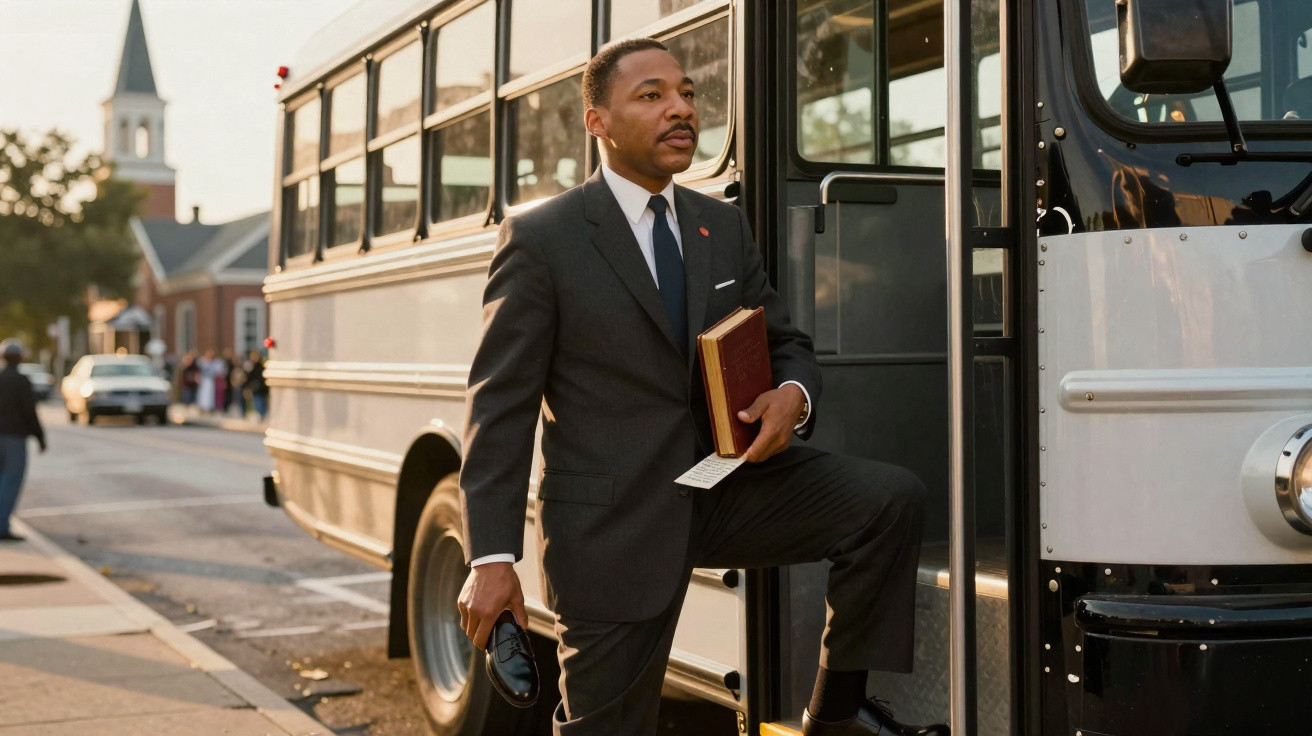
Martin Luther King Jr. linked faith with the courage to act even when the outcome cannot yet be foreseen. The image of the first step reflects an approach evident throughout his work as a Baptist minister and leader of the civil rights movement: begin a transformation without waiting for the entire route to come into view.
What does taking the first step with faith mean?
A staircase stands for an aim that cannot be achieved all at once. Those who stay on the ground until they can see every obstacle, answer and assurance may never set out. The first step represents the decision that can be made in the present, even though later stages still rely on time, learning and other people.
In this interpretation, faith does not mean disregarding risks or acting without a plan. Instead, it is the confidence needed to begin a task whose final result remains uncertain, recognising that some of the journey only becomes clear after the first actions are taken.
- Starting before having every answer;
- Focusing on the action that can be taken now;
- Recognising that major change requires several stages;
- Carrying on without an immediate guarantee of success;
- Reviewing the route as new circumstances emerge.
Why does the phrase carry such weight in Martin Luther King Jr.'s life?
The minister and activist Martin Luther King Jr. became one of the foremost figures in the United States civil rights movement between 1955 and 1968. His work included sustained campaigns against racial segregation, founded on non-violent resistance and civil disobedience.
What does the Montgomery bus boycott teach about perseverance?
The boycott began in 1955 after Rosa Parks was arrested for refusing to give up her seat to a white passenger. Martin Luther King Jr., then aged 26, helped lead a mobilisation that lasted for more than a year and required thousands of people to reorganise their daily travel around the city.
Throughout the campaign, there was no certainty that the authorities would agree to end segregation on buses. The movement's continuation relied on meetings, alternative transport networks, legal rulings and a shared willingness to endure months of pressure. Every stage became another step built before victory was assured.
- The goal was clear, but the timescale was unknown;
- The mobilisation required daily involvement from the community;
- The outcome depended on both legal and social action;
- Non-violence was upheld even in the face of intimidation;
- Progress came from the combined force of individual and collective decisions.
How can this reflection be applied to everyday decisions?
This message can guide anyone who needs to begin studying, change a habit, seek an opportunity or take on a lengthy project. Other reflections on optimism and hope also address the importance of continuing, but the staircase metaphor adds a particular point: it is not necessary to solve the entire journey before taking the next action.
Why does acting without guarantees not mean acting without direction?
Martin Luther King Jr. received the Nobel Peace Prize in 1964 for his struggle against racism through non-violent means. The award came while many demands remained unresolved, demonstrating that historic advances do not automatically complete the work that has begun or remove the challenges that follow.
The staircase in the phrase does not promise an easy route or an immediate arrival. It underlines that social and personal change begins when someone turns conviction into action, assesses the step already reached and finds the strength to keep climbing, even without a clear view of the destination.






Comments
No comments yet. Be the first to comment!
Leave a Comment