
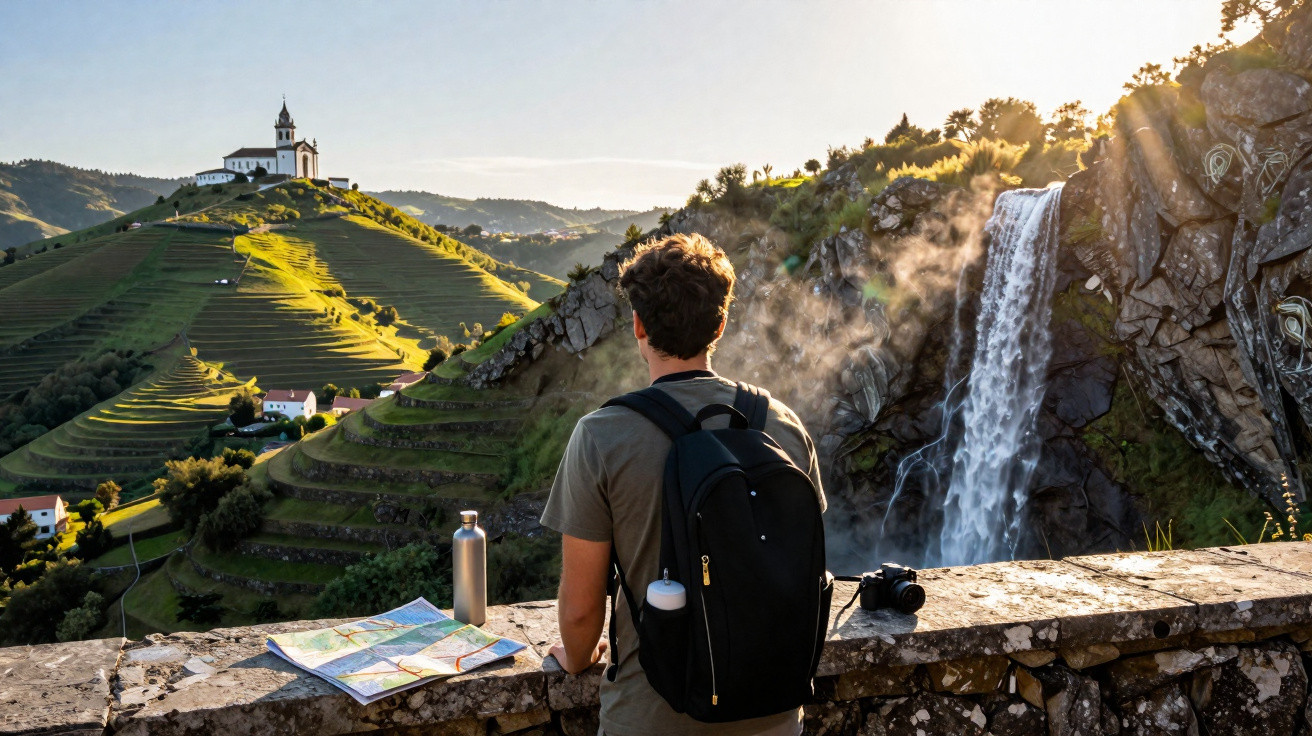
In northern Portugal, Mondim de Basto brings together two landscapes that seem to come from entirely different worlds. At the summit of Monte Farinha, the Sanctuary of Our Lady of Grace overlooks the surrounding countryside; below, in Alvão Natural Park, the Fisgas de Ermelo cut through the mountain in one of Europe’s most striking waterfalls. It is a small town, yet it is surrounded by legends, viewpoints, walking trails and untamed natural scenery.
Where is Mondim de Basto?
Mondim de Basto is in the Vila Real district, in a mountainous area of northern Portugal. The town is known for its green scenery, hillsides shaped by rivers and its proximity to Alvão Natural Park, one of the most beautiful natural areas in Portugal’s interior.
Although it does not have the profile of cities such as Porto, Braga or Guimarães, Mondim de Basto appeals to visitors seeking nature tourism, peaceful villages, regional food and pilgrimage sites. It is the sort of destination where walking, faith, viewpoints and river swimming can all be part of the same trip.
Watch the video from the 360portugal channel featuring the town of Mondim de Basto below:
What makes the Sanctuary of Our Lady of Grace so special?
The Sanctuary of Our Lady of Grace stands at the top of Monte Farinha, around 13 km from the centre of Mondim de Basto. It can be reached by road, following a winding ascent with wide views across the region. From the summit, visitors can take in a panoramic landscape of mountain ranges, valleys and small surrounding settlements.
The site is also associated with local legends. One of the best known tells of a hermit of Our Lady who was allegedly murdered near Pedra Alta. Local tradition says that he is buried beside the steps leading to the sanctuary, and the setting still has a powerful connection with devotion, remembrance and pilgrimage.
Why are the Fisgas de Ermelo so impressive?
The Fisgas de Ermelo are among the leading attractions of Alvão Natural Park. The Olo River creates a series of waterfalls set within very ancient quartzite rock, with a drop of around 400 metres, according to local tourism information.
The name “Fisgas” comes from the way the river appears to force its way between the rocks as it carves a route through the mountain. The outcome is a dramatic, vertical landscape unlike typical waterfalls: rather than falling in one single drop, the water flows down in several sections, forming viewpoints, natural pools and highly popular walking trails.
How can you visit the area safely?
Visitors to Mondim de Basto can include both the sanctuary and the Fisgas de Ermelo in the same itinerary, but it is worth planning the day carefully. The climb up Monte Farinha is a more leisurely experience, well suited to photographs and panoramic views. The Fisgas, meanwhile, require greater care, especially for those intending to walk the trails or approach the water.
- wear comfortable footwear with good grip;
- avoid trails on days of heavy rain;
- take water, sun cream and suitable clothing;
- follow signs and stay away from hazardous areas;
- do not go close to slippery edges to take photographs.
In summer, some of the area’s natural pools draw visitors for swimming, but it is important to check the current, depth and access before entering the water. In mountain settings, a beautiful landscape also calls for caution.
Why should Mondim de Basto be on your itinerary?
Mondim de Basto deserves a place on the itinerary because it brings together spirituality, legend and nature without feeling like an artificial destination. The Sanctuary of Our Lady of Grace provides both the view and its symbolic significance; the Fisgas de Ermelo reveal the power of the landscape; and the town offers the unhurried pace of Portugal’s interior.
Mondim de Basto’s appeal lies in this contrast. On one side is a mountaintop sanctuary, surrounded by faith and ancient stories. On the other is a monumental waterfall running through millennia-old rocks, turning Alvão Natural Park into an unforgettable setting. For anyone looking for a wilder, more authentic and surprising side of northern Portugal, this town is a stop that is hard to forget.






Comments
No comments yet. Be the first to comment!
Leave a Comment