
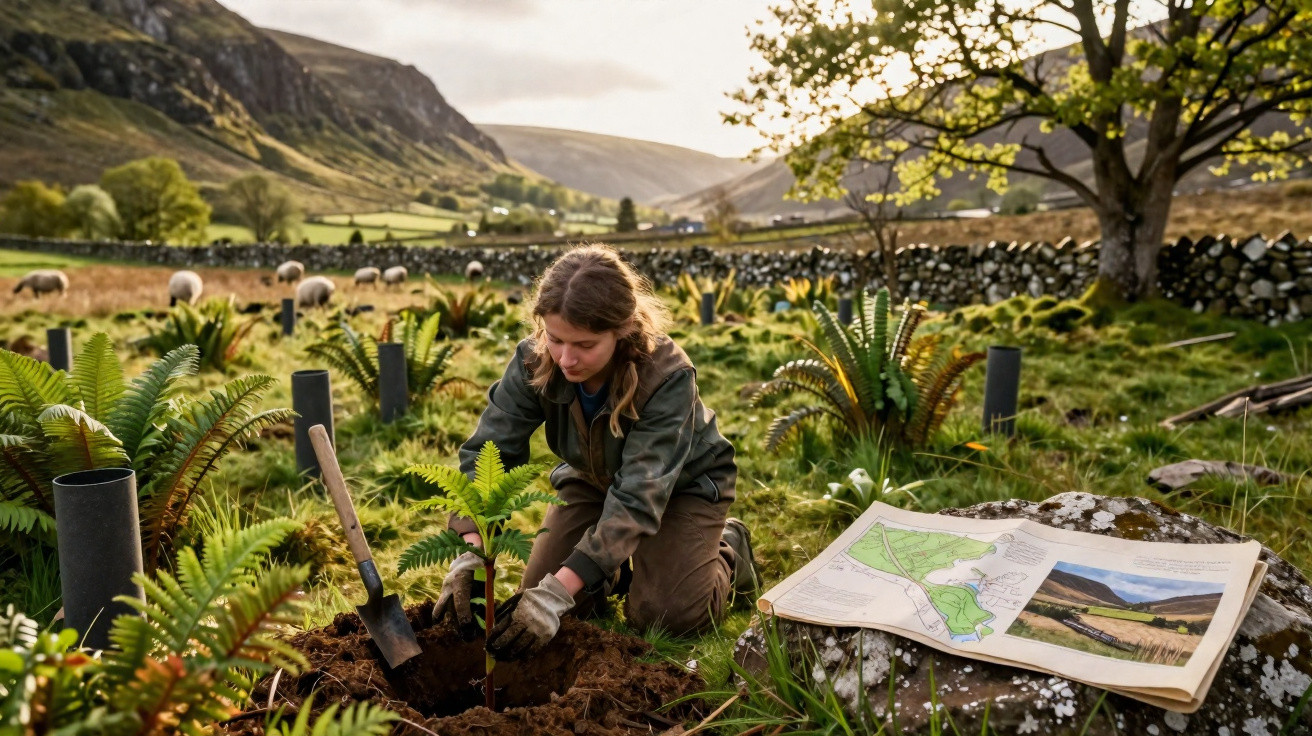
Carrifran Glen, a valley of roughly 660 hectares in southern Scotland, had been left almost treeless after centuries of grazing when a group set out to restore its ecosystem. Volunteers launched the project on 1 January 2000 by planting the first 100 saplings. More than 25 years later, over 750,000 native trees and shrubs have been planted, while removing the pressure from sheep has allowed vegetation to return in other parts of the valley.
How did 100 saplings begin the valley’s transformation?
That initial planting was modest compared with the size of the site. However, the intention was never to wait for those 100 trees alone to reproduce. Over the following years, volunteers and paid workers kept planting native species, selected using research into the soil, existing vegetation and even pollen preserved in peat bogs. The aim was to recreate a modern version of the ecosystem that existed there before intensive human intervention.
- The first saplings were planted on 1 January 2000.
- The project covers an area of around 660 hectares.
- Native trees and shrubs of local origin were used.
- Planting continued for years, far beyond the original 100 saplings.
- The total now exceeds 750,000 planted trees and shrubs.
Why was removing sheep as important as planting trees?
Sheep grazing had kept much of the hillside vegetation low and made it difficult for new trees to establish. Once the animals were excluded from the restoration areas, saplings, shrubs, wildflowers and other plants could grow without being repeatedly eaten or trampled. A fence of around 12 kilometres was erected to keep out sheep and goats.
This shift explains why Carrifran’s story cannot simply be described as tree planting. Recovery resulted from combining active reforestation with reduced pressure from domestic herbivores. The figure of 1,200 sheep reported in some recent headlines is not confirmed in the main information available about the project; what is clearly documented is the removal of sheep and goats from the areas being restored.
What began to return as the woodland developed?
Ecological restoration changed more than the number of tree trunks on the slopes. Wildflowers began to flourish, peat bogs started to recover, and tree and shrub cover created habitat for animals linked to woodland environments. Bird monitoring recorded just four individuals of woodland species in 2007, rising to 262 in 2015, as new species colonised the valley while the vegetation became denser.
- Wildflowers returned to areas no longer subject to intensive grazing.
- Degraded peat bogs entered a period of recovery.
- Tree cover created new places for shelter and feeding.
- Woodland bird species increased as the woodland matured.
- Golden eagles can be seen above the area’s cliffs.
Why was it not enough to leave nature to recover by itself?
In some places, removing livestock is enough to allow trees to regenerate naturally. At Carrifran Glen, however, centuries of vegetation loss had left few nearby sources of seed. A lone rowan, later known as the “Survivor Tree”, became a symbol of how nearly all native trees had disappeared from the valley. For that reason, those running the project chose to actively reintroduce hundreds of thousands of saplings.
The species were not planted at random either. Vegetation surveys, land characteristics, altitude, moisture levels and peat analysis helped determine the kind of woodland that could exist in each area. In locations too high to support trees, the project aimed to restore montane vegetation and other habitats instead of covering the entire landscape with woodland.
What do 25 years of Carrifran restoration show?
The outcome demonstrates that restoring a degraded landscape takes more than putting saplings into the ground. In this Scottish case, it was necessary to buy the land with support from hundreds of people, manage access for domestic animals, choose native species, monitor the developing vegetation and continue planting for years. The first 100 saplings were only the start of a process that went on to exceed 750,000 trees and shrubs.
Today, Carrifran Glen provides a striking visual comparison: slopes that were almost bare at the beginning of the project are now covered with woodland, shrubs and diverse vegetation. The project has become a reference point for community-led environmental restoration initiatives because it shows that removing the cause of degradation and rebuilding the conditions for growth can restore complexity to an ecosystem within a few decades, even after centuries of intensive grazing.




Comments
No comments yet. Be the first to comment!
Leave a Comment