
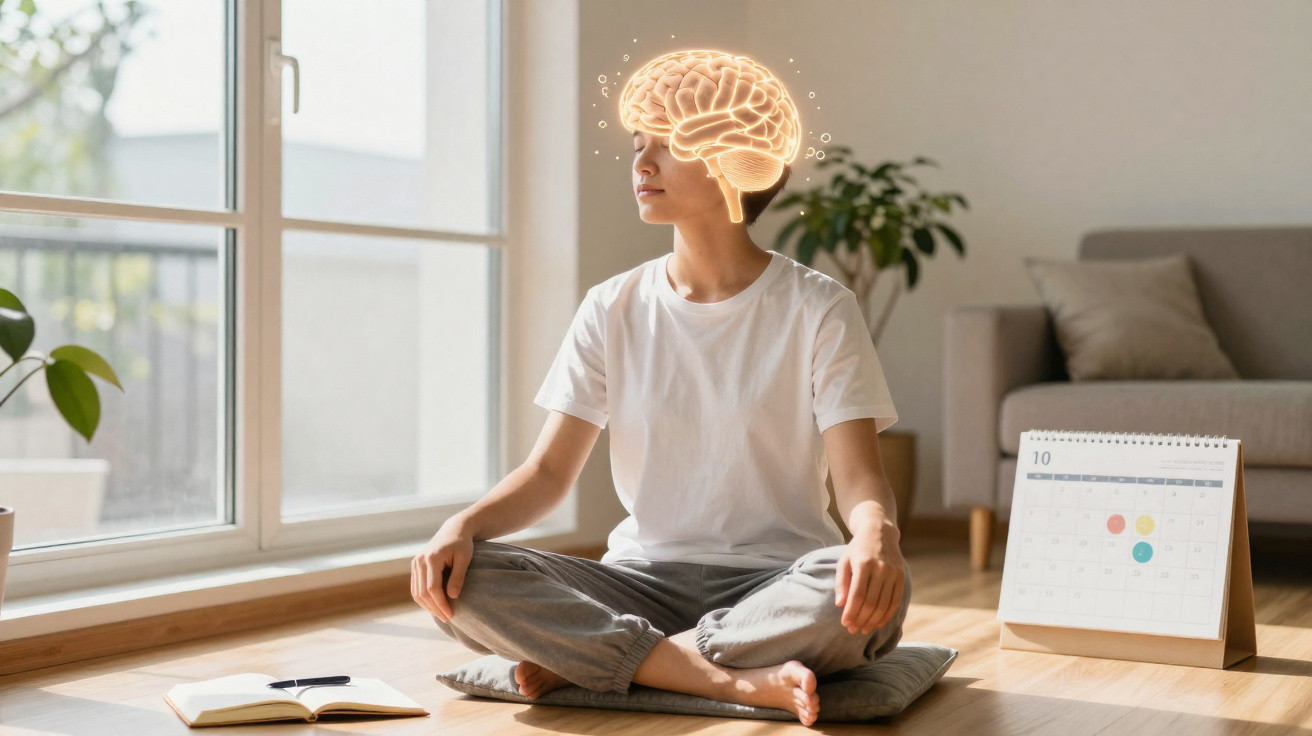
Work was noisy, the wider world even noisier, and my nervous system seemed to be running on espresso before breakfast. A friend sent me a link to an eight-week meditation course, adding, “Cheaper than therapy and fewer forms.” I rolled my eyes, brewed some tea and started a ten-minute guided session as the kettle clicked in the still kitchen. That morning, something subtle changed, like opening a window in an airless room, and I needed to find out whether it was genuine or simply wishful thinking.
The small ritual that never felt like self-help
I began with ten minutes of sitting before the emails started arriving, my thumb lingering over the snooze button while the radiator ticked as it heated up. The exercise was straightforward: inhale, exhale, notice when my thoughts raced towards unpaid bills or an odd message from my cousin, and gently come back. We all know the feeling of a brain that refuses to quieten, when even a silent room feels uncomfortably loud. Oddly, paying closer attention to my restlessness made me feel less caught by it.
There was no incense and no immaculate pose: only a timer, my rather sceptical mind and me. Later, on the bus, with the brakes hissing, I noticed my breathing in the way you might recognise a friend across a crowded room. Anxiety still flared up, and my inbox still supplied the occasional drama, but the volume had dropped slightly. It was not enlightenment; it simply gave the day a different feel.
Mindfulness meditation and the brain’s quieter smoke alarm
If your inner world can resemble a home with a wildly over-sensitive smoke alarm, that is not an unreasonable comparison. The amygdala - two almond-shaped structures - responds to uncertainty and threat with all the restraint of a car alarm. Eight weeks of mindfulness training has been shown to reduce grey matter density in this area. That may sound like science fiction, until you encounter somebody who once snapped at everything and now pauses to sigh before replying. Nothing mystical is happening; it is neuroplasticity, the brain’s clumsy yet remarkable ability to rewire itself through repeated activity.
Researchers affiliated with Harvard reported this change following a typical eight-week Mindfulness-Based Stress Reduction programme - the sort that asks participants to sit, breathe and sometimes pay attention to their toes. The people involved were not living in caves for months; they spent roughly half an hour daily practising while continuing their ordinary, complicated lives. During those two months, scans showed reduced amygdala reactivity, alongside falling stress scores. This is not placebo; you can see it on a scan.
In everyday terms, it means receiving a passive-aggressive email without feeling as though your chest is throwing a punch back. It is the half-second of space before you send a response you will later regret. You still have feelings - perhaps more truthfully than you did before - but the rush no longer takes over every system at once. Usually, that brief half-second is where better choices are made.
A stronger memory and steadier mood in the quiet
The hippocampus is the brain’s librarian: a curved structure that stores memories and helps to regulate mood. Following eight weeks of regular practice, it commonly becomes thicker, as though its shelves have been strengthened. There is something quietly affecting about that idea: repetition building structure, breath after breath, as the brain creates fresh scaffolding while you sit and try not to criticise yourself for thinking about lasagne again. For me, it appeared as fewer “Where on earth did I put my keys?” episodes and a clearer sense of “I can actually recall what she said” during conversations.
One morning, the kitchen carried a faint smell of toast as sunlight reached the sink, bringing with it an unexpected gentleness. I could remember exactly how stress had felt the previous day without being pulled back into it. Because the hippocampus is closely associated with depression and stress hormones, adding a thicker layer of grey matter is more than an academic achievement. It can mean waking up without feeling as though the day has already climbed on top of you.
Focus strengthens while the mind-wandering network settles
When someone says meditation boosts attention, it can sound like an advert for productivity. But after eight weeks of sitting, you may find your attention no longer acts like a puppy loose on a motorway. Practice produces measurable changes in the prefrontal cortex and anterior cingulate cortex, the regions responsible for holding focus and managing impulses. Attention is a muscle, and meditation is the gym where it grows.
The mind-wandering network moves into the background
There is also the default mode network, the brain’s social club that becomes active when you drift between the past and future. After several weeks of practice, areas within it - including the posterior cingulate cortex - become quieter and connect in different ways. It is less about fighting your thoughts and more about realising they are clouds rather than concrete. The weather continues to shift, but the sky is not quite so alarmed by it.
Scientists have observed these patterns in beginners after only a couple of months, which is striking when we have long been told that change must take ages. You can be entirely new to meditation and still benefit, because the brain responds to repetition rather than perfection. There is something profoundly democratic in that. No one inspects your posture before your neurons start rearranging themselves.
Reconnecting with the body without recoiling
Around the midpoint of my eight weeks, I realised I had been living from the neck upwards: a hovering head attached to a to-do list. Body scans - those gradual, slightly uncomfortable meditations in which you register your ankles, knees and the weight in your palms - activate the insula, the region that maps internal sensations. With time, this area tends to thicken, helping you recognise your own signals before they become alarms. I found myself relaxing my jaw during meetings and wondered: who had taught me that?
This is not about becoming an untroubled robot. It is about hearing the body’s messages before they become shouts. A constricted chest can be a prompt to take three breaths, rather than a reason to peck furiously at your inbox like a woodpecker. Responding early to smaller signals can prevent bigger storms from gathering.
What eight weeks really feels like, week by week
The first two weeks were largely a procession of excuses, with a surprising amount of yawning included. Sitting felt equally virtuous and absurd. I hoped for dramatic transformations, while meditation offered changes so tiny that noticing warm feet in socks seemed significant. When you are confronting yourself, eight weeks can feel both very brief and remarkably long.
By weeks three and four, a gentler change emerged: there was more room between impulse and response, and less of a flare-up when the bus was late and rain blew sideways. I skipped a day or two, then returned, because discipline has never been my native planet. Honestly, nobody truly manages this every single day. I learnt that consistency meant coming back repeatedly, not maintaining an unbroken run.
Weeks five to eight brought one especially specific surprise: my relationships shifted. I began listening until people had finished speaking instead of constructing my reply while they talked. At home, things felt less fragile. Meanwhile, the brain was doing its background work - the amygdala settling, the hippocampus thickening and attention systems growing stronger - as life became a little kinder around the edges.
Stress remains, but your response becomes more mature
One Thursday, a tense email came in with that small ping which always makes your stomach turn. I still felt the initial jolt, but it faded more quickly and I typed more slowly. That is neuroplasticity in practical form: not a treatment for hardship, but a more useful set of tools when hardship arrives wearing muddy shoes. I did not have to be calm; I had to be steady.
Research also points to changes in white matter, with the wiring between brain regions becoming more refined after a few concentrated hours each week. Studies have identified more efficient connections around the anterior cingulate following brief training - a kind of neurological tidying that makes moving between tasks less uncomfortable. Whether the effects are short- or long-term, the message remains unchanged: repetition rewires, and the brain responds well to patterns.
What remains after eight weeks of meditation
By the end, I had not achieved sainthood. Instead, I had a straightforward habit that kept proving useful: sit, notice, return. Missing a day brought no cosmic punishment, only a mind that felt slightly dustier. When I carried on, the structural changes - those thicker regions and quieter alarms - seemed like a familiar path that remained easy to locate.
Now I fit the practice into the overlooked moments of the day: one minute before a meeting, laptop light on my face; three breaths before opening messages; a gradual inhale at the kitchen sink while water taps softly against the metal basin. Eight weeks won’t change who you are, but it can change how your brain lets you be yourself.
Why mindfulness meditation matters beyond being calm
Calmness is pleasant, but it is not the central aim. The real point is agency: that quiet capability when life takes a sharp turn and you do not instantly veer with it. It is recognising that you are spiralling, then finding the ground beneath your feet without trying to solve everything at once. It is treating attention as the valuable, trainable resource it is.
You can begin while the kettle boils, with your eyes open and your spine slumped if necessary. Two months may sound substantial until you have lived through them, after which they are simply eight calendar marks that would have passed anyway. Given a repeated task, the brain does what it has always done: it adapts. There is something wonderfully human in that - a body quietly learning a better way to exist while buses sigh and rain taps against the window.






Comments
No comments yet. Be the first to comment!
Leave a Comment